
India's Crypto Tax Crackdown and Its Implications for Global Crypto Markets
India's regulatory approach to cryptocurrency in 2025 has become a case study in the tension between state control and market innovation. The Indian government's aggressive enforcement of a three-tier tax system-30% income tax on profits, 1% tax deducted at source (TDS) for transactions over ₹10,000, and 18% GST on platform services-has created a compliance burden that is reshaping investor behavior and sending ripples across global crypto markets. This crackdown, coupled with AI-driven enforcement tools and investigations into high-net-worth individuals, underscores a broader regulatory risk that could redefine how crypto ecosystems operate in emerging markets.
Regulatory Risk: A Heavy Hand on Compliance
India's tax authorities have escalated their efforts to monitor and penalize non-compliance. The Central Board of Direct Taxes (CBDT) has issued over 44,000 notices to taxpayers suspected of underreporting crypto gains, leveraging AI-powered tools like Project Insight and the Non-Filer Monitoring System (NFMS) to identify evasion, according to a Bar & Bench guide. These tools are part of a broader strategy to enforce the Prevention of Money Laundering Act (PMLA), which now requires crypto exchanges to register with the Financial Intelligence Unit (FIU-IND) and share user data, according to an IndWallet report.
The government's focus on Binance users-targeting 400 high-net-worth individuals for alleged tax evasion-highlights the risks of operating in a jurisdiction where regulatory scrutiny is both technologically advanced and politically driven, as reported by IndWallet. For global exchanges, this signals a need to balance compliance with user privacy, as data-sharing mandates could deter cross-border participation.
Investor Behavior: Migration and Market Resilience
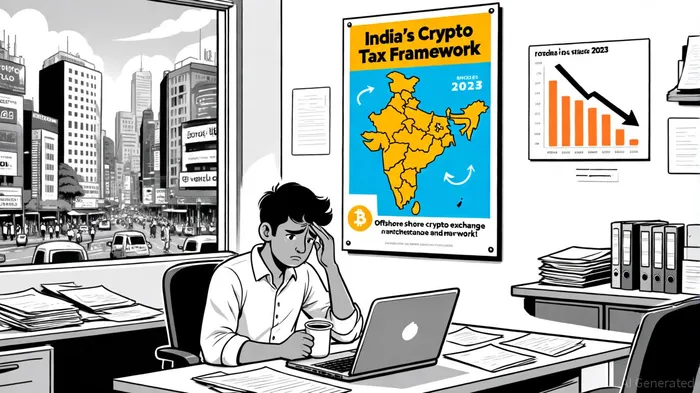
The tax burden has directly influenced investor behavior. Data from 2025 indicates a 40% decline in trading volumes since 2023, with many investors shifting to offshore platforms like Binance, KuCoin, and CoinbaseCOIN-- to avoid the 30% tax on gains and the inability to offset losses, according to a Badacha24 analysis. This migration has created a paradox: while India's 107 million crypto users remain a significant market, the high tax rates and lack of loss-set-off provisions have disproportionately impacted smaller retail investors, who now rely on peer-to-peer (P2P) transactions and decentralized finance (DeFi) platforms to circumvent regulations, according to an Invezz article.
Domestic exchanges like Mudrex and CoinSwitch are attempting to retain users by emphasizing compliance and faster customer service, but the allure of offshore platforms persists. A 2025 survey found that 84% of Indian crypto investors expressed dissatisfaction with the tax regime, citing its complexity and unfairness compared to equity taxation, according to IndWallet. This sentiment is compounded by the absence of deductions for mining or exchange fees, which further erodes net returns, a point also noted by Bar & Bench.
Global Implications: A New Regulatory Paradigm
India's approach is influencing global regulatory trends in two key ways. First, it has accelerated the adoption of Central Bank Digital Currencies (CBDCs). The Reserve Bank of India's (RBI) Digital Rupee is now seen as a state-backed alternative to private crypto, offering greater transparency and traceability, as reported by Invezz. This mirrors similar CBDC initiatives in the U.S. and Singapore, where governments are leveraging digital currencies to maintain control over financial systems while accommodating crypto innovation, a trend highlighted by Badacha24.
Second, India's tax policies have prompted a global dialogue on "Goldilocks regulation"-rules that protect investors without stifling growth. Countries like Japan and Singapore have introduced reforms to enhance crypto adoption, including clearer asset definitions and tax incentives for innovation, as noted in the Badacha24 analysis. These moves reflect a recognition that overly burdensome regulations, as seen in India, risk driving capital and talent to more favorable jurisdictions.
The Path Forward: Balancing Control and Innovation
India's regulatory trajectory remains uncertain. While the government has hinted at revising the 1% TDS rule and exploring loss-set-off provisions, according to a CoinGabbar report, the broader tax framework remains a barrier to mainstream adoption. For global investors, the key takeaway is that regulatory risk in emerging markets is no longer a peripheral concern-it is a central factor in portfolio strategy.
The challenge for India, and for regulators worldwide, is to strike a balance between preventing tax evasion and fostering innovation. If India continues to prioritize enforcement over reform, it risks ceding its position as a crypto hub to jurisdictions with more adaptive policies. Conversely, a shift toward balanced regulation could position India as a leader in the global Web3 economy, leveraging its tech-savvy population and growing crypto user base.
For now, the world watches as India's tax crackdown tests the resilience of its crypto market-and the adaptability of global investors.







Comentarios
Aún no hay comentarios