
India's Crypto KYC Crackdown: Risk Mitigation or Market Deterrent?
India's cryptocurrency sector in 2025 stands at a crossroads, shaped by a regulatory overhaul that has redefined compliance norms and investor behavior. The Financial Intelligence Unit-India (FIU-IND)'s stringent Know Your Customer (KYC) and anti-money laundering (AML) mandates-enforced under the Prevention of Money Laundering Act (PMLA)-have sparked a debate: Are these measures a necessary step toward legitimizing crypto as an asset class, or do they risk stifling innovation and driving capital away from the domestic market?
Regulatory Measures: A New Compliance Paradigm
The 2025 KYC framework, introduced via the March 2023 PMLA VASP Notification, reclassified Virtual Digital Asset Service Providers (VASPs) as "reporting entities," requiring them to register with FIU-IND and adhere to rigorous onboarding protocols. These include live selfie verification with liveness detection, geolocation tagging, and the "penny-drop" method to confirm bank-account ownership. Platforms must also update KYC details for high-risk clients every six months and for all others annually.
Enforcement has been swift and unrelenting. By 2025, 49 exchanges-45 domestic and four offshore-were mandated to register under PMLA, while non-compliant platforms like Binance and Bybit faced penalties totaling $3.1 million for failing to meet AML obligations. This regulatory tightening aligns India with global trends, such as the OECD's Crypto-Asset Reporting Framework (CARF), which India is expected to adopt by 2027.
Risk Mitigation: A Safer, More Transparent Ecosystem
Proponents argue that these measures are critical for curbing illicit activities. The FIU-IND's focus on transaction record-keeping and robust AML programs has reduced opportunities for money laundering, a persistent concern in India's shadow economy. For institutional investors, the enhanced transparency may foster trust. As stated by a Chainalysis report, India's alignment with global standards could attract formal investment, particularly in tokenization and blockchain-based solutions.
Moreover, the crackdown has spurred innovation in compliance. Custodial exchanges and tokenized financial instruments-such as money market funds and real-world asset (RWA) tokenization-have gained traction, with assets under management (AUM) in these categories showing notable growth. This suggests that, while the regulatory burden is heavy, it has also created a more structured environment for VASPs to operate.
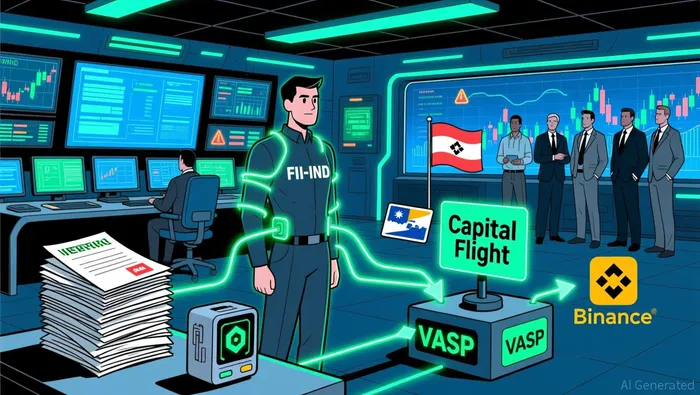
Market Deterrence: Compliance Costs and Capital Flight
Critics, however, highlight unintended consequences. The 1% Tax Deducted at Source (TDS) and 30% tax on crypto gains-coupled with the administrative burden of KYC-have driven investors toward fewer, longer-term positions and offshore alternatives. Data from Business Standard indicates that high-frequency trading has declined, with many retail investors opting for decentralized platforms outside India's jurisdiction.
The enforcement actions against major exchanges have also raised concerns about regulatory overreach. For instance, the Reserve Bank of India's (RBI) continued skepticism toward private cryptocurrencies-despite the Supreme Court's 2022 ruling against its 2018 ban-creates uncertainty. This fragmented regulatory landscape, spanning the Income Tax Act, PMLA, and cybersecurity directives, complicates compliance for platforms and investors alike.
Investment Shifts: Compliance-Driven Capital Flows
The regulatory shift has already begun reshaping capital flows. Investors are increasingly favoring compliant platforms that offer institutional-grade controls, while tokenized assets-such as gold and real estate-have emerged as a bridge between traditional and digital markets. Analysts predict that India's crypto market will see "measured expansion" in 2026, driven by global trends and the maturation of tokenization.
However, challenges persist. The absence of a dedicated regulatory body for crypto, coupled with the RBI's cautious stance, means the sector remains vulnerable to abrupt policy changes. For now, the market is navigating a delicate balance: adhering to compliance while seeking to retain its competitive edge in a globalized digital economy.
Conclusion: A Tipping Point for India's Crypto Market
India's 2025 KYC crackdown represents a pivotal moment. While the measures undeniably increase operational costs and risk driving some capital offshore, they also lay the groundwork for a more transparent, institutional-friendly ecosystem. The long-term success of this regulatory experiment will depend on whether the government can address lingering ambiguities-such as the lack of a unified crypto framework-and foster collaboration with industry stakeholders.
For investors, the message is clear: compliance is no longer optional. Those who adapt to the new norms may find opportunities in tokenization and regulated platforms, while those who resist risk being left behind in a market that is rapidly evolving under the weight of its own ambition.







Comentarios
Aún no hay comentarios