
India's Used-Car Unicorns: Valuation Rationalization and Market Entry Timing in the IPO Race
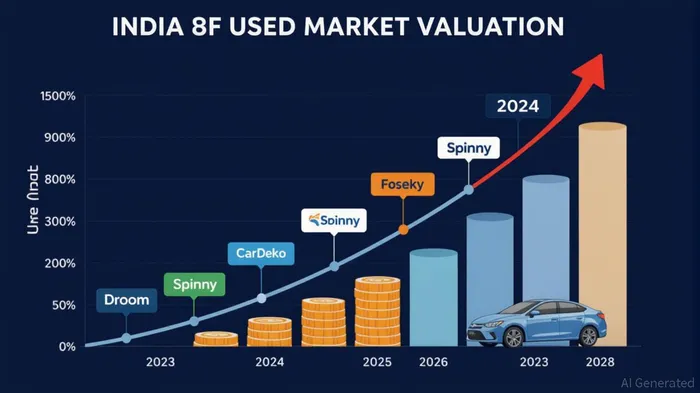
India's used-car unicorn ecosystem is at a pivotal juncture, with CARS24, CarDekho, Spinny, and Droom preparing for initial public offerings (IPOs) in the next 12 to 18 months. These companies, valued collectively at over $10 billion in recent years, are now navigating a dual challenge: rationalizing their valuations in a post-2024 IPO slowdown and timing their market entry amid macroeconomic headwinds.
Valuation Rationalization: From Burn Rate to EBITDA Positivity
The path to IPO readiness for these unicorns hinges on restructuring operations to align with investor expectations. CARS24, valued at $3.2 billion in 2021 but posting a 5 billion rupee loss in FY24[1], has slashed costs by shutting down non-core ventures like Inspare and FourDoor and reducing its workforce[1]. Similarly, CarDekho is merging its insurance arm, InsuranceDekho, with RenewBuy to streamline operations[1], while Spinny has slowed expansion to focus on capital efficiency[1]. Droom, aiming for EBITDA positivity by FY26[4], has cut losses by 54% in FY23 and restructured to prioritize premium and luxury vehicles[4].
These moves reflect a broader trend of “valuation rationalization” in the Indian startup ecosystem. As of 2024, two-tenths of India's 117 unicorns had fallen below $1 billion valuations[2], signaling investor skepticism toward pre-revenue or high-burn models. For used-car unicorns, the key to justifying valuations lies in demonstrating unit economics, such as CARS24's new app feature, Orbit, which integrates financing and insurance to boost customer lifetime value[2].
Market Entry Timing: Navigating a Cautious IPO Climate
While 2024 saw India lead global IPO activity with over $10 billion raised[3], 2025 has been marked by caution. Only five Indian startups have listed so far in 2025, despite 26 filing draft prospectuses with SEBI[3], as macroeconomic pressures and geopolitical tensions dampen investor appetite. This environment forces used-car unicorns to time their entries strategically.
Droom's planned November 2025 IPO[4], for instance, leverages domestic-focused investment trends, with a pre-IPO round targeting INR 200 crore ($23 million) from Indian family offices[4]. CARS24 and CarDekho, meanwhile, are adopting a wait-and-watch approach, assessing investor sentiment before filing[1]. The used-car market itself offers a tailwind: India's second-hand car sales ratio has risen from 1.2 to 1.65 per new car sold in the past decade[5], and the market is projected to reach $73 billion by FY28[4].
Investment Implications: Balancing Optimism and Caution
For investors, the IPOs of India's used-car unicorns present a high-risk, high-reward proposition. On one hand, the sector's growth potential—driven by urbanization, digital adoption, and a $100-billion projected used-car market by 2035[2]—is compelling. On the other, the companies' path to profitability remains unproven. CARS24's FY24 loss[1] and Spinny's capital-seeking efforts[1] highlight operational challenges.
A critical factor will be how these firms price their IPOs. Droom's target valuation of $1.2–1.5 billion[4] appears aggressive given its FY23 performance, but aligns with the broader unicorn market's $385-billion valuation in 2024[3]. Investors must weigh whether the companies' restructuring efforts will translate into sustainable margins or merely delay inevitable valuation corrections.
Conclusion
India's used-car unicorns are betting on a strategic mix of operational discipline and market timing to navigate the IPO landscape. While their restructuring efforts signal a shift toward profitability, the success of their public market debuts will depend on macroeconomic stability, investor confidence, and the sector's ability to scale efficiently. For now, the road to $1 billion in combined IPO proceeds remains paved with both opportunity and uncertainty.







Comentarios
Aún no hay comentarios