
India's Bond Market at Inflection Point: Capitalizing on Foreign Inflows and Policy Tailwinds
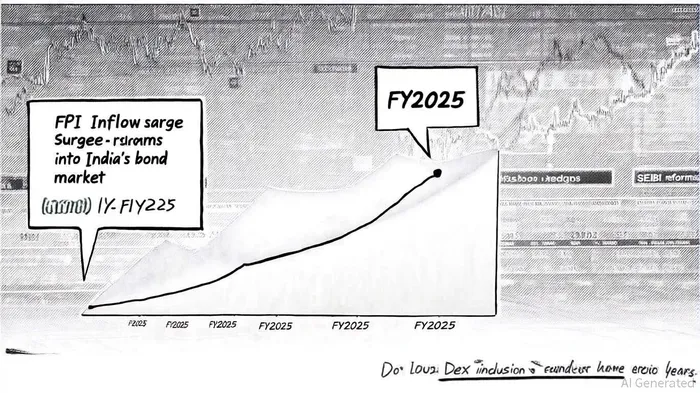
India's bond market is at a pivotal inflection pointIPCX--, offering international investors a rare confluence of structural tailwinds and strategic opportunities. With foreign portfolio investments (FPIs) surging to a five-year high of Rs 1.32 lakh crore in FY2025, driven by global index inclusion and regulatory easing, the country's sovereign debt market is emerging as a magnet for capital seeking yield and diversification[2]. For investors navigating a post-pandemic, high-interest-rate environment, India's bond market presents a compelling case to balance risk and return.
Drivers of the Inflow Surge
The primary catalyst for this inflow boom is the inclusion of Indian government securities in global bond indices such as the JPMorgan Global Bond Index and Bloomberg Emerging Market Local Currency Government indices[2]. This inclusion has automatically redirected trillions of dollars in passive fund flows into India's debt market, with foreign investors net buying ₹1.24 trillion ($14.5 billion) of Indian bonds in 2024 alone[3]. The momentum has carried into 2025, with August 2025 seeing FPI purchases of index-eligible Indian bonds reach ₹104 billion ($1.2 billion)—the highest since March[1].
Complementing these market-driven forces are India's domestic policy reforms. The Reserve Bank of India's (RBI) fiscal consolidation efforts, coupled with a cooling of U.S. Treasury yields, have enhanced the relative attractiveness of Indian bonds. Meanwhile, the Securities and Exchange Board of India (SEBI) has introduced regulatory changes to streamline compliance for FPIs investing in government securities under the Fully Accessible Route (FAR). Effective February 2026, these reforms exempt GS-FPIs from providing investor-group details and reduce reporting frequency, lowering operational costs and encouraging long-term inflows[1].
Strategic Entry for International Investors
For international investors, the current environment offers a dual advantage: yield arbitrage and diversification benefits. Indian government bonds currently yield over 7%, significantly outpacing U.S. Treasuries, which hover near 4% as of September 2025[2]. This spread, combined with India's robust domestic growth outlook—projected at 6.5% for FY2025—creates a compelling case for capital deployment[2].
However, timing and structure matter. BlackRockBLK--, a leading asset manager, has emphasized the potential of Indian bonds for roll-down returns, where investors benefit from the natural appreciation of bonds as they approach maturity[1]. For instance, a 10-year Indian government bond purchased today could generate both coupon income and capital gains as it rolls down the yield curve. Additionally, the market's size—now valued at ₹238 trillion ($2.69 trillion)—provides liquidity and resilience, mitigating concerns about market depth[2].
Navigating Risks and Volatility
While the tailwinds are strong, external risks persist. Global interest rate trends, particularly in the U.S., remain a wildcard. A reversal in the Federal Reserve's rate-cutting cycle could pressure emerging market debt, including India's. Similarly, geopolitical tensions and currency volatility—especially against the U.S. dollar—pose challenges for foreign investors[3].
To mitigate these risks, investors should adopt a barbell strategy: allocate a portion of capital to short-term, high-liquidity instruments to hedge against rate volatility, while maintaining exposure to longer-dated bonds for yield capture. The SEBI reforms, which facilitate smoother transitions between regular FPIs and GS-FPIs, also enable investors to adjust their portfolios dynamically[1].
The Road Ahead
India's bond market is poised for sustained inflows, supported by structural reforms and global capital reallocation. While 2025 may see a moderation in inflows compared to record highs in 2024, the underlying fundamentals remain intact[3]. For international investors, the key is to act now—before the window of historically attractive yields narrows further.







Comentarios
Aún no hay comentarios