
India Bond Market Dynamics: Navigating Liquidity Shifts and Rate-Cut Expectations
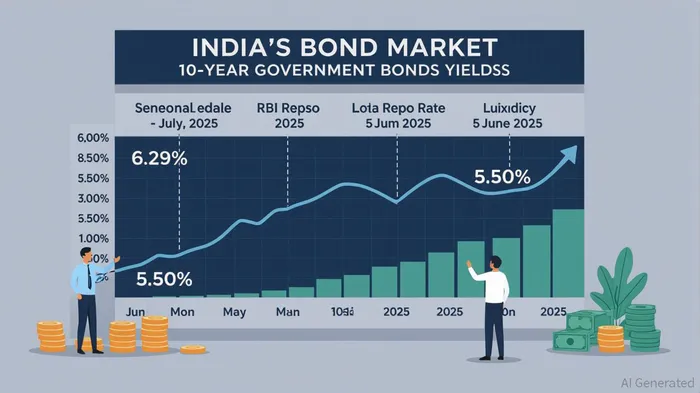
The Reserve Bank of India's (RBI) aggressive policy easing in 2025 has created a unique inflection point for India's bond market. With a 100-basis-point repo rate reduction since the start of the year, a flattening yield curve, and a surge in government bond auction demand, investors now face a landscape where yield stability and capital preservation are achievable—provided they navigate liquidity shifts with precision.
The RBI's Dual Play: Rate Cuts and Liquidity Management
The RBI's June 2025 decision to cut the repo rate by 50 bps to 5.50%—a move larger than expected—was a clear signal to stimulate growth amid easing inflation (CPI at 3.16% in April). This dovish stance has driven government bond yields lower, with the 10-year benchmark falling to 6.14% post-announcement. However, the RBI's pivot to a neutral policy stance in subsequent months has caused yields to rebound to 6.29%, reflecting caution about future rate cuts.
Meanwhile, the RBI has employed liquidity management tools to balance its easing cycle. A ₹2.5 trillion Open Market Operation (OMO) in Q2 2025 injected liquidity into the system, propping up bond prices and enabling banks to book treasury gains. Yet, the central bank has also tightened short-term liquidity via Variable Rate Reverse Repo (VRRR) auctions, such as a ₹2 trillion operation in July, to prevent excess money supply from spooking inflation expectations.
Tactical Entry Points: Auctions and Yield Curve Opportunities
Recent government bond auctions have underscored strong investor demand. The July 11, 2025, auction of the 5.63% 2026 bond saw a bid-to-cover ratio of 2.04, with 99% of ₹26,616 crore in bids accepted. This highlights a preference for intermediate-duration securities, particularly in the 5- to 7-year segment, where yields offer a balance of income and liquidity.
The yield curve has flattened significantly, with the spread between 5-year and 10-year bonds narrowing to 75 bps from 150 bps a year ago. This creates an asymmetrical opportunity: investors can lock in higher yields on shorter-dated bonds (e.g., the 5.63% 2026 bond trading at 5.9704%) while hedging against potential volatility in the long end of the curve.
Liquidity Dynamics: A Tightrope Walk for Investors
The RBI's liquidity operations have introduced short-term volatility. For example, the July VRRR auction tightened overnight rates, pushing the one-year OIS to 5.51%. Yet, the broader trend of rate cuts and a projected 3.7% CPI for FY26 suggests yields will remain range-bound.
Investors must also factor in global dynamics. The U.S. Federal Reserve's anticipated rate cuts in late 2025 have reduced carry trade pressures, boosting capital inflows into India's government securities. A narrowing current account deficit (0.8% of GDP) and India's fiscal credibility further enhance the appeal of its bond market.
Strategic Recommendations for Short-Term Investors
- Focus on Intermediate-Duration Bonds: The 5- to 7-year segment offers optimal yield-to-liquidity ratios. The 5.63% 2026 bond, with its high bid-to-cover ratio, exemplifies this.
- Leverage Dynamic Bond Funds: These funds can capitalize on shifting liquidity conditions, rotating between short- and medium-term bonds as the RBI's policy evolves.
- Monitor Auction Outcomes: High subscription demand in upcoming RBI auctions (e.g., the 7.09% 2054 bond) signals tactical entry points for yield-hungry investors.
- Hedge Against Liquidity Shocks: Use short-duration corporate bonds (AA+ rated) to preserve capital while earning higher yields than government securities.
Conclusion: A Window of Opportunity
India's bond market in 2025 is defined by a delicate balance between rate easing and liquidity management. The RBI's actions have created a favorable environment for tactical investors, particularly those who prioritize intermediate-duration bonds and remain agile in response to liquidity shifts. As the central bank prepares for its next policy move on August 6, the key will be to align portfolios with both near-term yield stability and the potential for further rate cuts.
For now, the data suggests that Indian government bonds—especially those in the 5- to 7-year range—remain a cornerstone of a diversified, short-term strategy. The challenge lies in timing entries amid the RBI's liquidity tightrope, but the rewards for those who navigate it successfully could be substantial.







Comentarios
Aún no hay comentarios