
India's Billion-Dollar IPOs: Post-Listing Performance and the Sustainability of Returns
India's IPO market has witnessed a surge in billion-dollar listings since 2020, driven by regulatory reforms, investor enthusiasm, and the rise of tech-driven and sustainable business models. However, the post-listing performance of these IPOs reveals a complex narrative of short-term euphoria and long-term uncertainty. This analysis examines the sustainability of returns for India's largest IPOs, the role of ESG practices, and the factors that determine whether initial gains translate into enduring value.
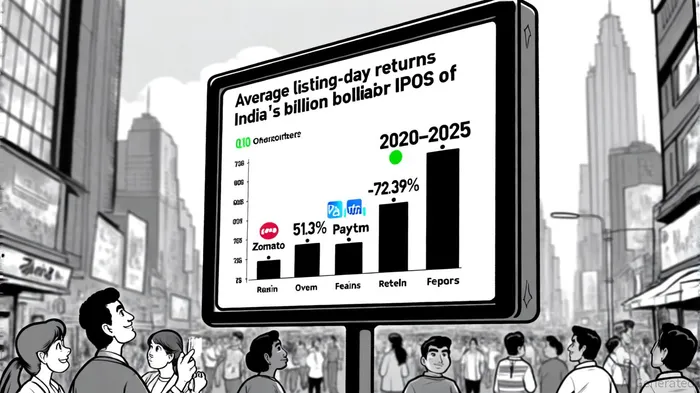
Listing Day Gains: A Mixed Bag of Outcomes
The first day of trading for India's billion-dollar IPOs has been marked by significant volatility. For instance, Zomato (Eternal) surged 51.3% in July 2021, reflecting investor optimism about the food delivery sector, according to a Livemint report. Similarly, Tata Capital's 2025 listing saw a $15.78 billion valuation, with shares jumping 13%, according to IPO Central. Conversely, Paytm's parent company, One97 Communications, faced a 27% discount on its 2021 listing, underscoring concerns over profitability, per the Livemint report.
According to the Livemint report, 2025 saw 51 IPOs listed, with 37 delivering positive returns on the listing day, averaging 12.66%. However, these gains were not uniform. For example, Amanta Healthcare and NSDL recorded robust returns of 12.50% and 17.00%, respectively, while Swiggy's 5.6% premium in 2024 highlighted sector-specific dynamics.
Long-Term Sustainability: Erosion of Initial Gains
Beyond the listing day, the sustainability of returns has been uneven. A 13-year study (2012–2025) reveals that while IPOs averaged 23.22% gains on the listing day, these returns declined to 20.29% after one year, 10.03% after two years, and 8.72% after three years, according to a Wealthease study. This erosion reflects broader market dynamics, including macroeconomic pressures and sector-specific challenges.
Notable exceptions include Laxmi Organic (LXCHEM), which delivered 235.33% returns within six months, and Happiest Minds Technologies, which surged 301.64% in the first year, as noted in the Wealthease study. However, companies like Apollo Microsystems saw steep declines, with returns plummeting to -70.57% over six months. The contrast between Zomato's initial success and its subsequent struggles-driven by intense competition and unprofitability-further illustrates the fragility of long-term value creation, a point emphasized in the Livemint report.
The Role of ESG Practices in Sustaining Returns
Environmental, Social, and Governance (ESG) factors have emerged as critical determinants of IPO success. A 2024 EY India survey found that 60% of investors now prioritize ESG disclosures when evaluating IPOs, as reported by IndiaIPO. Companies with robust ESG frameworks, such as Tata Steel, have demonstrated enhanced investor confidence and reduced IPO under-pricing, supported by a ScienceDirect article.
Regulatory mandates, including SEBI's Business Responsibility and Sustainability Reporting (BRSR) requirements for the top 1,000 listed firms, have accelerated ESG integration, according to an ISESG post. For example, NTPC Green Energy's 14% listing-day jump was attributed to investor anticipation of India's clean energy growth. Academic research also supports a positive correlation between ESG performance and financial outcomes, with Nifty 50 companies showing improved profitability at lower ESG quantiles, as discussed in the ScienceDirect article.
Future Outlook: Balancing Hype and Substance
India's IPO market remains resilient, with October 2025 becoming one of the largest months for IPO proceeds, exceeding $5 billion, according to the Wealthease study. However, the sustainability of returns will depend on companies' ability to align with ESG standards, demonstrate capital-efficient growth, and navigate global uncertainties like inflation and trade tensions, as noted in an Outlook Business wrap-up.
Startups planning 2025 IPOs are increasingly focusing on scalable business models and transparent governance. For instance, green hydrogen and renewable energy firms are leveraging ESG-linked incentives from the 2025 Union Budget to attract capital, a trend highlighted by ISESG. Yet, as the case of Paytm and Ola Electric shows, overvaluation and weak unit economics can undermine long-term value, even in high-growth sectors, the Wealthease study warns.
Conclusion
India's billion-dollar IPOs since 2020 highlight the duality of investor optimism and market reality. While listing-day gains are common, sustaining these returns requires a combination of strong ESG practices, clear monetization strategies, and adaptability to macroeconomic shifts. As the IPO landscape evolves, companies that prioritize long-term value creation over short-term hype are likely to emerge as winners in this dynamic market.







Comentarios
Aún no hay comentarios