
India's Auto Sector Surges in Q3 2025: Tax Incentives and Festival Demand Drive Growth
India's automotive sector has emerged as a standout performer in Q3 2025, driven by a confluence of strategic tax incentives and robust festival-driven retail demand. The Union Budget 2025-26 and subsequent GST reforms have catalyzed a transformation in the industry, particularly in electric vehicle (EV) manufacturing and affordable mobility. Meanwhile, the festive season-spanning Navratri, Dhanteras, and Diwali-has further amplified sales momentum, creating a compelling investment narrative for stakeholders.
Tax Incentives: Fueling Domestic Manufacturing and EV Growth
The Union Budget 2025-26 introduced a suite of measures to bolster the auto sector, with a sharp focus on clean technology and self-reliance. Customs duties on 35 capital goods used in lithium-ion battery production were fully exempted, directly supporting domestic EV battery manufacturing according to an EY alert. This aligns with the National Manufacturing Mission for Clean Tech, which prioritizes batteries, motors, and controllers, as noted in a BusinessWorld article.
Complementing these efforts, the government increased the income tax exemption threshold to ₹12 lakh, potentially boosting disposable income and stimulating demand for entry-level vehicles according to an Autonexa analysis. For instance, reduced GST rates on small cars and motorcycles (from 28% to 18%) made mass-mobility options more affordable, while higher levies on luxury SUVs (40%) signaled a shift toward progressive taxation, as reported in an Economic Times report. These policies have not only strengthened the domestic supply chain but also positioned India as a competitive hub for EV exports.
Festival-Driven Retail Demand: Navratri and GST 2.0 Spark a Sales Boom
The festive season in Q3 2025 proved to be a game-changer for auto retail. According to Economic Times Auto, September 2025 saw a 5.22% year-on-year (YoY) surge in auto retail sales, with two-wheelers and passenger vehicles growing by 6.5% and 5.8%, respectively. The Navratri festival (September 22–October 2) alone delivered a historic 34% YoY sales increase, driven by GST 2.0 reforms, festive discounts, and pent-up demand according to The Tribune.
Two-wheelers led the charge, with a 36% YoY growth, while commercial vehicles rose by 14.8% despite weather-related disruptions in construction equipment sales. Major automakers capitalized on this momentum: Tata Motors recorded a record 60,907 passenger vehicle sales in September (up 47% YoY), Royal Enfield hit 124,328 unit sales, and Maruti Suzuki saw a 9.1% rise in domestic wholesales, according to a News18 report.
Looking Ahead: Diwali and Dhanteras to Sustain Momentum
With Dhanteras and Diwali approaching, industry optimism remains high. The Federation of Automobile Dealers Associations (FADA) anticipates record-breaking sales, according to Editorji, citing favorable GST benefits, stable interest rates, and improved monsoon conditions. Additionally, the government's allocation of INR 7,000 crore for clean-tech initiatives and continued 5% GST on EVs, noted earlier in the BusinessWorld article, suggest a long-term commitment to sustainable mobility.
However, challenges persist. July 2025 saw a 4.3% decline in auto sales due to monsoon disruptions and delayed consumer purchases, reported by Economic Times Auto. Yet, the Q3 rebound underscores the sector's resilience and the efficacy of policy interventions.
Investment Outlook
For investors, India's auto sector presents a dual opportunity:
1. Policy-Driven Growth: Tax incentives for EVs and clean-tech manufacturing are likely to attract foreign direct investment (FDI) and spur innovation.
2. Retail Resilience: Festival-driven demand, coupled with GST reforms, has proven to be a reliable growth engine, particularly in rural and semi-urban markets.
Stakeholders should monitor upcoming policy updates and festive sales trends in October–November 2025, as these could further validate the sector's trajectory. With India's push for "Make in India" and "Atmanirbhar Bharat," the auto sector is poised to remain a cornerstone of the nation's economic revival.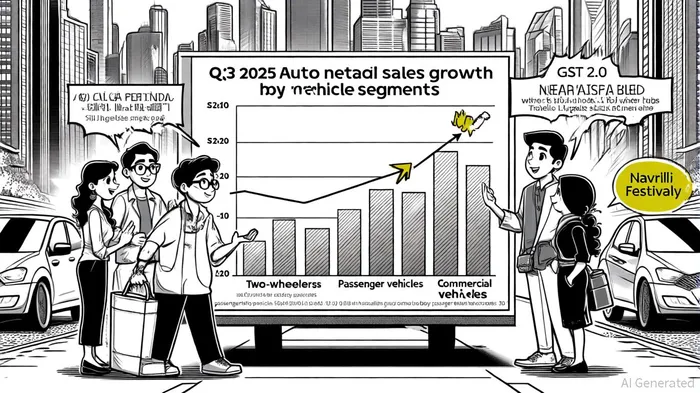







Comentarios
Aún no hay comentarios