
India's Auto Sector: A Strategic Investment Opportunity Amid GST Reforms and Seasonal Demand Surges
India's auto sector is emerging as a compelling short-to-medium-term investment opportunity, driven by a confluence of structural policy reforms and cyclical demand dynamics. Recent Goods and Services Tax (GST) adjustments, coupled with robust seasonal demand during festivals, have catalyzed a revival in production, sales, and capital inflows. This analysis explores how these factors are reshaping the sector's trajectory and what they mean for investors.
GST Reforms: A Tailwind for Affordability and Demand
The Indian government's decision to reduce GST rates on small cars and commuter two-wheelers to 18% has directly enhanced affordability, particularly in rural and semi-urban markets. According to The Economic Times, this reduction has led to an 8.5% price drop in compact passenger vehicles and a 7.8% decline in two-wheeler prices (excluding those above 350cc). For instance, models like Maruti Suzuki's Alto and WagonR, and Hero Splendor, have seen renewed demand, with on-road prices becoming accessible to a broader demographic. As reported by The Economic Times, some segment leaders have already noted stronger retail traction post-revision.
Electric vehicles (EVs), already taxed at 5%, have further benefited from this environment. Data from EV Reporter indicates that GST-led price cuts, combined with lower loan rates, are accelerating EV adoption, particularly in urban centers. This aligns with India's net-zero ambitions and positions the sector to capitalize on both domestic and export markets.
However, the policy is not without its challenges. Motorcycles above 350cc face a 40% GST rate, a move criticized by industry leaders like Royal Enfield's CEO, Siddhartha Lal, who warned of potential market contraction and reduced global competitiveness, highlighting the need for nuanced investment strategies that favor segments aligned with current tax incentives.
Seasonal Demand: Festivals as a Catalyst for Sales
In September 2025, a Reuters report noted a 5.4% year-on-year increase in passenger vehicle sales, reaching 381,437 units, fueled by GST cuts and festive spending. Maruti Suzuki and Tata Motors reported particularly strong performances, with the latter seeing a 47% surge in domestic wholesales.
Two-wheeler sales also rebounded, with Hero MotoCorp and Bajaj Auto reporting growth of 5% and 5.3%, respectively. This trend mirrors historical patterns: during the 42-day festive period in 2023, a FADA analysis in The Economic Times found two-wheeler registrations rose by 21%, while passenger vehicle sales increased by 10%. The combination of reduced prices, pent-up demand, and aggressive financing schemes has created a virtuous cycle, particularly in rural markets where affordability is a key driver.
Investment Implications: Balancing Opportunities and Risks
The sector's short-to-medium-term outlook is optimistic, but investors must navigate several risks. While GST cuts have spurred demand, supply bottlenecks-such as component shortages and production delays-remain a concern. As noted in a Business Standard analysis, some manufacturers have not fully passed on cost savings to consumers, potentially dampening the expected price reductions.
On the positive side, the 18% GST rate for commercial vehicles is boosting logistics and agricultural transport operators, who are acquiring fleets at lower costs. This bodes well for companies like Tata Motors and Ashok Leyland, which dominate the commercial vehicle segment. Additionally, global supply chain shifts following U.S.-China trade tensions are opening export opportunities for Indian automakers, particularly in Southeast Asia and Africa.
For investors, the key is to focus on companies with strong rural market penetration, robust supply chains, and diversified product portfolios. EV manufacturers and two-wheeler producers are particularly well-positioned, given their alignment with current GST incentives and seasonal demand patterns.
Conclusion
India's auto sector is at an inflection point, with GST reforms and seasonal demand creating a fertile ground for growth. While challenges like supply constraints and uneven tax treatment persist, the sector's resilience and adaptability-evidenced by record sales during the 2025 festive season-suggest a strong investment case. Investors who strategically target segments benefiting from policy tailwinds and cyclical demand surges are likely to reap significant returns in the coming years.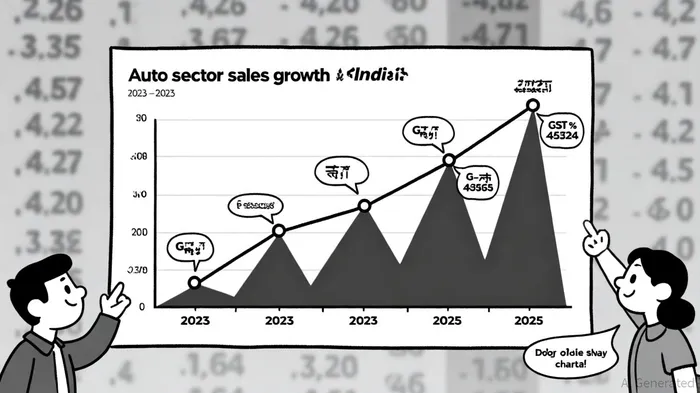







Comentarios
Aún no hay comentarios