
Income Investing in the Magnesium Sector: Clarifying MAGY, YMAG, and Strategic Alternatives
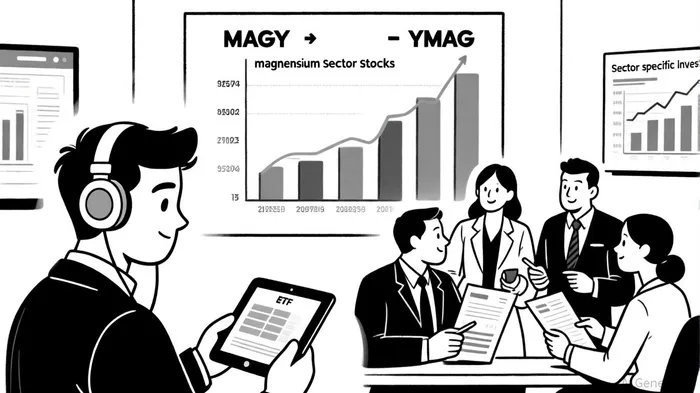
The global magnesium sector, driven by demand for lightweight materials in automotive and aerospace industries, is projected to grow at a compound annual rate of 5.42% through 2033[1]. However, investors seeking income opportunities in this space must navigate a critical misalignment: MAGY (Roundhill Magnificent Seven Covered Call ETF) and YMAG (YieldMax Magnificent 7 Fund of Option Income ETFs) are not magnesium production companies but tech-focused ETFs leveraging the Magnificent Seven stocks (Apple, Amazon, Alphabet, Meta, Microsoft, NVIDIA, Tesla). This distinction is pivotal for strategic stock selection.
The Misconception: MAGYMAGY-- and YMAG as Magnesium ETFs
Despite their ticker symbols, MAGY and YMAG are structured as covered call ETFs targeting the Magnificent Seven, not magnesium producers. MAGY, launched in April 2025, employs a weekly distribution strategy with a 34.9% yield[3], while YMAG, a fund-of-funds structure, offers a 49.89% yield through monthly rebalancing[5]. These high yields, however, come with caveats:
- Expense ratios: MAGY (0.65%) and YMAG (1.28%)[5] are significantly higher than sector averages.
- Return of capital: A portion of distributions may represent return of capital rather than income[1].
- Sector exposure: Neither ETF holds magnesium producers; their holdings are entirely concentrated in tech stocks[3].
Magnesium Sector Fundamentals: Beyond MAGY and YMAG
China dominates global magnesium production (85% of supply), with prices fluctuating due to environmental regulations and energy costs[2]. Key players like Marubeni (market cap: $33.28B) and Dow (DOW)[4] offer diversified exposure to the sector. For income investors, magnesium producers with stable cash flows and dividend histories—such as US Magnesium LLC (North America's sole primary producer) or VSMPO-AVISMA (aerospace-grade alloys)—are more aligned with sector-specific goals[4].
Strategic Recommendations for Income Investors
- Avoid misaligned ETFs: MAGY and YMAG are unsuitable for magnesium sector income due to their tech-centric strategies.
- Target sector leaders: Companies like Marubeni and Sumitomo Electric Industries (SMTOY) offer exposure to magnesium demand cycles[4].
- Consider diversified ETFs: For broader industrial metals exposure, the iShares MSCI Global Metals & Mining Producers ETF (METL) provides a 3.2% yield with magnesium-related holdings[6].
Conclusion
The magnesium sector's growth trajectory is underpinned by EV adoption and aerospace innovation, but income investors must prioritize alignment with sector fundamentals. While MAGY and YMAG deliver high yields, their tech focus and structural risks make them poor substitutes for direct magnesium sector investments. By targeting producers with sustainable cash flows and leveraging diversified industrial ETFs, investors can capitalize on the sector's long-term potential without sacrificing income quality.





Comentarios
Aún no hay comentarios