
Income Generation in a Low-Yield World: Evaluating the Virtus Newfleet Multi-Sector Bond ETF's Strategic Dividend Signal
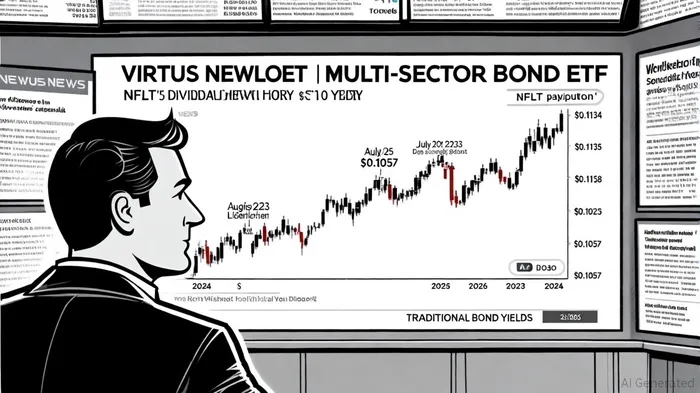
In an era where traditional fixed-income assets struggle to generate meaningful returns, the Virtus Newfleet Multi-Sector Bond ETF (NFLT) has emerged as a compelling solution for income-focused investors. The recent $0.1057 per-share dividend declared on July 18, 2025—payable on July 25 with an ex-dividend date of July 21—serves as a strategic signal of the fund's ability to navigate low-yield environments while maintaining a robust income stream[5]. This analysis examines NFLT's dividend strategy, structural advantages, and market positioning to argue why it deserves a core role in diversified income portfolios.
The Challenge of Low-Yield Environments
For decades, bond investors relied on predictable yield curves and stable coupon payments. However, the post-pandemic era has seen central banks maintain historically low interest rates, compressing returns across fixed-income markets. According to a report by Bloomberg, the average yield on investment-grade corporate bonds fell below 4.5% in 2025, while U.S. Treasury yields stagnated near 3.8%[1]. In such conditions, passive bond strategies often underperform, as they lack the agility to capitalize on sector-specific opportunities.
NFLT's active management model directly addresses this challenge. By rotating across sectors—including investment-grade corporates, high-yield bonds, securitized assets, and even emerging markets—the fund dynamically allocates capital to areas with the most attractive risk-adjusted returns[2]. This unconstrained approach, combined with a focus on capital appreciation, allows NFLTNFLT-- to generate income even when broader markets struggle.
NFLT's Dividend as a Strategic Signal
The July 2025 dividend of $0.1057 per share underscores the fund's commitment to consistent income generation. While this amount represents a slight reduction from the August 2023 payout of $0.1134[4], it reflects a deliberate recalibration to current market conditions. Data from MarketBeat indicates that NFLT's dividend yield as of September 2025 stands at 5.17%[4], significantly outperforming the 3.2% average yield of the Bloomberg Aggregate Bond Index[3].
This resilience stems from NFLT's disciplined risk management framework. The fund's managers, led by David Albrycht and Benjamin Caron, prioritize sectors with strong fundamentals and attractive spreads, even as overall yields decline[2]. For example, in 2025, the team increased exposure to floating-rate loans and short-duration securities, which offer protection against rate volatility while maintaining income[2]. The July dividend, therefore, is not a sign of weakness but a calculated adjustment to sustain long-term returns.
Structural Advantages for Income Investors
NFLT's appeal extends beyond its dividend. With a total expense ratio of 0.50%, it offers cost efficiency compared to actively managed bond funds, which typically charge 0.75% or more[2]. The fund's liquidity profile further enhances its attractiveness: as of August 21, 2025, its net asset value (NAV) stood at $22.7973, with a closing price of $22.80, indicating minimal discount/premium volatility[2]. This stability is critical for income investors, who rely on predictable cash flows.
Moreover, NFLT's $289.5 million in net assets[2] suggests a balance between scale and agility. While large enough to avoid liquidity constraints, the fund remains nimble enough to exploit niche opportunities—a rarity in today's crowded bond market.
Conclusion: A Core Income Vehicle for Uncertain Times
The Virtus Newfleet Multi-Sector Bond ETF's recent $0.1057 dividend is more than a routine payout—it is a testament to the fund's strategic adaptability in a low-yield world. By combining active sector rotation, disciplined risk management, and a focus on capital appreciation, NFLT delivers a rare combination of income and growth potential. For investors seeking to preserve purchasing power while generating reliable cash flows, NFLT represents a compelling core holding.
As central banks remain cautious and global yields remain subdued, the ability to pivot across sectors will become increasingly valuable. The July 2025 dividend reaffirms that NFLT is not just surviving in this environment—it is thriving.





Comentarios
Aún no hay comentarios