
Income Generation in a Low-Yield Environment: Evaluating Fidelity International High Dividend ETF's Strategic Dividend Play
In a global financial landscape where central banks have normalized low interest rates, income-focused investors face a critical challenge: how to generate reliable returns without sacrificing capital preservation. The Fidelity International High Dividend ETF (FID) and its Canadian counterpart (FCID.TO) have emerged as focal points for investors seeking to balance yield with diversification. This analysis examines the strategic value of FID's recent CAD 0.0255 monthly dividend per share, contextualized against broader market trends and competing international dividend ETFs.
A Competitive Yield in a Crowded Space
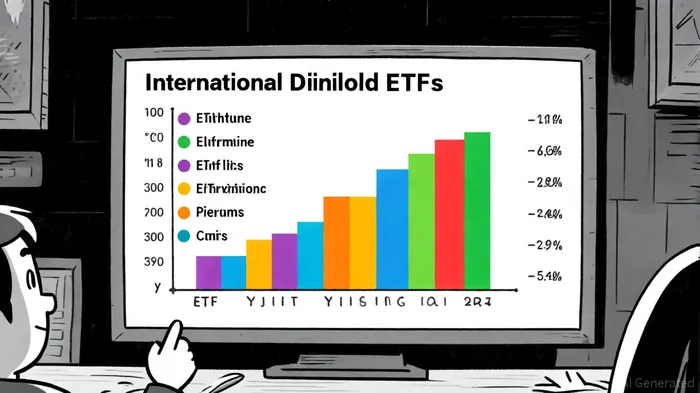
FID's trailing twelve-month (TTM) dividend yield of 4.46% as of September 24, 2025, positions it as a strong contender in the international dividend ETF space[1]. This outperforms the Schwab International Dividend Equity ETF (SCHY)'s 3.75% yield[1] and aligns with the broader trend of high-dividend ETFs offering yields significantly above the 3.3% of the Vanguard Total International Stock ETF (VXUS)[2]. However, FID's yield lags behind niche players like the First Trust STOXX European Select Dividend Index Fund (FDD), which boasts a 5.79% yield[2], and the iShares International Select Dividend ETF (IDV) at 5.30%[2]. These comparisons highlight the importance of aligning an ETF's geographic and sectoral focus with an investor's risk tolerance and income goals.
For Canadian investors, FCID.TO's recent monthly dividend of CAD 0.0255 per share, with an ex-dividend date of September 26, 2025[3], reflects a TTM yield of 3.48%[4]. While this is lower than the 5.79% of FDD, it remains competitive in a market where the WisdomTree International High Dividend Fund (DTH) yields 4.30%[2]. The key differentiator for FCID.TO lies in its monthly payout structure, which provides more frequent income compared to quarterly-paying counterparts like IDV and FDD.
Strategic Income Potential and Market Volatility
The recent CAD 0.0255 dividend for FCID.TO must be evaluated alongside its historical volatility. For instance, FCID.TO's July 2025 payout of 0.1173 CAD marked a 4.28% decline from June's 0.1226 CAD[5], underscoring the ETF's sensitivity to underlying asset performance and macroeconomic conditions. This volatility, while concerning for income stability, also reflects the ETF's exposure to high-dividend equities in regions like Europe and Asia, where earnings growth and currency fluctuations can amplify yield fluctuations.
In contrast, FID's U.S.-listed counterpart has demonstrated more consistent yield performance. Its 4.46% TTM yield[1] suggests a more stable dividend policy, likely due to its diversified portfolio of international equities. However, FID's quarterly dividend of $0.1980 per share (3.26% yield) in September 2025[6] represents a significant drop from its March 2024 payout of $0.45[6], indicating potential headwinds in its underlying holdings.
Risk Considerations and Diversification
While high dividend yields are attractive, investors must weigh them against credit risk and sustainability. For example, FDD's 5.79% yield[2] is underpinned by European equities, which may face regulatory and economic headwinds in 2025. Similarly, FCID.TO's recent dividend reductions raise questions about the sustainability of its payout ratio. As noted by Morningstar, “dividend yields above 5% often signal either exceptional value or financial distress”[7], a nuance investors must assess through fundamental analysis of the ETF's holdings.
Conclusion: A Strategic, Not a Silver-Bullet, Solution
FID and FCID.TO offer compelling income potential in a low-yield environment, particularly for investors prioritizing monthly cash flow (FCID.TO) or broader international diversification (FID). However, their yields must be contextualized within a diversified portfolio that balances income with growth and risk mitigation. For instance, pairing FID with growth-oriented ETFs like VXUS could create a hybrid strategy that leverages high yields while hedging against equity market volatility.





Comentarios
Aún no hay comentarios