
Income Generation in a Low-Yield Environment: Assessing the BMO Monthly Income ETF's Dividend Consistency and Risk-Adjusted Returns
In a world where central banks have slashed interest rates to historic lows, income-focused investors face a daunting challenge: generating reliable returns without exposing their portfolios to unsustainable risk. The BMO Monthly Income ETF (ZMI), a balanced fund allocating 50% to equities and 50% to fixed income[1], has emerged as a potential solution. This article evaluates ZMI's dividend consistency and risk-adjusted performance in a low-yield environment, drawing on historical data and theoretical frameworks to assess its viability for income seekers.
Dividend Consistency: A Decade of Reliability
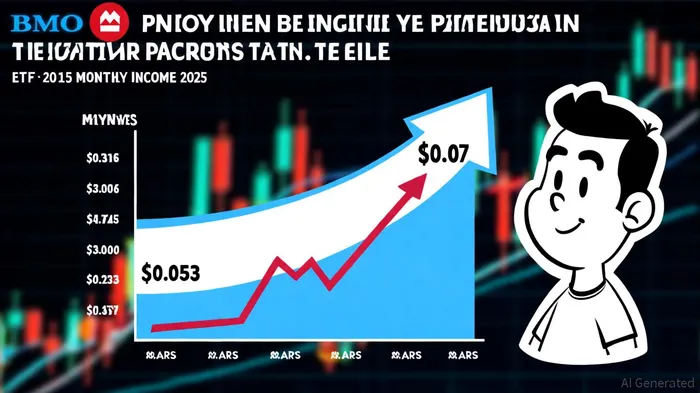
ZMI has demonstrated an unbroken record of monthly dividend payments since its inception in 2015[2]. The dividend amount has steadily increased from $0.053 per share in early 2015 to $0.07 by 2023[2], reflecting a disciplined approach to income generation. This consistency is critical in a low-yield environment, where investors prioritize predictable cash flows over volatile capital gains. For example, in 2025, ZMI's 4.6% dividend yield[3] outperforms many traditional fixed-income alternatives, which struggle to compete with near-zero benchmark rates.
However, dividend consistency alone does not guarantee long-term success. ZMI's total return of -64.58% over the past year[4] underscores the risks of relying on a fund with significant equity exposure (57% as of August 2025[5]) during market downturns. While the fund's balanced structure aims to mitigate volatility, investors must weigh the trade-off between income stability and capital preservation.
Risk-Adjusted Returns: Navigating a Low-Yield Landscape
In a low-yield environment, risk-adjusted return metrics like the Sharpe Ratio and Sortino Ratio become essential tools for evaluating investments. The Sharpe Ratio, which measures excess return per unit of total volatility[6], is particularly relevant for ZMI's diversified portfolio. Although specific Sharpe Ratio data for ZMI is unavailable, its 50/50 equity-fixed income allocation suggests a moderate risk profile. Fixed-income components provide downside protection, while equities offer growth potential—a balance that could enhance risk-adjusted returns in a low-yield climate[7].
The Sortino Ratio, which focuses on downside volatility[8], further highlights ZMI's appeal. By prioritizing downside risk over total volatility, this metric aligns with the goals of income-focused investors who are more concerned with preserving capital than with short-term market fluctuations. While ZMI's Sortino Ratio is not disclosed, its conservative structure and monthly dividend payments imply a favorable risk-return profile compared to high-yield equities or leveraged fixed-income alternatives.
Challenges in a Low-Yield Environment
Despite its strengths, ZMI faces headwinds in 2025. The fund's fixed-income segment, which includes bonds and preferred shares, may underperform as central banks maintain accommodative policies[3]. Additionally, global economic fragility and trade policy uncertainties could amplify market volatility, testing the resilience of ZMI's balanced approach[9]. Investors must also consider that ZMI's 4.6% yield may not fully offset inflation or capital erosion in prolonged downturns[10].
Conclusion: A Prudent but Cautious Bet
The BMO Monthly Income ETF offers a compelling case for income generation in a low-yield environment. Its decade-long dividend consistency and balanced structure provide a reliable income stream with moderate risk. However, investors must remain vigilant about macroeconomic trends and the fund's exposure to equity markets. While ZMI's risk-adjusted returns appear favorable in theory, the absence of concrete Sharpe and Sortino Ratio data underscores the need for ongoing due diligence. For those prioritizing stability over growth, ZMI remains a viable option—but not without its caveats.







Comentarios
Aún no hay comentarios