
Income-Generating Multi-Asset ETFs: Navigating Dividend Consistency and Portfolio Resilience in a Low-Yield Era
In an era where traditional fixed-income assets struggle to outpace inflation, income-generating multi-asset ETFs have emerged as a compelling solution for investors seeking both yield and resilience. These funds, which blend equities, bonds, and alternative assets, offer a dual mandate: generating consistent dividends while mitigating downside risk through diversification. Recent performance data and expert strategies underscore their growing relevance in low-yield environments.
Dividend Consistency: A Mixed Landscape
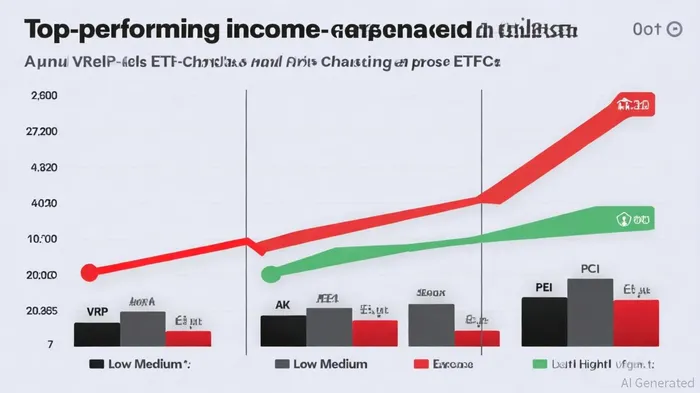
The dividend consistency of multi-asset ETFs varies significantly, reflecting differences in asset allocation and market conditions. For instance, the Invesco Variable Rate Preferred ETF (VRP) has delivered a 5.64% annual dividend yield alongside a 6.51% year-to-date price increase, demonstrating resilience in preferred stocks and convertible bonds[1]. Similarly, the First Trust Institutional Preferred Securities & Income ETF (FPEI) has posted a 5.48% yield and 7.76% YTD price growth[1]. However, not all funds have fared equally well. The Aptus Collared Investment Opportunity ETF (ACIO), while achieving a 7.52% YTD price gain, offers a modest 0.41% yield, highlighting the trade-offs between capital appreciation and income generation[1].
Historical data further reveals divergent trends. The iShares Core 60/40 Balanced Allocation ETF (AOR) has maintained a consistent $1.60 dividend (2.52% yield), while the Aptus Defined Risk ETF (DRSK) has seen its yield decline from higher levels to 3.46%[1]. These variations underscore the importance of scrutinizing a fund's underlying holdings—such as mortgage REITs, high-yield bonds, or dividend-paying equities—to assess long-term income sustainability.
Portfolio Resilience: Diversification and Tactical Allocation
Portfolio resilience in low-yield environments hinges on strategic diversification and dynamic rebalancing. BlackRock's Multi-Asset Income model portfolios, for example, combine fixed income, equities, and active mutual funds to balance risk and return[2]. These portfolios employ a dynamic rebalancing approach, adjusting allocations based on macroeconomic signals to preserve capital during volatility. Similarly, State Street's Active Multi-Asset Income ETF Portfolio uses a proprietary model to forecast returns and optimize asset weights, emphasizing tactical shifts in response to interest rate changes[2].
Expense ratios and volatility metrics further illuminate resilience strategies. The BlackRock Multi-Asset Income ETF (BAICX), with a 0.81% expense ratio, has delivered a 9.61% annual return and a Sharpe ratio of 1.23, reflecting strong risk-adjusted performance[3]. In contrast, the YieldMax™ MSTR Option Income Strategy ETF (MSTY)—despite a 1.92 Sharpe ratio—exhibits a 40.82% maximum drawdown, illustrating the inherent risks of high-yield strategies[4]. These metrics highlight the critical balance between cost efficiency and volatility management.
Academic and Expert Validation
Academic research reinforces the efficacy of multi-asset strategies in crisis periods. A study employing Markowitz's mean-variance model found that portfolios combining BRICS equity indices, gold, and crude oil outperformed benchmarks like the S&P 500 in terms of adjusted Sharpe ratios and modified Value at Risk[5]. This aligns with real-world applications, such as BlackRock's use of global opportunities and active mutual funds to access specialized assets like floating-rate bank loans[2]. Additionally, real assets such as inflation-linked bonds and commodities have proven effective in hedging against macroeconomic uncertainties[5].
Strategic Recommendations for Investors
For investors navigating a low-yield landscape, the following strategies are critical:
1. Prioritize Diversification: Allocate across uncorrelated assets (e.g., gold, BRICS indices, real estate) to mitigate sector-specific risks[5].
2. Balance Yield and Risk: Favor ETFs with moderate expense ratios and robust Sharpe ratios, such as VRP or BAICX, while avoiding high-volatility options like MSTY[4].
3. Leverage Tactical Rebalancing: Opt for portfolios that dynamically adjust to interest rate cycles, as seen in BlackRock's and State Street's models[2].
Conclusion
Income-generating multi-asset ETFs offer a nuanced approach to yield generation in a low-interest-rate world. While dividend consistency varies, funds with diversified, income-focused allocations—such as those emphasizing preferred securities or high-yield bonds—can provide reliable returns. Portfolio resilience, meanwhile, depends on strategic diversification, cost efficiency, and proactive rebalancing. As macroeconomic uncertainties persist, these ETFs will remain a cornerstone for investors seeking to balance growth and income.





Comentarios
Aún no hay comentarios