
Incentive-Driven Innovation: How Peter Thiel's Unconventional Models Reshape the Startup Landscape
In the high-stakes arena of venture capital, Peter Thiel has long been a contrarian force, challenging conventional wisdom with incentive models that prioritize bold experimentation over incremental progress. His portfolio of startups—spanning venture debt, biotechnology, and alternative education—reflects a philosophy rooted in accelerating innovation by redefining how talent is cultivated and rewarded. According to a report by Forbes, Thiel-backed ventures have generated over $220 billion in collective value, driven by programs like the Thiel Fellowship and investments in niche markets such as longevity tech and AI-powered robotics[1]. This analysis explores how Thiel's unconventional incentives—ranging from financial structures to mentorship networks—create a disruptive edge in attracting top talent and accelerating breakthroughs.
The Thiel Fellowship: A Talent Magnet for Disruptive Thinkers
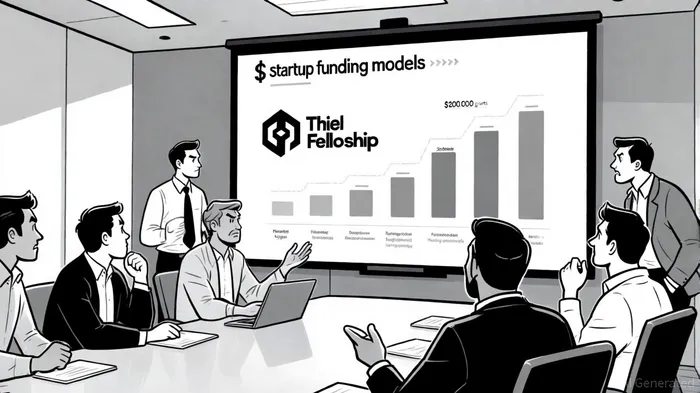
Thiel's most audacious experiment, the Thiel Fellowship, offers young entrepreneurs $200,000 to abandon or delay college and build startups full-time. This model directly challenges the traditional education-entrepreneurship pipeline, emphasizing speed and execution over academic credentials. Data from Fortune reveals that alumni like Dylan Field (Figma) and Vitalik Buterin (Ethereum) have scaled billion-dollar ventures before the age of 25, leveraging the program's mentorship network and early-stage funding[2]. The fellowship's focus on “producer mindsets” fosters intrinsic motivation, a trait critical for navigating the uncertainties of innovation[3].
The program's success is quantifiable: Thiel Fellows have collectively raised over $10 billion in follow-on funding, with startups like Scale AI (acquired for $1.4 billion) and Mercor (valued at $2 billion) exemplifying the rapid scaling enabled by this model[4]. By prioritizing individuals with early STEM excellence and entrepreneurial grit, the fellowship creates a feedback loop where talent attracts capital, and capital accelerates innovation.
Venture Debt and Biotech: Funding the Unconventional
Thiel's investments extend beyond education to financial and scientific frontiers. Tacora Capital, a venture debt firm he supports, offers non-dilutive loans to startups in capital-intensive sectors like fintech and hardware, preserving founder equity while enabling aggressive growth[5]. This contrasts sharply with traditional VC models, where equity stakes often dilute control. For instance, Quantum Systems, an AI-driven drone-robotics startup backed by Thiel, secured €63.6 million in Series B funding to develop dual-use technologies for defense and commercial markets[6].
In biotechnology, Thiel's Methuselah Foundation has allocated $1 million to companies targeting age-related diseases, such as Cortexyme's Alzheimer's therapies and EpiBone's regenerative bone grafts[7]. These ventures, often funded through Breakout Labs' milestone-based grants, avoid the rigid timelines of academic research, enabling rapid iteration. As FierceBiotech notes, Breakout Labs' non-dilutive model has supported over 50 startups in synthetic biology and sustainable materials, with Modern Meadow's biofabricated leather emerging as a disruptive alternative to traditional manufacturing[8].
The Broader Impact: Speed, Talent, and Market Capture
The disruptive potential of Thiel's models lies in their ability to compress timelines. Traditional startups often spend years navigating academic or corporate hierarchies, while Thiel-backed ventures prioritize execution. A 2025 analysis by Capitaly found that Thiel Fellows' startups achieve Series A funding 18 months faster than industry averages, a metric attributed to the program's emphasis on mentorship and network access[9]. This speed is critical in markets like AI and blockchain, where first-mover advantage defines success.
Moreover, Thiel's focus on contrarian thinking—encapsulated in his Zero to One thesis—encourages founders to target monopolistic niches rather than crowded markets. PayPal's early focus on eBay sellers and Facebook's campus-centric social network exemplify this strategy[10]. By aligning incentives with long-term vision, Thiel's portfolio companies avoid the short-termism that plagues many tech startups.
Conclusion: A Blueprint for the Future of Innovation
Peter Thiel's incentive-driven models—whether through venture debt, biotech grants, or educational disruption—demonstrate a clear departure from conventional norms. By aligning financial rewards with contrarian thinking and hands-on execution, he has created a framework where talent and innovation thrive. As the global economy increasingly rewards agility over tradition, these models offer a compelling blueprint for the next generation of startups.







Comentarios
Aún no hay comentarios