
Implications of Trump's 130% China Tariffs on Global Supply Chains and Commodity Markets
The re-imposition of Trump's 130% tariffs on Chinese goods in 2025 has ignited a seismic shift in global trade dynamics, reshaping supply chains, distorting commodity markets, and forcing investors to recalibrate their strategies. This analysis unpacks the sector-specific fallout and offers actionable insights for navigating a protectionist climate.
Supply Chain Adjustments: Winners, Losers, and the Cost of De-Risking
The tariffs have accelerated the fragmentation of global supply chains, particularly in manufacturing and agriculture. U.S. steel and aluminum producers initially benefit from reduced foreign competition, with domestic steel prices rising due to 50% import tariffs, according to a J.P. Morgan outlook. However, downstream industries like construction and automotive face steep cost increases. For example, tariffs on softwood lumber and gypsum could raise homebuilding costs by thousands of dollars, per a MarketMinute report, and automotive tariffs may add $2,000–$5,000 to new vehicle prices, the report estimates.
Agriculture is another flashpoint. China's retaliatory measures-such as bureaucratic hurdles for U.S. pig and poultry exports-threaten to erode rural economies in key Trump states like Iowa and Nebraska, according to The Conversation. Meanwhile, China's export restrictions on rare earth minerals, critical for U.S. defense and clean energy sectors, have exposed vulnerabilities in decoupling strategies, The Conversation warns.
Commodity Market Volatility: The New Normal
Commodity markets have become a barometer for trade war anxiety. Copper prices on the London Metal Exchange (LME) plummeted 4.9% in response to tariff announcements, the MarketMinute article reported, reflecting fears of reduced demand from disrupted manufacturing. Aluminum prices, meanwhile, have surged to $2,200/mt in Q2 2025, driven by a combination of tariffs and supply constraints, as J.P. Morgan noted. Rare earths, already under Chinese export controls, face further price shocks if Trump escalates tariffs, the MarketMinute coverage adds.
The ripple effects extend to energy and materials sectors. Steel and aluminum tariffs are pushing inflation higher, with households projected to lose $3,800 in purchasing power by year-end, according to a Morgan Stanley guide. For investors, this volatility underscores the need for hedging and sectoral agility.
Strategic Sector Rotation: Navigating the Protectionist Storm
In a protectionist climate, sector rotation becomes a survival strategy. Here's how to position portfolios:
Defensive Sectors as Safe Havens
Defensive sectors like healthcare, utilities, and consumer staples are less exposed to trade disruptions and offer stability. For instance, utilities, with their regulated revenue streams and low beta, have outperformed during periods of tariff uncertainty, Morgan Stanley observes. Healthcare, insulated from import/export shocks, is another anchor for risk-averse investors, J.P. Morgan notes.Services and Tech: The Tariff-Proof Winners
U.S. services industries-software, cybersecurity, and large-cap financials-are largely immune to tariffs. These sectors benefit from domestic demand and technological tailwinds like AI adoption, per J.P. Morgan. Defense and semiconductor firms, though indirectly impacted by rare earth shortages, remain resilient due to government contracts and strategic importance, the MarketMinute piece adds.Commodity Hedges: Gold and Inflation-Protected Bonds
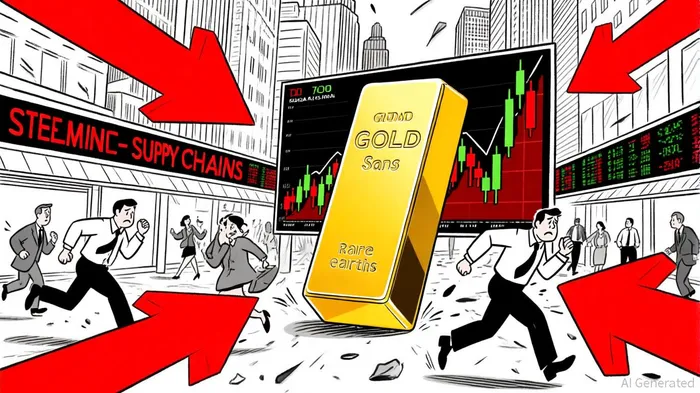
Gold has emerged as a geopolitical hedge, surging amid trade war uncertainty, The Conversation reports. Inflation-protected bonds (TIPS) also offer protection against tariff-driven inflation, particularly as households face higher costs, an iShares analysis notes.ETFs for Tactical Flexibility
Exchange-traded funds (ETFs) enable rapid sectoral reallocation. For example, cryptocurrency and nuclear energy ETFs have gained traction as diversifiers, capitalizing on policy shifts and energy transition trends, the iShares piece observes.
Historical Lessons and the Path Forward
History offers cautionary tales. The 2018 U.S.-China trade war triggered anticipatory contractions in global output, driven by eroded business confidence, The Conversation recounts. While short-term protectionism may bolster domestic producers, long-term costs-like fragmented supply chains and retaliatory tariffs-often outweigh gains, iShares analysis argues.
Investors must balance short-term tactical shifts with long-term resilience. For instance, while manufacturing tariffs may temporarily boost U.S. steel producers, the broader economy risks a 0.8% GDP contraction in 2025, according to a Tax Foundation analysis. Diversification across geographies and sectors, coupled with a focus on innovation-driven industries, is key.
Conclusion
Trump's 130% China tariffs are reshaping the economic landscape, creating both headwinds and opportunities. For investors, the path forward lies in strategic sector rotation, defensive positioning, and leveraging hedging tools like gold and ETFs. As the Supreme Court prepares to rule on the tariffs' legality in November 2025, the market volatility noted by the Tax Foundation is likely to persist. The winners will be those who adapt swiftly, balancing short-term pragmatism with long-term resilience.







Comentarios
Aún no hay comentarios