
The Implications of Strong US GDP Data on Global Equity Markets and FTSE 100 Outperformance: Assessing the Sustainability of Gains Amid Diverging Growth Dynamics
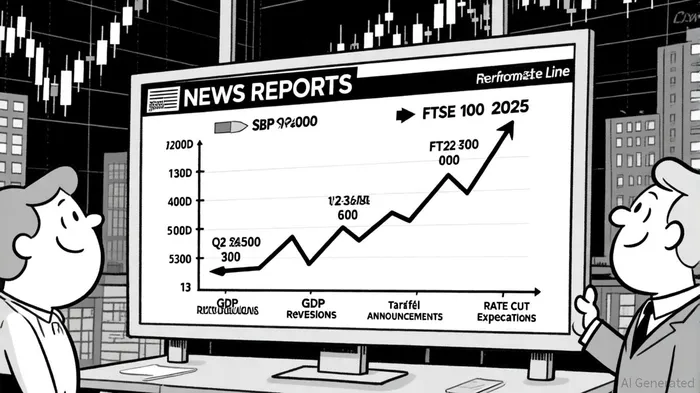
The U.S. economy's explosive 3.8% annualized GDP growth in Q2 2025 has sent ripples through global equity markets, creating a stark divergence in performance between U.S. and international benchmarks. While the S&P 500 surged 10.9% in the quarter, the MSCIMSCI-- ACWI ex USA Index outperformed with a 12.0% gain, driven by a weaker dollar and divergent monetary policy trajectories [3]. This backdrop raises critical questions about the sustainability of the FTSE 100's gains, which hit a record high of 8,679.46 points in January 2025 but later faced headwinds from U.S. tariff policies and trade uncertainty [2].
U.S. GDP Growth: A Double-Edged Sword for Global Markets
The U.S. GDP rebound in Q2 2025—revised sharply higher to 3.8% from an initial 3.0% estimate—was fueled by robust consumer spending (up 2.5% annually) and a narrowing trade deficit [1]. This growth, coupled with Trump-era tax cuts and deregulation, has reinforced investor confidence in U.S. equities, particularly in the Magnificent 7, which delivered 19.1% returns in the quarter [4]. However, the same policies have introduced volatility. The April 2025 tariff announcements, which raised average U.S. effective tariffs to 22.5%, reduced real GDP growth by 0.5–0.9 percentage points and triggered a 10% depreciation in the dollar year-to-date [5]. This depreciation, while boosting international equities for dollar investors, has also heightened concerns about global economic stability and corporate earnings for export-dependent markets like the UK [6].
FTSE 100: Attractive Valuations, Fragile Momentum
The FTSE 100's trailing P/E of 12.91 and forward P/E of 12.48 as of July 2025 suggest it trades at a discount to historical averages and global peers [3]. This valuation, combined with strong earnings from sectors like healthcare (e.g., AstraZeneca) and banking (e.g., Barclays), initially drove the index to record highs amid weak U.S. Q1 GDP data [7]. However, analysts caution that the FTSE 100's gains are precarious. UBS notes a “slow earnings recovery” and highlights the index's reliance on energy and financials, which remain vulnerable to commodity price swings and interest rate uncertainty [3].
The index's exposure to U.S. trade dynamics further complicates its outlook. While UK exports to the U.S. account for only 2% of GDP, the FTSE 100 derives 27.7% of its revenue from U.S. markets [6]. Tariff-related volatility and the Trump administration's broader protectionist agenda have already caused the index to dip from its peak, as investors priced in risks to corporate margins and trade flows [8].
Sustainability: Balancing Optimism and Caution
The FTSE 100's ability to sustain its gains hinges on three factors:
1. Earnings Resilience: Q3 2025 earnings reports show upward revisions to EPS estimates, with FactSet noting positive guidance from companies [5]. However, UBS warns that a “slow earnings recovery” could limit upside potential, particularly if U.S. tariffs escalate [3].
2. Valuation Attractiveness: The index's 11.4x P/E multiple, below its long-run average, offers a buffer against short-term volatility [5]. Yet, with the Buffett Indicator signaling U.S. stock overvaluation, capital may continue to flow toward undervalued international assets [4].
3. Trade Policy Uncertainty: The UK's limited trade agreement with the U.S. (capping tariffs at 10%) has softened the blow of protectionist policies [2]. Still, a broader shift in U.S. trade strategy could disrupt global supply chains and erode investor confidence in the FTSE 100.
Conclusion: A Tenuous Equilibrium
The FTSE 100's outperformance in early 2025 was underpinned by attractive valuations and a flight to quality amid U.S. economic turbulence. However, the index now faces a delicate balancing act. While its earnings growth and undervaluation provide a foundation for moderate gains, the sustainability of these gains depends on navigating U.S. trade policy risks and divergent global growth trajectories. For investors, the path forward requires a nuanced approach: capitalizing on the FTSE 100's relative value while hedging against the volatility of a world increasingly shaped by protectionism and divergent monetary policies.





Comentarios
Aún no hay comentarios