
The Implications of Stable U.S. Jobless Claims for Market Stability and Sector Rotation
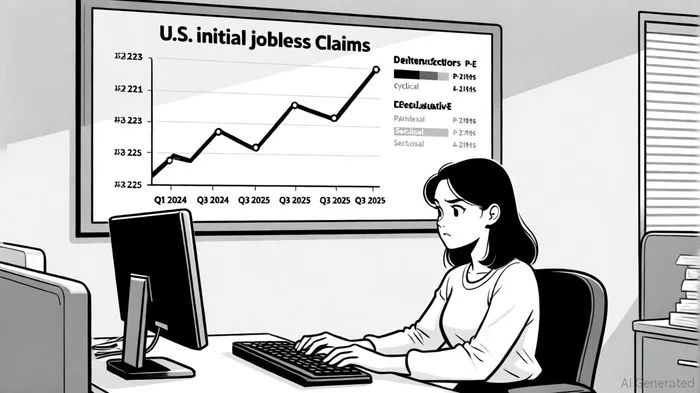
The U.S. labor market's recent stability, as evidenced by volatile but historically low jobless claims, has become a cornerstone of market stability in Q3 2025. While initial claims fell to 218,000 in early September—well below the 235,000 forecast—earlier spikes, such as the 263,000 reported in late August, reveal geographic and sectoral imbalances, particularly in manufacturing and services [1]. This duality underscores a labor market that, while resilient, is not immune to structural shifts. For investors, the implications are clear: defensive and cyclical sectors are poised for distinct rotations as economic resilience persists amid moderating growth.
Defensive Sectors: Utilities Outperform Healthcare Amid Uncertainty
Defensive sectors like utilities and healthcare have historically served as safe havens during periods of economic uncertainty. However, Q3 2025 data reveals a divergence in their performance. The SPDR Utilities ETF (XLU) has delivered a 4% year-to-date return with a 2.92% dividend yield, outperforming the flat performance of the SPDR Healthcare ETF (XLV), which yields just 1.73% [1]. This gap reflects utilities' unique positioning: regulated pricing models, essential demand, and growing infrastructure needs (e.g., grid modernization for AI and EV adoption) make them less sensitive to macroeconomic headwinds than healthcare, which faces biotech sector volatility and interest rate sensitivity [1].
Morningstar's analysis reinforces this trend, identifying utilities like Duke EnergyDUK-- and Edison InternationalEIX-- as undervalued plays with strong cash flow and defensive characteristics [2]. Meanwhile, healthcare's appeal remains tied to long-term demographics and innovation, but its near-term underperformance suggests investors are prioritizing sectors with more immediate cash flow visibility [1].
Cyclical Sectors: Financials and Industrials Navigate Mixed Signals
Cyclical sectors, including Financials and Industrials, have shown mixed performance in 2025. Financials, rated Marketperform by Schwab, have benefited from rising interest rates but face headwinds from trade policy uncertainties and potential slowdowns in consumer credit demand [2]. The sector's trailing 12-month return of 26.1% outpaces the S&P 500's 14.4% but lags in the six-month window (0.1%) [2]. Industrials, similarly rated Marketperform, have seen 18.9% growth over the past year but remain vulnerable to tariffs on critical inputs like steel and aluminum [2].
Despite these risks, cyclical sectors remain attractively valued compared to high-growth tech stocks. For instance, the Information Technology sector trades at a P/E ratio of 38.09 [2], reflecting elevated expectations for AI-driven earnings growth. However, this valuation premium comes with heightened volatility, making cyclical sectors more suitable for investors with a medium-term horizon and risk tolerance for macroeconomic fluctuations.
Strategic Sector Rotation: Balancing Resilience and Growth
The interplay between stable jobless claims and sector valuations suggests a strategic rotation toward defensive utilities and selectively positioned cyclical sectors. Defensive utilities, with their low P/E ratio of 21.17 [2] and steady dividends, offer a hedge against rising unemployment (projected to edge toward 4.8% in 2025 [1]). Cyclical Financials and Industrials, while more volatile, benefit from a resilient U.S. consumer and upwardly revised GDP forecasts (2.7% for 2024, 2.1% for 2025 [1]).
Investors should also consider the role of trade policy and AI-driven demand in shaping sector dynamics. For example, the manufacturing resurgence post-U.S. election has boosted Industrials, while tax cuts and deregulation have fueled optimism in Financials [1]. However, these gains are contingent on the resolution of global trade tensions, which remain a wildcard.
Conclusion: A Nuanced Approach to Sector Allocation
The U.S. labor market's stability—marked by low but uneven jobless claims—provides a foundation for market stability but does not guarantee immunity from sector-specific shocks. Defensive utilities and healthcare remain critical for income-focused portfolios, while cyclical Financials and Industrials offer growth potential for those willing to navigate macroeconomic risks. As the OECD notes, structural reforms and AI adoption will further shape sector trajectories, but for now, investors must balance resilience with growth in a landscape defined by moderation and uncertainty [1].





Comentarios
Aún no hay comentarios