
Implications of Rising US Consumer Credit Growth for Financial Sector Stocks
Risk Appetite and Credit Quality: A Delicate Balance
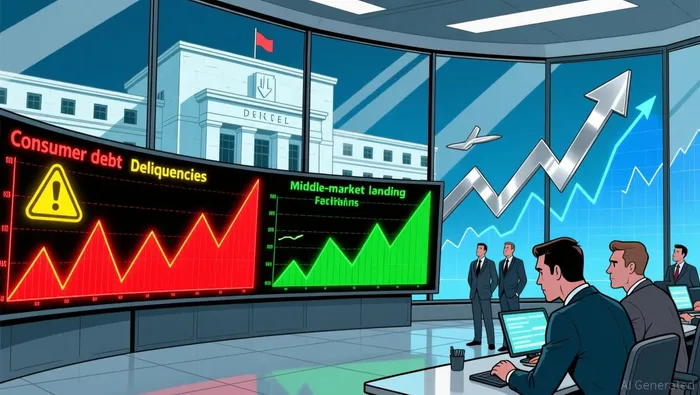
The expansion of consumer credit is not without its shadows. A 4.5% delinquency rate across all debt types, as noted in the New York Fed report, signals growing fragility in the credit ecosystem. This is particularly concerning for financial institutions, which must balance aggressive lending with prudence. For instance, Open Lending CorporationLPRO-- (LPRO) has adopted a more conservative approach, reducing certified loans to 23,880 in Q3 2025 from 27,435 a year earlier, while reporting a net loss of $7.6 million-a stark contrast to its prior-year profit, according to a nasdaq.com report. Such adjustments reflect a sector recalibrating risk appetite in response to tighter underwriting standards and economic uncertainty.
Conversely, entities like Morgan Stanley Direct Lending Fund (MSDL) have thrived in this environment. The fund reported $43.7 million in net investment income for Q3 2025, with a $3.776 billion portfolio spread across 218 middle-market companies, according to a StockTitan article. This divergence underscores the importance of strategic positioning: while some lenders retreat, others capitalize on niche markets where credit quality remains robust.
Lending Cycle Dynamics and Fed Policy: A Historical Lens
The Federal Reserve's role in shaping the financial sector's trajectory cannot be overstated. Historical data reveals that easing cycles-such as those in 2002-2003 and 2020-have often catalyzed sectoral gains by lowering borrowing costs and boosting liquidity. For example, during the 2020 pandemic-driven easing, the Fed's near-zero rate policy and asset purchases stabilized markets, enabling financial institutions to maintain credit flow despite economic turmoil, according to a Reuters report.
However, the 2024-2025 easing cycle is distinct. Fed officials, including St. Louis President Alberto Musalem, have emphasized a "modestly supportive" approach to financial conditions, prioritizing job market stability over aggressive stimulus, according to the Reuters report. This measured stance reflects a broader effort to avoid reigniting inflation while addressing rising unemployment. For financial stocks, this means a potential narrowing of net interest margins-a double-edged sword that could benefit risk-tolerant lenders but challenge those reliant on high-yield spreads.
Investment Positioning: Navigating the Fed's Tightrope
As the Fed edges toward easing, investors must weigh the sector's exposure to both cyclical and structural risks. Cyclical plays, such as regional banks and specialty lenders, may benefit from rate cuts that spur economic activity and loan demand. Conversely, structural risks-including persistent delinquencies and regulatory scrutiny-could weigh on broader financial indices like the KBW Bank Index (XLF).
A strategic approach might involve tilting toward high-conviction names like MSDL, which have demonstrated resilience in middle-market lending, according to the StockTitan article, while hedging against macroeconomic volatility. Additionally, investors should monitor the Fed's balance sheet normalization efforts, which could influence liquidity conditions and, by extension, credit availability.
Conclusion
The financial sector's response to rising consumer credit growth and potential Fed easing will hinge on its ability to balance risk and reward. While historical easing cycles offer a roadmap for optimism, the current environment demands vigilance. As the Fed walks its tightrope between inflation control and growth support, investors must remain agile-leveraging insights from past cycles while staying attuned to evolving credit dynamics.







Comentarios
Aún no hay comentarios