
The Implications of a Rising U.S. 3-Month Bill Bid-to-Cover Ratio for Short-Term Markets
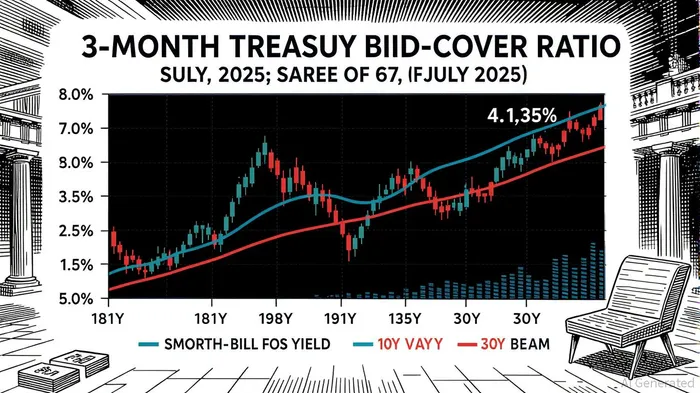
The U.S. , , signaling a seismic shift in short-term market dynamics [4]. This metric, which gauges the ratio of bids to securities offered at auctions, has become a barometer for investor confidence and liquidity demand. With the ratio now hovering near multi-year highs for short-term instruments, the implications for short-term markets—and the behavior of institutional players—are profound.
A Liquidity Magnet: The Bid-to-Cover Ratio and Money Market Rates
The surge in demand for 3-month bills reflects a flight to safety amid . According to a report by the U.S. Treasury, stable repo market financing and ample liquidity have underpinned this trend, with the bid-to-cover ratio remaining in “normal ranges” despite rising fiscal uncertainties [4]. However, the relationship between this ratio and liquidity metrics like bid-ask spreads is nuanced. While robust demand typically narrows spreads, recent volatility—such as the April 2025 spike in longer-term Treasury bid-ask spreads—suggests that broader market conditions, not just auction dynamics, dictate liquidity [3].
Money market rates, including the 3-month T-bill yield, have also been reshaped by this demand. , 2025, , as investors prioritize safety over returns [4]. This decline, coupled with a stable (SOFR), indicates that the market is pricing in a cautious outlook, with investors hedging against potential Fed rate cuts and inflationary pressures [4].
Institutional Behavior: Flight to Safety or Strategic Hedging?
The rise in the bid-to-cover ratio is not merely a liquidity story—it’s a behavioral one. Institutional investors, particularly those managing cash reserves or hedging against rate volatility, have flocked to short-term bills. A recent auction of 20-year Treasury bonds saw weak demand, , underscoring a stark preference for shorter maturities [2]. This shift aligns with broader fiscal concerns, including rising debt-servicing costs and the potential for Treasury supply shocks, which could destabilize longer-term markets [3].
Moreover, the post- (QE) environment has amplified deposit flightiness, with banks and money market funds rapidly reallocating cash to secure assets. As noted by the , this dynamic has created a “self-reinforcing cycle” where heightened liquidity needs drive demand for short-term Treasuries, further tightening repo markets and compressing yields [3].
Risks on the Horizon: Can the Trend Hold?
While the current bid-to-cover ratio suggests robust demand, structural challenges loom. Treasury issuance is growing to meet expanding fiscal needs, and if supply outpaces demand, the ratio could face downward pressure [3]. Additionally, the Federal Reserve’s potential rate cuts in late 2025 may reduce the yield advantage of short-term bills, prompting a rebalancing of portfolios toward riskier assets.
Investors must also contend with the “convenience yield” of holding cash. As highlighted by a 2025 study, the liquidity premium embedded in Treasury bills has widened, reflecting market participants’ willingness to pay for short-term safety [5]. However, this premium is not infinite. A sudden shift in risk appetite—triggered by a fiscal crisis or geopolitical shock—could reverse the trend, leaving short-term markets vulnerable to sharp repricing.
Conclusion: Navigating the New Normal
The U.S. 3-Month Bill Bid-to-Cover Ratio is more than a number—it’s a signal of market sentiment and liquidity health. For investors, the key takeaway is clear: short-term Treasuries remain a haven in uncertain times, but their dominance is contingent on fiscal discipline and monetary policy. As the Fed’s playbook evolves and Treasury issuance accelerates, the bid-to-cover ratio will serve as a critical early warning system for shifts in liquidity and risk appetite.
In the near term, a balanced approach—leveraging the safety of short-term bills while hedging against potential yield compression—is prudent. After all, in a world where liquidity can vanish faster than it appears, preparation is the best defense.
Source:
[1] Report to the Secretary of the Treasury from ... [https://home.treasury.gov/news/press-releases/sb0213]
[2] Will US fiscal worries continue to hit sentiment? [https://exante.eu/press/publications/2604-will-us-fiscal-worries-continue-to-hit-sentiment/]
[3] The Rise in Deposit Flightiness and Its Implications for Financial Stability [https://libertystreeteconomics.newyorkfed.org/2025/07/the-rise-in-deposit-flightiness-and-its-implications-for-financial-stability/]
[4] United States 3 Month Bill Yield - Quote - Chart [https://tradingeconomics.com/united-states/3-month-bill-yield]
[5] Liquidity of the treasury bill market and the term structure ... [https://www.sciencedirect.com/science/article/abs/pii/S0148619598000125]







Comentarios
Aún no hay comentarios