
The Implications of Rising 2-Year JGB Yields on Global Fixed Income Markets
The Japanese Government Bond (JGB) market has entered a new phase in 2025, marked by a steady rise in yields and shifting investor sentiment. The 2-year JGB yield, which stood at 0.93% on September 26, 2025, reflects a 0.02 percentage point increase over the past month and a 0.49 point rise compared to a year earlier, according to reports from Bloomberg, Reuters, and NHK. This upward trajectory, though modest relative to historical averages, signals a departure from the Bank of Japan's (BoJ) long-standing ultra-accommodative stance. The BoJ's recent decision to maintain its benchmark rate at 0.5% during the September 2025 meeting, coupled with its announcement to sell ETFs and REITs, underscores a cautious but evolving policy framework, according to the Bank of Japan.
Policy Divergence and the BoJ's Tightening Signals
The BoJ's gradual normalization of monetary policy has created a stark contrast with global central banks. While the U.S. Federal Reserve remains hesitant to cut rates amid inflationary pressures and geopolitical uncertainties tied to the incoming Trump administration, Reuters reported, the European Central Bank (ECB) and Bank of England (BoE) have pursued aggressive rate-cutting paths to stimulate stagnating economies, according to Statista. This divergence has amplified the appeal of carry trade strategies, where investors borrow in low-yielding JPY to fund higher-yielding assets in the U.S. and Europe.
However, the BoJ's recent actions suggest a tightening bias. The weak demand for Japan's 2-year bond auction—the lowest since 2009—has been interpreted as a market signal that investors are pricing in future rate hikes, as reported by Bloomberg, Reuters and NHK. Board member Asahi Noguchi's remarks, emphasizing the “increasing need to adjust the policy interest rate,” further reinforce this narrative, according to reporting from the same outlets. Such signals are critical for global fixed income markets, as they influence capital flows and currency dynamics.
Carry Trade Re-Emergence and Market Risks
The re-emergence of carry trade activity is evident in cross-currency swap volumes and investor positioning. As of Q3 2025, JPY cross-currency swaps have surged, with notional amounts reaching $14.2 trillion, driven by the yen's status as a low-cost funding currency, according to the BIS and Investing.com. The narrowing U.S.-Japan yield differential—projected to fall to 375 basis points by year-end—has, however, compressed the profitability of these trades.
Rising JGB yields also pose risks to the stability of the yen carry trade. The 40-year JGB yield hit 3.689% in May 2025, a record high, as the BoJ scaled back its bond-buying program, according to CNBC and OANDA. This has led to concerns about a potential unwind of the carry trade, particularly if the BoJ intervenes to curb further yield increases. A sudden unwinding could trigger global market volatility, as Japanese investors repatriate capital from U.S. equities and other foreign assets.
Global Fixed Income Implications
The BoJ's policy normalization is reshaping global fixed income markets. The steepening of Japan's yield curve, driven by declining demand from life insurers and foreign investors, has pushed term premiums to decade highs, according to S&P Global and DBS Bank. This dynamic is mirrored in other markets, where divergent central bank policies have led to steeper yield curves and heightened term premiums. For instance, the ECB's incremental rate cuts have supported European bond markets, while the Fed's cautious stance has kept U.S. yields elevated.
Investors are recalibrating their strategies in response to these shifts. Securities lending balances in the JGB market have risen as investors adopt strategies to capitalize on higher yields, while repo balances have declined due to economic uncertainties, according to S&P Global and DBS Bank. The yen's strengthening, fueled by its safe-haven status and rising yields, has also introduced currency risk into carry trade portfolios, a trend noted by BIS and Investing.com.
Conclusion
The interplay of rising JGB yields and global policy divergence is creating both opportunities and risks for fixed income markets. While the BoJ's gradual tightening has reinvigorated carry trade activity, the potential for a sudden unwind remains a critical concern. Investors must navigate a landscape where central bank signals, yield differentials, and currency volatility are inextricably linked. As the BoJ continues to balance its dual mandate of price stability and financial market stability, global markets will remain on edge, awaiting the next move in this evolving policy narrative. 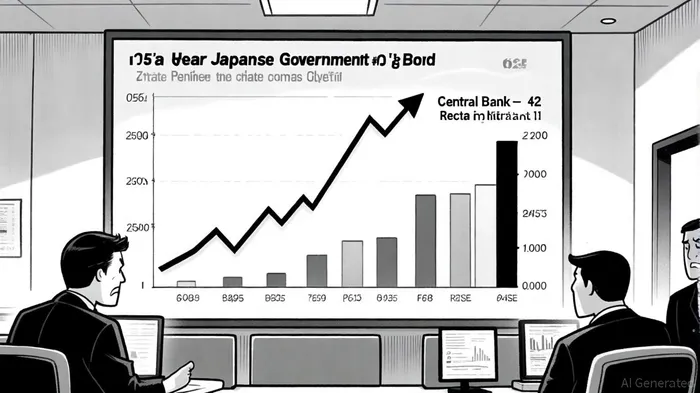







Comentarios
Aún no hay comentarios