
The Implications of a Rising 10-Year TIPS Yield in a Shifting Inflation Landscape
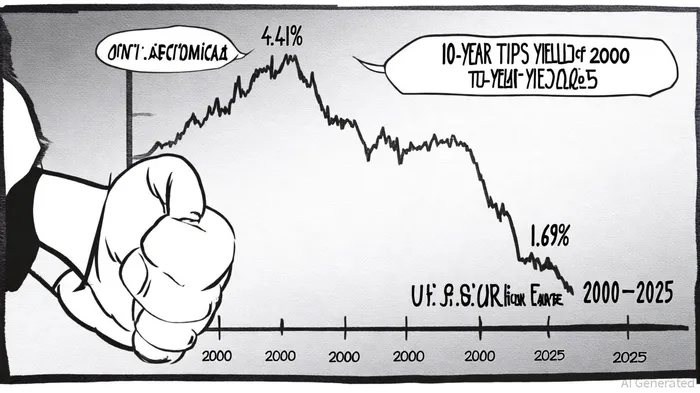
The 10-Year Treasury Inflation-Protected Securities (TIPS) yield has long served as a barometer for inflation expectations and real interest rate trends. As of September 9, 2025, the 10-Year TIPS yield stood at 1.71%, a marginal increase of 0.02 percentage points from the prior session but a 0.16-point decline over the past month [1]. This figure, while modestly higher than its year-ago level, reflects a broader narrative of shifting inflation dynamics and evolving investor sentiment.
The TIPS Yield and Inflation Expectations: A Delicate Balance
The TIPS yield is derived by subtracting the inflation breakeven rate from the nominal Treasury yield. For the 10-Year TIPS auctioned in early September 2025, the real yield of 1.69% corresponded to a nominal Treasury yield of 4.06%, resulting in an inflation breakeven rate of 2.37% [2]. This breakeven rate implies that investors would require inflation to average over 2.37% over the next 9 years and 10 months for TIPS to outperform nominal Treasuries.
Historically, U.S. inflation has averaged 3.1% over the past decade [2], yet the current breakeven rate remains anchored near 2.37%. This discrepancy suggests that market participants may be underestimating future inflation risks or factoring in the Federal Reserve's aggressive policy tightening and recent signals of potential rate cuts. Analysts note that real yields could continue to decline into 2026 if economic weakness materializes, though some caution that the current selloff in real yields may be overdone [2].
Historical Context and Market Signals
The 10-Year TIPS yield has exhibited significant volatility over the past two decades. In January 2000, it reached an all-time high of 4.41%, reflecting a period of economic exuberance and low inflationary pressures [3]. By contrast, the yield has trended lower in recent years, with the September 2025 reopening auction marking a two-year low. This decline aligns with broader trends in real yields, which have been pressured by expectations of prolonged low inflation and accommodative monetary policy.
The inflation breakeven rate itself has stabilized at 2.37%, consistent with the long-term average of 2.10% [5]. However, this figure contrasts sharply with the inflationary spikes observed in 2021–2022, when the U.S. inflation rate peaked at 8.0% [4]. The current stabilization of inflation at 2.9% as of August 2025 [4] has reinforced investor confidence in the Fed's ability to manage price pressures, even as structural risks—such as supply chain fragility and fiscal stimulus—persist.
Strategic Implications for Investors
The interplay between TIPS yields and inflation expectations carries critical implications for bond market participants. A declining real yield environment, as seen in recent months, suggests that investors are increasingly favoring nominal Treasuries unless inflation accelerates. However, the historical gap between the 10-year average inflation rate (3.1%) and the current breakeven rate (2.37%) indicates a potential mispricing. If inflation reaccelerates—even modestly—TIPS could outperform nominal bonds, rewarding those who position for inflation resilience.
Conversely, a prolonged period of low inflation or deflationary shocks could erode the value of nominal Treasuries, making TIPS a more attractive hedge. Analysts project the 10-Year TIPS yield to trade at 1.69% by the end of 2025 and 1.65% in 12 months [1], suggesting a bearish outlook for real yields. Investors must weigh these projections against macroeconomic risks, including a potential U.S. recession or renewed inflationary surges driven by geopolitical tensions.
Conclusion
The 10-Year TIPS yield remains a pivotal indicator for gauging inflation expectations and real rate dynamics. While current data points to a subdued inflation outlook and declining real yields, historical volatility underscores the importance of maintaining a balanced portfolio. As the Fed navigates a shifting economic landscape, investors must remain vigilant to both inflationary and deflationary risks, leveraging TIPS as a strategic tool to hedge against uncertainty.







Comentarios
Aún no hay comentarios