
The Implications of Revised Jobs Growth on Equity Sectors and Cyclical Plays
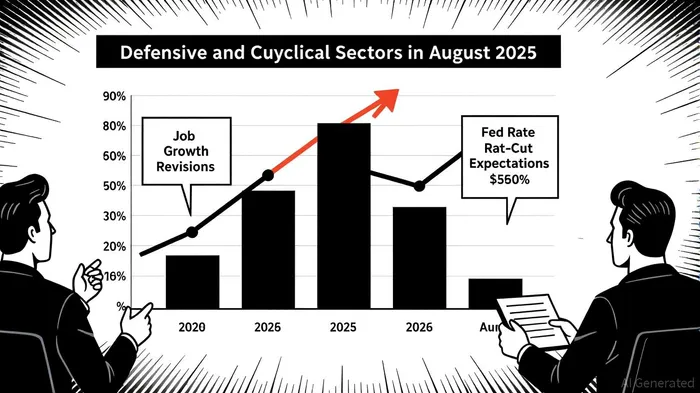
The U.S. labor market has entered a period of profound recalibration. The August 2025 jobs report, which added a paltry 22,000 nonfarm payrolls, has shattered previous assumptions about economic resilience. This figure, coupled with downward revisions to prior months—most notably a 911,000-job markdown for the year ending March 2025—reveals a labor market that is not merely slowing but structurally weakening[1]. The implications for equity sectors are stark, as investors grapple with a shifting landscape of risk and opportunity.
A Labor Market in Structural Retreat
The revised data paints a picture of a labor market caught in a "no-hire, no-fire" equilibrium[2]. Sectors like leisure and hospitality, professional services, and retail have seen sharp contractions, with 176,000, 158,000, and 126,200 jobs erased from historical totals, respectively[1]. This is not cyclical weakness but a reallocation shock, akin to the pandemic's abrupt disruption of labor flows. Unlike the 2008 financial crisis, where policy interventions preserved jobs through liquidity injections, today's labor market is constrained by structural mismatches—skills gaps, automation, and a reluctance to hire amid trade policy uncertainty[3].
The Federal Reserve, now facing mounting pressure to cut rates, is caught between its dual mandate of price stability and maximum employment. With inflation easing and unemployment edging toward 4.3%—its highest since late 2021—the Fed's September 2025 rate cut is increasingly inevitable[4]. Such cuts typically favor rate-sensitive sectors, yet the broader economic context complicates this dynamic.
Sector Rotation: Defensive Tilts and Cyclical Caution
The equity market's response to the jobs slump has been a textbook defensive rotation. Healthcare, which added 31,000 jobs in August, has attracted institutional capital, with stocks like UnitedHealth GroupUNH-- and CenteneCNC-- seeing significant inflows[5]. This sector's long-duration cash flows and inelastic demand make it a natural haven in a "rolling recession" environment, where different sectors face downturns at staggered intervals[6]. Similarly, utilities and consumer staples—sectors with stable dividends and low sensitivity to economic cycles—have gained traction as investors prioritize income over growth.
Cyclical sectors, however, face headwinds. Energy stocks, down 2.4% in August, are caught in a dual bind: falling oil prices and reduced consumer demand[5]. Financials861076--, which rely on net interest margins and loan growth, have also faltered, with outflows accelerating as rate-cut expectations rise[5]. Even industrials and construction, traditionally resilient during accommodative monetary policy, have underperformed, reflecting broader economic fragility.
The S&P 500's forward P/E ratio of 30, well above its 10-year average, underscores the market's premium valuation. Yet cyclical stocks trade at a discount (19.2 forward P/E), suggesting potential for outperformance if the Fed's rate cuts spur a "rolling recovery" in 2026[7]. However, this hinges on the Fed's ability to balance rate cuts with inflation control—a tightrope walk that could yet destabilize market sentiment.
Historical Parallels and Strategic Lessons
History offers cautionary tales. During the 2008 financial crisis, central banks prioritized liquidity over labor market support, preserving financial stability but leaving workers vulnerable. In contrast, the 2020 pandemic saw aggressive job retention schemes, which mitigated long-term scarring but created a mismatch between vacancies and unemployment[3]. Today's labor market resembles a hybrid of both: structural distortions (skills gaps, automation) are compounding cyclical weakness, creating a "rolling recession" where no sector is immune.
Strategic sector rotation must account for this complexity. Defensive positioning in healthcare and utilities remains prudent, but investors should also consider small-cap and value stocks, which historically outperform in low-rate environments[8]. International diversification is another key lever, as U.S.-centric risks—tariffs, political tensions—continue to distort domestic growth.
The Road Ahead
The Fed's September rate cut will likely provide a short-term boost to rate-sensitive sectors like housing and utilities. However, the broader market's trajectory depends on whether the labor market can transition from a "rolling recession" to a "rolling recovery." Early signs are mixed: corporate earnings revisions have stabilized, and AI-driven productivity gains are creating new growth pockets in technology[6]. Yet the risk of a prolonged "no-hire, no-fire" equilibrium remains, particularly in sectors vulnerable to automation and trade policy shifts.
For investors, the path forward is one of disciplined rotation. Defensive sectors will remain in favor until labor market data shows consistent improvement. Cyclical plays, while undervalued, should be approached with caution—reserves for volatility are essential. As always, the key lies in balancing macroeconomic signals with micro-level fundamentals, a task made more urgent by the Fed's evolving policy calculus.







Comentarios
Aún no hay comentarios