
The Implications of the Pump.fun $400M USDC Cash-Out for Crypto Project Due Diligence
The Illusion of Tokenomics: A Double-Edged Sword
Pump.fun's tokenomics appear designed to incentivize long-term participation. The $PUMP token has a fixed supply of 1 trillion, with 55% in circulation as of July 2025 and 44% locked in team and investor wallets. A 20% allocation to the core team and 13% to venture capital firms like Framework Ventures and Anagram suggest a balance between founder control and external validation. However, the vesting schedules for these locked tokens-10 billion PUMP tokens unlocked monthly until July 2029-create a ticking clock for investors.
The team's Q3 2025 buyback of 3 billion tokens, intended to stabilize the price, failed to reverse its decline. This highlights a fundamental flaw in tokenomics: even well-structured models can falter when team actions contradict stated goals. The $400M USDC cash-out, which occurred without public announcement, further eroded trust. Investors who had assumed the team's long-term commitment to the project were left questioning whether the vesting schedules were ever a genuine constraint or merely a public relations tool.
On-Chain Transparency: The New Baseline for Trust
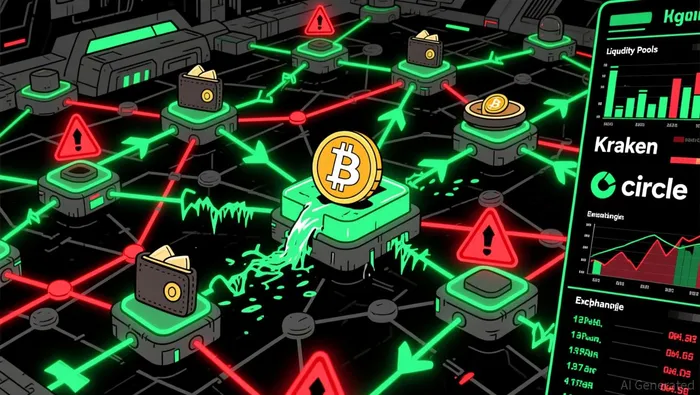 The Pump.fun cash-out was only exposed through on-chain analytics platforms like Lookonchain, which tracked the movement of funds from Kraken to Circle. This transparency, while critical, was reactive rather than proactive. For investors, the lesson is clear: projects must provide real-time visibility into treasury movements and token allocations.
Consider the contrast with XRPXRP--, where on-chain data revealed that barely half of the circulating supply remained in profit, exacerbating selling pressure during the liquidity crisis. In Pump.fun's case, the absence of official communication for over a week after the cash-out compounded the damage. Retail investors, often reliant on social media for updates, were left in the dark while institutional actors-presumably aware of the withdrawals-adjusted their positions accordingly.
Investor Due Diligence: Beyond the Whitepaper
The Pump.fun sagaSAGA-- demonstrates that traditional due diligence-reviewing tokenomics, team backgrounds, and use cases-is insufficient. Investors must now incorporate on-chain analytics into their evaluation frameworks. Key questions include:
1. Token Unlock Schedules: Are large token sales or unlocks imminent? How might they impact price?
2. Treasury Movements: Is the project's treasury being managed transparently? Are there signs of liquidity extraction?
3. Team Activity: Do on-chain actions (e.g., token sales, wallet activity) align with public statements?
For Pump.fun, the answer to all three questions was troubling. The team's ability to execute a $400M cash-out without triggering alarms suggests a lack of accountability mechanisms. This is particularly concerning given that 2.6% of $PUMP tokens are reserved for liquidity and exchanges, a feature that could be exploited for further exits.
Regulatory Scrutiny and the Future of Crypto Projects
The Pump.fun cash-out has not gone unnoticed by regulators. The ongoing class-action lawsuit and the SEC's past investigations into FTX signal a growing appetite for oversight in the crypto space. Projects that fail to demonstrate transparency-whether through delayed disclosures or opaque treasury management-risk falling into the same regulatory crosshairs.
This scrutiny is not unwarranted. The FTX collapse in 2022 revealed how centralized control and lack of transparency could lead to systemic risks. Pump.fun's actions, while not yet catastrophic, echo similar patterns of behavior. For institutional investors, the takeaway is clear: regulatory compliance and transparency are no longer optional-they are prerequisites for survival.
Conclusion: A Call for Proactive Vigilance
The Pump.fun $400M USDC cash-out is a wake-up call for the crypto community. It illustrates how even projects with robust tokenomics and high-profile backers can become high-risk investments when transparency and governance falter. For investors, the path forward requires a shift from passive participation to active scrutiny.
On-chain analytics tools must become standard in due diligence processes, and projects must be held to account for their actions-not just their promises. As the crypto ecosystem matures, the line between innovation and recklessness will be defined by those who prioritize transparency over opacity. Pump.fun's story is not just a cautionary tale-it's a blueprint for what to avoid.






Comentarios
Aún no hay comentarios