
The Implications of the November WTI Crude Oil Price Drop for Energy Sector Investments
The Implications of the November WTIWTI-- Crude Oil Price Drop for Energy Sector Investments
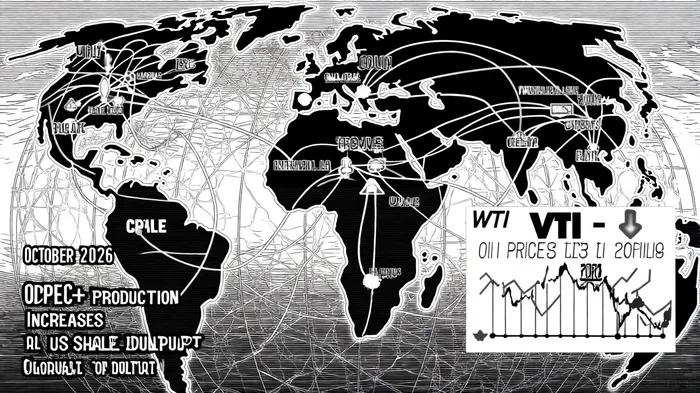
The November 2025 collapse in West Texas Intermediate (WTI) crude oil prices-settling at $60.48 per barrel, the lowest since May-has sent shockwaves through the energy sector. This decline, driven by a structural imbalance between supply and demand, underscores the need for strategic repositioning in energy commodities. As of October 2025, WTI trades at $61.70, with the U.S. Energy Information Administration (EIA) forecasting a further drop to $50 per barrel by early 2026 in its Short-Term Outlook. The primary culprits are accelerated OPEC+ production unwinding, surging U.S. shale output, and sluggish demand recovery in key markets, according to a Morgan Stanley outlook.
Structural Imbalances and Market Reactions
The current price slump reflects a fundamental shift in global oil dynamics. OPEC+'s anticipated production increase of 500,000 barrels per day, coupled with U.S. output hitting 13.6 million barrels per day in July 2025, has exacerbated oversupply concerns. Meanwhile, global oil inventory builds are projected to average over 2 million barrels per day through Q1 2026, compounding downward pressure. While geopolitical tensions-such as Ukraine's actions against Russian oil infrastructure-introduce short-term volatility, the overarching trend remains bearish according to the EIA.
Market participants are already recalibrating. For instance, energy infrastructure master limited partnerships (MLPs) have gained traction as stable income generators, insulated from direct commodity price swings, a point highlighted in the Morgan Stanley outlook. Similarly, natural gas is emerging as a critical pivot point, buoyed by AI-driven data center demand and U.S. exports to the EU, as discussed in the same Morgan Stanley outlook.
Strategic Positioning in a Volatile Landscape
Investors must adopt a dual approach: hedging against near-term risks while capitalizing on long-term structural shifts.
1. Diversification into Resilient Subsectors
Natural gas and clean energy are prime candidates. Natural gas demand is surging due to its role in powering AI data centers and replacing Russian imports in Europe, a trend noted by Morgan Stanley. Nuclear energy, too, is gaining momentum, supported by policy incentives and AI-driven power demands. Morgan Stanley also highlights energy infrastructure MLPs as a hedge against inflation, given their steady cash flows from transportation and storage.
2. Hedging Strategies for Price Volatility
Futures, options, and collars are essential tools. For example, costless collars-combining put and call options-allow producers to lock in price floors without upfront costs, as detailed in an oil hedging guide. Producers should prioritize hedging volumes tied to critical financial obligations rather than speculative bets.
3. Lessons from the 2020 Crash
The 2020 oil price crash, marked by negative WTI prices, offers cautionary tales. Debt-light firms like EOG ResourcesEOG-- and integrated majors such as ExxonMobil fared better due to stronger balance sheets, a point illustrated in a Nasdaq analysis. Today, similar logic applies: prioritize companies with manageable leverage and diversified revenue streams. Midstream MLPs, with their long-term contracts, remain less vulnerable to price swings.
The Road Ahead
While lower oil prices offer short-term relief for consumers and central banks, they pose existential risks for oil-dependent economies like Saudi Arabia. The EIA warns that fiscal strains could force policy recalibrations, potentially reshaping OPEC+ dynamics. For investors, the key lies in balancing exposure to cyclical oil markets with growth in resilient subsectors.
Conclusion
The November 2025 WTI price drop is not an isolated event but a symptom of deeper structural shifts. By diversifying into natural gas, energy infrastructure, and clean technologies while employing disciplined hedging, investors can navigate volatility with strategic clarity. As history shows, adaptability-not speculation-will define success in this new energy era.





Comentarios
Aún no hay comentarios