
The Implications of Mass Liquidations and ETF Outflows for Bitcoin's Near-Term Trajectory
ETF Outflows and Inflows: A Tale of Two Weeks
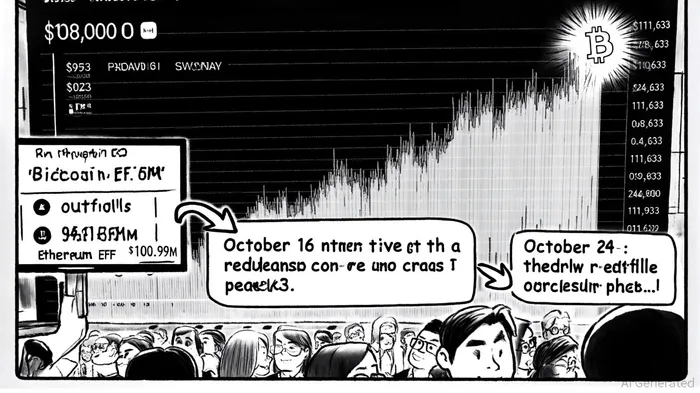
Bitcoin ETFs have emerged as a cornerstone of institutional participation in the crypto market. However, October 2025 has been a rollercoaster. In early October, spot Bitcoin ETFs faced a wave of redemptions, with $1.23 billion in outflows reported last week, including a record $536 million in single-day withdrawals on October 16, according to a Coinotag report. That exodus-driven by profit-taking and macroeconomic jitters-exerted downward pressure on Bitcoin's price, which hovered near $108,000 and struggled against resistance at $110,500, Coinotag noted.
Yet, by late October, the narrative shifted. On October 24, Bitcoin ETFs saw a surge in inflows totaling $90.6 million, led by BlackRock's IBIT and Fidelity's FBTC, marking the end of a five-day outflow streak in a TradingNews report. This reversal coincided with Bitcoin climbing to $111,633, signaling renewed institutional demand. BlackRock's IBIT alone reported $324.3 million in inflows for the week ending October 24, according to an FXEmpire analysis, reinforcing its dominance in the Bitcoin ETF space with $89.17 billion in AUM, TradingNews later summarized.
The contrast between EthereumETH-- and Bitcoin ETF flows is telling. While Bitcoin ETFs attracted capital, Ethereum ETFs continued to hemorrhage, with BlackRock's ETHA ETF leading withdrawals at $100.99 million during the same period, TradingNews reported. This divergence underscores Bitcoin's growing role as a store of value, particularly as macroeconomic factors-such as expectations of Fed rate cuts and easing inflation-reshape investor priorities, as FXEmpire wrote.
Mass Liquidations: Separating Signal from Noise
Mass liquidations in October 2025 highlight the fragility of leveraged positions in the crypto market. On October 10, on-chain analytics revealed $2.31 billion in actual liquidation losses across Bitcoin and Ethereum, far below the widely reported $19 billion in nominal leveraged positions, according to a Coinotag on-chain analysis. This discrepancy, attributed to the U.S. government's 100% tariff announcement on Chinese imports, underscores the importance of distinguishing between theoretical exposure and real-world outcomes, as highlighted in a BitPinas list of large liquidations.
While the tariff event triggered fears of supply chain disruptions and economic instability, Bitcoin's price resilience-stabilizing around $110,000-suggests that leveraged positions may be less systemic than feared, a conclusion supported by a Coinotag study on ETF outflows. Historical data from Glassnode indicates that such outflows often precede stabilization and eventual price recoveries, offering cautious optimism for the future, as the Coinotag study also observed.
Market Structure and Sentiment Dynamics
The ETF-driven liquidity boom has fundamentally altered Bitcoin's market structure. Average daily realized volatility has dropped from 62% in July to 39% in October 2025, TradingNews reported, reflecting a more mature and institutionalized market. Bitcoin spot ETF assets now represent $149.96 billion, or 6.78% of Bitcoin's total market capitalization, a figure TradingNews highlighted that signals deepening institutional integration.
Regulatory developments further reinforce this trend. The SEC's review of 155 pending crypto ETF applications, noted by TradingNews, signals growing legitimacy for Bitcoin as an asset class, attracting capital from traditional investors who previously shunned the space. Meanwhile, strategic acquisitions like FalconX's purchase of 21shares have enabled European firms to expand into the U.S., intensifying competition with BlackRockBLK-- and Fidelity, according to Coinotag coverage.
The Road Ahead: Caution and Opportunity
Bitcoin's near-term trajectory hinges on balancing caution with opportunity. While ETF outflows in late October reflected short-term uncertainties-such as the Fed's FOMC meeting and Q3 earnings season-historical patterns suggest these outflows may precede a rebound, as the Coinotag study observed. The market's higher lows (trading well above $70,000 levels from earlier in 2025), the Coinotag study further noted, indicate long-term strength, even as volatility persists.
For investors, the key takeaway is clear: Bitcoin's market structure is evolving toward greater stability and institutional adoption. ETFs are not just liquidity providers but also stabilizers, reducing volatility and attracting capital from traditional markets. While mass liquidations and outflows remain risks, they also present opportunities for disciplined investors to capitalize on undervalued positions.
As the SEC's regulatory review progresses and institutional players continue to consolidate, Bitcoin's trajectory will likely be shaped by a combination of macroeconomic shifts, ETF dynamics, and evolving sentiment. The coming months will test the market's resilience, but the underlying fundamentals-strong institutional demand, reduced volatility, and regulatory progress-suggest a path toward renewed growth.





Comentarios
Aún no hay comentarios