
The Implications of U.S. Labor Data Integrity on Inflation and Equity Valuations
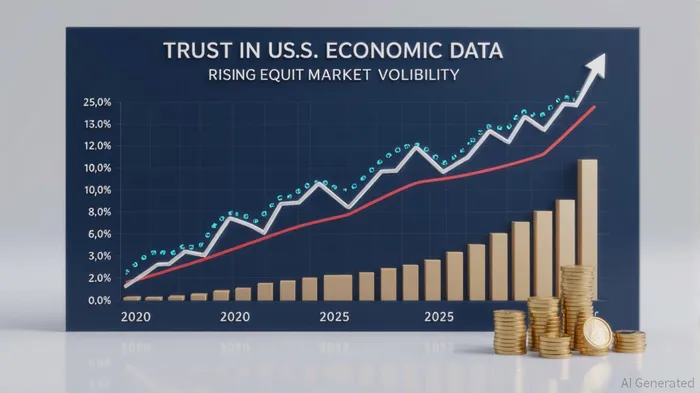
The reliability of U.S. labor statistics has long been a cornerstone of economic policymaking and financial market stability. However, under the Trump administration's second term, concerns about the integrity of these data have intensified, raising critical questions about their implications for inflation expectations and equity valuations. Recent events, including the abrupt removal of Bureau of Labor Statistics (BLS) commissioner Erika McEntarfer in August 2025 and the nomination of E.J. Antoni—a conservative economist affiliated with the Heritage Foundation—have fueled fears of politicization and eroded confidence in the agency's independence. These developments, coupled with staffing cuts and operational constraints at the BLS, threaten to distort the very metrics that guide monetary policy and investor decisions[1].
Labor Data Integrity: A Fractured Foundation
The BLS, which has historically maintained a reputation for methodological rigor, now faces unprecedented scrutiny. According to a report by The New York Times, the firing of McEntarfer followed the release of a jobs report that showed a weaker labor market than expected, with only 22,000 jobs added in August 2025 and an unemployment rate of 4.3%[2]. Critics argue that the administration's actions—such as replacing McEntarfer with Antoni, who has publicly criticized the BLS for “politically biased numbers”—signal a broader effort to align economic data with political narratives[3].
Compounding these concerns are structural challenges at the BLS, including a 15% workforce reduction under Trump's tenure[4]. Such cuts risk operational inefficiencies and sampling biases, particularly in an era of rapid labor market shifts, such as the decline in workforce participation and the rise of gig economy jobs. As The Guardian notes, the erosion of institutional capacity at the BLS could lead to data revisions that further destabilize economic forecasts[5].
Inflation Expectations: A Ticking Time Bomb
The integrity of labor data is inextricably linked to inflation expectations, which are critical for both monetary policy and asset pricing. The BLS's Consumer Price Index (CPI), a key inflation gauge, relies on accurate labor market data to contextualize wage growth and consumer demand. However, the politicization of labor statistics risks creating a feedback loop: if investors lose trust in the reliability of CPI data, they may overcorrect for inflation risk, driving up hedging costs and distorting market signals.
A case in point is the $2.1-trillion Treasury Inflation-Protected Securities (TIPS) market, which directly ties payouts to BLS data. As Reuters highlights, the August 2025 jobs report—which showed a 900,000 downward revision in job additions over 12 months—sparked a spike in 10-year TIPS yields to 1.864%, reflecting heightened inflation risk premiums[6]. This shift underscores how perceived data manipulation can force investors to demand higher compensation for uncertainty, even in the absence of concrete evidence of bias.
Moreover, the Trump administration's aggressive tariff policies and immigration restrictions have added fuel to the inflationary fire. According to a Bloomberg analysis, every 100-basis-point increase in effective tariff rates could push inflation higher by 10 basis points[7]. With U.S. tariffs now at Depression-era levels, the risk of persistent inflation—exacerbated by unreliable labor data—poses a dual threat to both consumers and businesses.
Equity Valuations: A Market in Perpetual Doubt
Unreliable labor data also casts a shadow over equity valuations. Investors rely on labor metrics to gauge corporate earnings potential and consumer spending power. When data integrity is compromised, as seen in the August 2025 jobs report, markets react with heightened volatility. CNN reports that the revelation of a 22,000-job gain—a stark contrast to earlier projections—triggered a sell-off in equities, particularly in sectors sensitive to labor demand, such as retail and manufacturing[8].
The politicization of the BLS further complicates the Federal Reserve's ability to anchor inflation expectations. By publicly criticizing the Fed's leadership and advocating for rate cuts based on contested labor data, the administration has introduced uncertainty into monetary policy. This ambiguity forces investors to hedge against a range of scenarios, from aggressive Fed tightening to prolonged accommodative policies, both of which can destabilize equity valuations.
Investor Strategies in a Shifting Landscape
For investors, the erosion of trust in U.S. labor data necessitates a recalibration of risk management strategies. Diversifying hedging instruments—such as increasing allocations to commodities, real assets, and alternative inflation-linked securities—can mitigate exposure to data-driven volatility. Additionally, monitoring non-official data sources, such as private-sector employment surveys and real-time wage tracking platforms, may provide more reliable signals in an environment of institutional doubt[9].
Policymakers, meanwhile, must address the root causes of data integrity concerns. Restoring public confidence in the BLS requires not only insulating the agency from political interference but also modernizing its methodologies to capture the complexities of today's labor market. Failure to do so risks perpetuating a cycle of economic uncertainty that could have long-term repercussions for both inflation and equity markets.
Conclusion
The Trump administration's second term has exposed vulnerabilities in the U.S. economic data infrastructure, with labor statistics at the epicenter of the crisis. As inflation expectations and equity valuations become increasingly decoupled from reliable data, investors must navigate a landscape defined by uncertainty and political risk. The path forward demands a renewed commitment to data integrity—not just for the sake of economic stability, but for the credibility of democratic institutions themselves.







Comentarios
Aún no hay comentarios