
The Implications of Declining Canadian Retail Sales for Consumer Discretionary Sectors
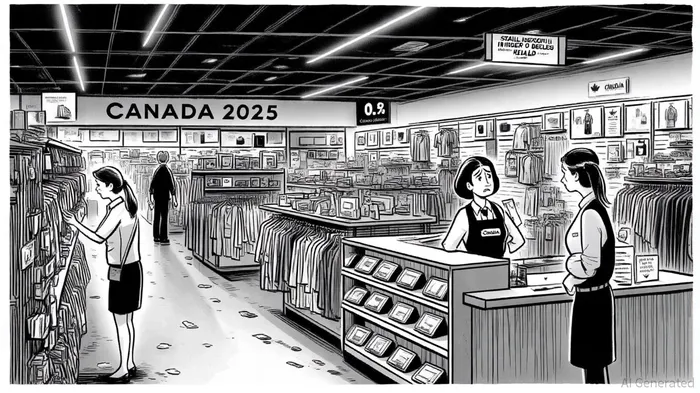
The Canadian retail sector is navigating a turbulent landscape in 2025, marked by sharp declines in discretionary spending and a fragile rebound in staples. Retail sales fell by 0.8% month-on-month in July 2025, driven by steep declines in food and beverage (-1.3%) and clothing subsectors[1]. While August data showed a 1.0% rebound[2], the broader trend underscores a shift in consumer behavior toward essentials, driven by trade tensions, inflation, and economic uncertainty. For investors, this divergence between discretionary and staples sectors demands a strategic reallocation of capital.
The Discretionary Sector: A Tale of Mixed Resilience
Discretionary spending categories have shown uneven performance. Dining, for instance, defied expectations with a 7.7% quarterly gain, reflecting pent-up demand for in-person experiences[3]. However, travel spending—particularly cross-border U.S. travel—has contracted consistently, with 55% of consumers expressing reluctance to fly for vacations in Q3 2025[4]. Apparel and air travel face additional headwinds: spending intentions for apparel hit a five-quarter low, while air travel demand softened as price sensitivity rose[5].
The Stifel consumer survey further highlights the sector's fragility: only 50% of Canadians plan to increase discretionary spending in the next 12 months, a 600-basis-point drop from January 2025[6]. This decline spans all age groups and income levels, signaling widespread economic caution. Even resilient categories like pet care and dollar stores are outliers; 76% of consumers plan to boost pet-related spending, while discount retailers attract 74% of respondents[7].
Staples Outperform as Defensive Play
In contrast, the consumer staples sector has demonstrated resilience. Core staples sales—excluding gas and autos—fell by 1.2% in July[1], but annualized earnings growth for the sector is projected at 8.3%[8]. Companies like Alimentation Couche-Tard and The North West Company (TSX:NWC) have outperformed, with the latter reporting 4.9% same-store sales growth in Q3 2025[9]. The sector's market cap of CA$229.3 billion as of September 2025 reflects investor confidence in its defensive nature[10].
Trade tensions have accelerated a "Buy Canadian" shift, particularly in fast-moving consumer goods (FMCG). Nearly half of Canadian consumers now prioritize domestic products[11], a trend amplified by U.S. tariffs on Canadian exports. While exports to the U.S. fell 12.5% year-over-year in June[12], domestic demand for staples has remained robust. This dynamic is evident in grocery sales, which grew 6.78% year-over-year in Q3 2025[13], despite convenience stores declining by 7.7%[14].
Capital Reallocation: A Strategic Imperative
Investment flows in Q3 2025 underscore a clear shift toward staples. The Vanguard Consumer Staples ETF gained over 5% in 2025[15], while the Consumer Discretionary Select Sector SPDR ETF fell nearly 7%[16]. Analysts at BMOBMO-- Private Wealth recommend underweighting staples due to stretched valuations but caution that discretionary sectors remain vulnerable to macroeconomic volatility[17].
Corporate strategies also reflect this reallocation. Retailers like Canadian Tire and Loblaw are leveraging their dominance in essential goods and health services to offset discretionary declines[18]. Meanwhile, discount retailers are capitalizing on shifting demographics, with higher-income households increasingly driving dollar store spending[19].
Conclusion: Prioritizing Defensive Exposure
The Canadian retail landscape in 2025 is defined by divergent trajectories. While discretionary sectors face headwinds from trade tensions and consumer caution, staples offer a buffer against macroeconomic shocks. For investors, the case for reallocating capital to defensive staples is compelling—particularly as the Bank of Canada projects a 2.6% GDP drag from U.S. tariffs[20]. As the Retail Council of Canada notes, 83% of retailers achieved margin gains through inventory discipline in 2025[21], a trend likely to favor staples over discretionary plays.
In this environment, a strategic tilt toward staples—while monitoring for valuation extremes—appears well-positioned to navigate the uncertainties of 2025 and beyond.







Comentarios
Aún no hay comentarios