
The Implications of Coinbase Delisting a Major Ethereum DeFi Token
Centralized Exchange Influence on DeFi Liquidity and Investor Sentiment
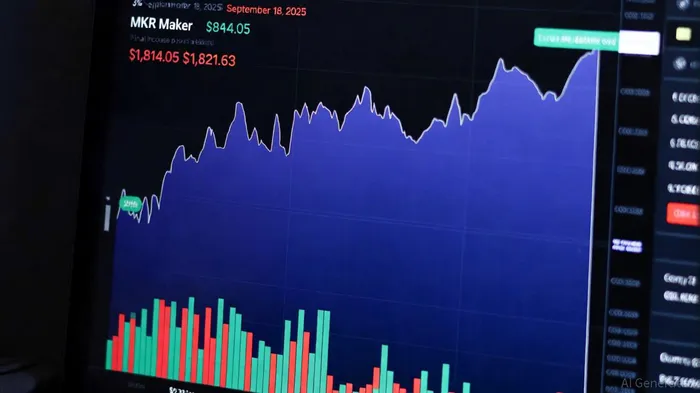
Coinbase's delisting of the MKR-PERP perpetual futures contract on September 18, 2025, underscores the profound influence centralized exchanges (CEXs) wield over decentralized finance (DeFi) ecosystems. By removing trading pairs that no longer meet its compliance or technical standards, CoinbaseC-- not only reshapes liquidity dynamics but also amplifies investor sentiment—often with immediate and volatile consequences. This analysis explores the implications of such actions, using MKR's delisting as a case study.
Price Volatility and Rebranding Catalysts
The delisting of MKR-PERP, which settled open positions at $1,814.05[1], coincided with a 3% price surge in the spot market to $1,821.63[2]. This counterintuitive rally highlights the dual-edged nature of delistings: while they reduce short-term liquidity, they can also trigger bullish reactions if perceived as catalysts for rebranding or token upgrades. In MKR's case, the delisting aligned with MakerDAO's transition to Sky Protocol (SKY), a 1:24,000 token swap that rebranded governance rights[4]. Investors interpreted the delisting as a strategic move to consolidate value, driving speculative buying ahead of the migration.
However, not all delistings yield positive outcomes. For example, Coinbase's removal of MOBILE, RNDR, RBN, and SYN in June 2025 led to double-digit price drops, with SYN plummeting nearly 15%[4]. These divergent responses underscore how investor sentiment hinges on the perceived intent behind delistings—whether as compliance-driven pruning or signals of project obsolescence.
Liquidity Metrics: A Quantitative Shift
Liquidity metrics reveal the tangible impact of delistings. Prior to the MKR-PERP delisting, Coinbase's order book for MKR/USD showed 65% buy volume on September 18[1]. By September 19, this dropped to 56%, and by September 20, to 52%, reflecting a gradual erosion of buyer confidence[1]. Total trading volume also halved, from 560 on the 18th to 266 on the 19th[1]. Such declines exacerbate slippage and widen bid-ask spreads, particularly for large orders, as order book depth diminishes[3].
This liquidity contraction is not unique to MKRMKR--. When Coinbase delisted older versions of tokens like RNDR (replaced by Solana-based RENDER), trading activity migrated to alternative platforms, but not all exchanges could absorb the displaced volume[2]. The result is a fragmented market where liquidity becomes increasingly concentrated on fewer venues, heightening systemic risks.
Investor Sentiment and Social Media Amplification
Social media trends further amplify the psychological toll of delistings. Platforms like Twitter and RedditRDDT-- often become echo chambers for FUD (fear, uncertainty, and doubt), as seen in the aftermath of the MovementMOVE-- (MOVE) token delisting, which triggered an all-time low price[2]. Conversely, positive rebranding narratives—such as MKR's transition to SKY—can galvanize retail investors, creating short-term bullish momentum[4].
Coinbase's broader Q1 2025 performance, marked by a 31–33% stock decline[5], also influenced investor sentiment. The exchange's struggles with regulatory scrutiny and economic uncertainty (e.g., Trump's BitcoinBTC-- reserve proposal) created a backdrop of caution, making delistings more anxiety-inducing for retail traders[5].
Broader Implications for DeFi
The delisting of MKR-PERP and similar tokens raises critical questions about the role of CEXs in DeFi governance. While exchanges like Coinbase justify delistings as compliance measures, their actions often override on-chain governance mechanisms, centralizing control over token viability. This tension is particularly acute for DeFi projects reliant on CEX liquidity, as delistings can accelerate token depreciation or force rebranding strategies to retain exchange listings[4].
Moreover, the shift toward decentralized exchanges (DEXs) is gaining traction. As CEXs prune tokens, DEXs like UniswapUNI-- and Curve Finance may absorb displaced liquidity, albeit with higher slippage for volatile pairs[6]. This transition could democratize liquidity but also fragment market data, complicating price discovery.
Conclusion
Coinbase's delisting of MKR-PERP exemplifies the dual role of CEXs as both gatekeepers and disruptors in DeFi. While compliance-driven delistings aim to maintain platform integrity, they often trigger liquidity contractions and polarized investor sentiment. For DeFi projects, the lesson is clear: adaptability—whether through rebranding, DEX integration, or token upgrades—is essential to survive in an ecosystem increasingly shaped by centralized exchange policies. As the MKR-to-SKY transition demonstrates, strategic delistings can catalyze value, but only if executed with clear communication and market alignment.





Comentarios
Aún no hay comentarios