
Implications of the US-China Rare Earths and Tariff Deal on Global Tech and Trade Supply Chains
Strategic Opportunities in Critical Minerals
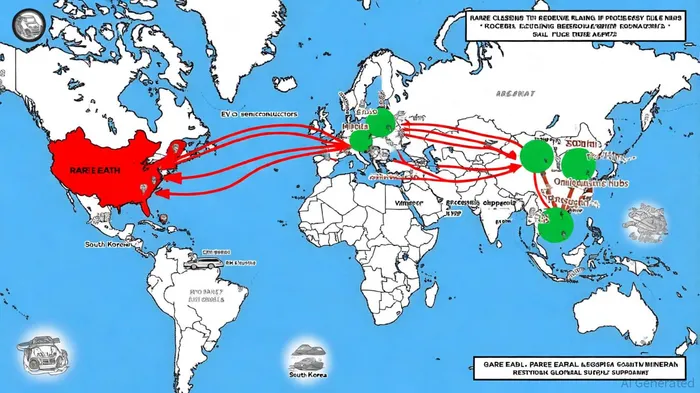
China's dominance in rare earth processing-over 90% of global refining capacity, according to Bitget-has long been a bottleneck for U.S. and global industries. The 2025 deal temporarily halts export curbs, ensuring a steady flow of materials for companies like TeslaTSLA-- and BoeingBA--, which depend on rare earths for EV batteries and aircraft components, according to Bitget. This pause has already triggered a correction in U.S. rare earth miner stocks (e.g., MP MaterialsMP--, Critical Metals), as investors recalibrate expectations, StockTwits reported.
However, the long-term solution lies in diversifying supply chains. Malaysia's decision to ban raw rare earth exports and focus on domestic processing, according to Mining.com, highlights a growing trend: resource-rich nations prioritizing value addition. For instance, South Korea's KEPCO has invested in a 1,200-megawatt gas plant in Malaysia, signaling a shift toward infrastructure partnerships, Korea Post reported. Investors should target firms involved in processing infrastructure, particularly in countries like Malaysia, where U.S.-China collaboration could unlock long-term economic and technological gains.
Chinese Export-Oriented Manufacturing: A Post-Deal Outlook
The tariff reductions and rare earth stability have directly benefited Chinese manufacturers. Companies like Huawei, previously constrained by U.S. export controls, now face eased restrictions on advanced chip sales, Coinotag reported. This could lower production costs and revive demand for Chinese-made semiconductors. Additionally, the resumption of U.S. soybean purchases by China, LiveMint reported, suggests broader trade normalization, which could boost agricultural exports and indirectly support manufacturing sectors reliant on U.S. inputs.
For investors, the key is to identify firms that have adapted to U.S. market demands. For example, Chinese rare earth processors that secured U.S. government partnerships (e.g., through equity stakes in domestic firms like MP Materials, as Reuters reported) are well-positioned to capitalize on the truce. Similarly, firms in the EV and semiconductor sectors-such as those supplying Tesla's Gigafactories-stand to gain from sustained U.S. demand.
Risk Mitigation and Long-Term Positioning
While the deal offers short-term relief, risks remain. China retains the right to restrict exports for "national security" reasons, according to TradeImex, and U.S. tariffs could resurge if bilateral tensions escalate. Investors should prioritize companies with diversified supply chains and those leveraging the current truce to build domestic processing capabilities. For example, U.S. firms acquiring stakes in Chinese or Malaysian processing infrastructure could hedge against future disruptions.
Moreover, the agreement's focus on AI and fentanyl control, Coinotag noted, underscores a broader trend: technology-driven trade negotiations. Firms involved in AI chip manufacturing (e.g., those using Nvidia's Blackwell architecture, as The Guardian reported) or blockchain hardware (which relies on GPUs, according to The Vibes) could see reduced costs as supply chain stability improves.
Conclusion
The 2025 U.S.-China deal is a pivotal moment for global tech and trade. By stabilizing rare earth flows and reducing tariffs, it has created a window for strategic investments in critical minerals and Chinese manufacturing. Investors should focus on three areas:
1. Processing infrastructure in countries like Malaysia, where U.S.-China collaboration is deepening.
2. Chinese manufacturers with U.S. market access, particularly in EVs and semiconductors.
3. Diversified supply chain players that mitigate geopolitical risks through domestic production or partnerships.
As the APEC summit looms and the truce extends to November 10, according to Bitget, the next few months will test the durability of this framework. For now, the deal offers a rare opportunity to align with both geopolitical pragmatism and market fundamentals.





Comentarios
Aún no hay comentarios