
The Implications of BlackRock's $268M Bitcoin ETF Outflows for Crypto Market Sentiment and Institutional Allocation Strategies
The recent $268 million outflow from BlackRock's iShares BitcoinBTC-- Trust (IBIT) has sparked renewed debate about institutional confidence in crypto assets and the broader implications for market dynamics. While this outflow—part of a broader trend of volatility in U.S. spot Bitcoin ETFs—signals short-term caution, the underlying institutional appetite for Bitcoin remains robust. This analysis explores how institutional investor behavior, regulatory developments, and market mechanics are shaping the trajectory of crypto asset valuation and confidence.
Institutional Investor Behavior and Outflow Dynamics
Institutional investors have historically treated Bitcoin ETFs as a gateway to digital assets, and BlackRock's IBITIBIT-- has been their preferred vehicle. However, the $292.5 million outflow on August 4, 2025—the largest since May—reveals a nuanced picture, according to a FinancialContent analysis. According to a report by Investor Newstoday, this outflow broke a 37-day streak of consecutive inflows, reflecting a strategic reallocation of capital rather than panic selling. Analysts suggest that institutions are shifting funds to "stronger institutional hands," a trend consistent with the broader market's maturation, as noted in a Holder report.
This behavior is further contextualized by the SEC's July 2025 approval of in-kind creation and redemption mechanisms for IBIT, a change explained in an EdgarIndex report. By reducing tax inefficiencies and enhancing liquidity, this regulatory shift has made IBIT more attractive for large-scale allocations. For instance, Abu Dhabi's Mubadala Sovereign Wealth Fund invested $436 million into IBIT by May 2025, becoming its seventh-largest holder, according to the FinancialContent analysis. Similarly, David Shaw's D.E. Shaw firm increased its stake by 345%, acquiring 7.4 million shares, as reported by FingerLakes1. These moves underscore that institutional interest remains anchored to long-term strategic goals rather than short-term price swings.
Market Sentiment and Price Correlation
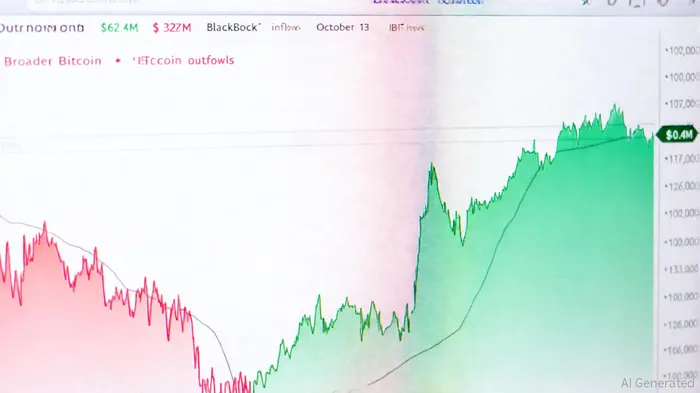
Bitcoin's price action in late 2025 highlights the complex interplay between ETF flows and market sentiment. Despite a 20% correction from its October 6 all-time high of $126,000, IBIT continued to attract inflows. On October 13 alone, it recorded a $60.4 million net inflow, bucking a $327 million outflow across rival Bitcoin ETFs, according to a CoinDesk article. This divergence suggests that institutions view IBIT as a stabilizing force, even during market downturns.
Data from Bloomberg ETF strategist Eric Balchunas indicates that digital assets attracted $60 billion in capital inflows by July 22, 2025, a figure cited in the FinancialContent analysis. While this figure includes both retail and institutional contributions, the dominance of IBIT—now managing $98 billion in assets under management—points to a structural shift in how institutions perceive Bitcoin. Its 0.25% management fee, compared to Grayscale's 1.5%, further cements its appeal, as noted in the Holder report. However, Bitcoin's growing correlation with traditional equities remains a concern. As noted by BeInCrypto, this linkage could limit IBIT's adoption as a hedging tool during macroeconomic stress, a point also highlighted in the FinancialContent analysis.
Strategic Reallocations and Long-Term Confidence
The May 30 outflow of $430.8 million—BlackRock's largest recorded outflow—was part of a broader $616.1 million net outflow across 11 Bitcoin ETFs, per the FinancialContent analysis. Yet, this event coincided with a $2.75 billion inflow into spot Bitcoin ETFs over the prior week, illustrating the tug-of-war between short-term volatility and long-term accumulation, as reported by CoinDesk. Institutional investors appear to be adopting a "buy the dip" strategy, as evidenced by IBIT's 10-day inflow streak in October 2025, according to the Holder report.
Moreover, the in-kind mechanism approved by the SEC has unlocked new efficiency gains. EdgarIndex explains that this innovation allows institutions to deposit Bitcoin directly into the ETF, bypassing cash-based tax drag. This structural advantage positions IBIT to capture a larger share of institutional capital, even amid periodic outflows. Projections suggest up to $50 billion in inflows over the next 12–18 months, driven by its cost efficiency and regulatory clarity, as discussed in the EdgarIndex report.
Challenges and Future Outlook
Despite these positives, challenges persist. Bitcoin's correlation with equities and inflationary concerns led to its first net outflow week in late 2025, a trend documented in the FinancialContent analysis. Additionally, the October 17 outflow of $536 million—though less severe than peers' losses—signals that institutions are not immune to market corrections, as highlighted in the Holder report. However, the resilience of IBIT's inflows during Bitcoin's October selloff suggests that institutional confidence is not easily shaken, per CoinDesk.
Wall Street analysts remain bullish. Some project an 110% appreciation in IBIT's value by year-end, according to FingerLakes1, while others highlight its role in democratizing access to Bitcoin for pension funds and sovereign wealth vehicles. The ETF's ability to maintain inflows during downturns—such as the $134 million added over two sessions as Bitcoin fell to $107,000—further reinforces its appeal, as reported in the Holder piece.
Conclusion
BlackRock's Bitcoin ETF outflows, while noteworthy, are best understood as part of a broader narrative of institutional maturation in the crypto space. The interplay between regulatory advancements, cost efficiency, and strategic reallocations has created a resilient framework for Bitcoin's institutional adoption. While short-term volatility will persist, the long-term trajectory of IBIT—and by extension, Bitcoin's valuation—remains firmly upward. For investors, the key takeaway is that institutional behavior is increasingly decoupling from retail sentiment, signaling a new era of stability and growth for crypto assets.





Comentarios
Aún no hay comentarios