
Imperial Brands' FY25 Performance and Long-Term Strategic Resilience
Revenue and Profit Trends: A Delicate Equilibrium
The company's constant currency tobacco and NGP net revenue growth is largely driven by sustained pricing power in combustible products and double-digit expansion in NGPs. This duality reflects a broader industry trend: legacy tobacco markets remain cash generators, while NGPs-encompassing vapor products and heated tobacco-offer growth potential. However, the low single-digit growth figures highlight the challenges of scaling NGP adoption in markets where regulatory uncertainty and consumer skepticism persist.
Shareholder value creation in this context hinges on operational efficiency and capital allocation. Imperial Brands has signaled its intent to prioritize returns through a £1.45 billion share buyback program for FY26, a move that, if executed effectively, could offset dilution from reinvestment in NGP R&D and market expansion. High single-digit adjusted EPS growth for FY25, supported by operating profit gains and buybacks, suggests the company is leveraging its cash flow to reward shareholders amid a low-growth environment.
Regional Dynamics and Strategic Priorities
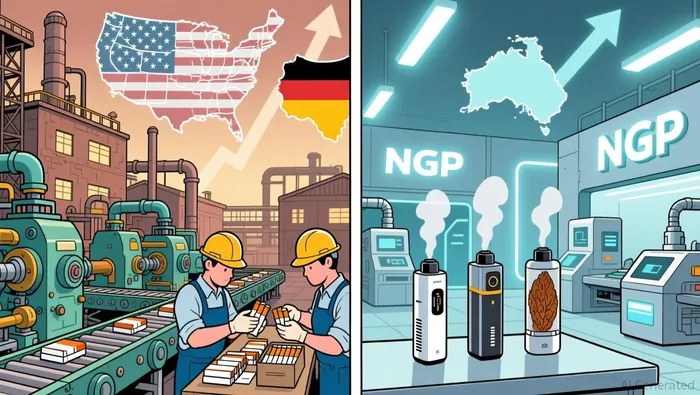
Geographic diversification remains a cornerstone of Imperial Brands' strategy. The company anticipates market share gains in the US, Germany, and Australia-markets where NGP adoption is accelerating and regulatory frameworks are relatively stable. These gains are expected to counterbalance declines in Spain and the UK, where smoking rates are falling and tobacco control policies are more aggressive. This regional balancing act illustrates the company's agility in adapting to local conditions, though it also exposes vulnerabilities in markets where policy shifts could disrupt revenue streams.
The NGP segment's projected mid-point growth of 12-14% for FY25 is particularly noteworthy. While this outpaces the tobacco segment's growth, it still lags behind the explosive adoption rates seen in some Asian markets. For Imperial Brands, the challenge lies in scaling NGP sales without cannibalizing its core business-a delicate balancing act that requires precise marketing and product differentiation.
Long-Term Resilience: Innovation and Capital Discipline
Imperial Brands' long-term strategic resilience depends on its ability to innovate within NGPs while maintaining profitability in traditional markets. The company's FY25 guidance indicates a focus on "high-margin" NGP products, which could drive incremental profit growth as these products mature according to the pre-close update. However, the sector's competitive landscape-dominated by Philip Morris International and British American Tobacco-means margins may face downward pressure unless Imperial Brands can differentiate its offerings through technology or brand loyalty.
Capital discipline will also be critical. The FY26 share buyback program, while a short-term boost to EPS, must be balanced against reinvestment in NGP infrastructure and R&D. According to the pre-close update, the company's ongoing buyback program has already contributed to EPS growth in FY25, but overreliance on buybacks could limit flexibility in responding to unforeseen challenges, such as supply chain disruptions or regulatory crackdowns.
Conclusion: A Cautious Optimism
For investors, Imperial Brands' FY25 performance represents a mix of cautious optimism and strategic pragmatism. The company's ability to deliver modest revenue and profit growth in a challenging sector, coupled with disciplined capital returns, positions it as a defensive play in the tobacco space. However, the long-term outlook hinges on its capacity to accelerate NGP adoption and navigate regulatory headwinds. As the industry evolves, Imperial Brands' success will depend not just on its financial metrics, but on its ability to align with global health trends while preserving shareholder value.







Comentarios
Aún no hay comentarios