
Impending Fed Leadership Shift and Its Implications for Rate Policy and Market Volatility
The Federal Reserve is on the brink of a seismic shift. With President nearing a decision on his next Fed Chair-likely Kevin Hassett, , or another Trump-aligned figure-the markets are bracing for a policy pivot that could redefine the economic landscape. This transition, coupled with Trump's vocal push for aggressive and a more dovish stance, raises critical questions about the Fed's independence and the trajectory of interest rates. For investors, the stakes are high. Strategic asset positioning is no longer optional-it's a necessity.
The Trump-Backed Fed: A New Era of Policy Uncertainty
Trump's final list of Fed Chair candidates includes figures like , a staunch advocate for lower rates, and Christopher Waller, a more moderate voice. While Hassett's alignment with Trump's economic agenda makes him a frontrunner, the broader implications of a Trump-aligned Fed are clear: a potential erosion of the central bank's independence and a shift toward short-term political goals over long-term stability.
This isn't hypothetical. During Trump's first term, his administration's push for rate cuts and created a volatile environment. The Fed's credibility was tested as conflicting signals from officials like and John Williams fueled market whiplash. Now, with Trump's influence likely to grow, the risk of policy-driven volatility is amplified.
Historical Lessons: Trump's Market Legacy and Volatility Patterns
History offers a blueprint. During Trump's first term (2017–2021), the S&P 500 surged 67%-a remarkable feat-but this growth was punctuated by sharp corrections tied to trade tensions and fiscal uncertainty. For example, the 2018–2019 with China triggered sector-specific meltdowns in semiconductors and industrials, while gold and surged as safe havens.
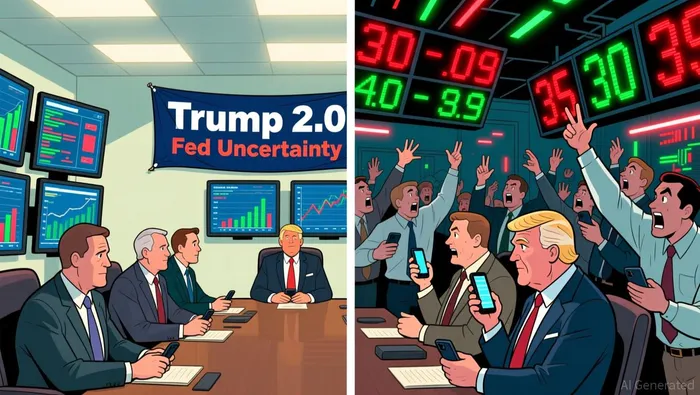 The 2020 pandemic further exposed the fragility of this era. The Fed's emergency measures and the CARES Act averted a deeper crisis, but the recovery was uneven and reliant on unprecedented . By the end of Trump's first term, investors had learned to hedge against policy-driven shocks, favoring a mix of equities, credit, and duration to navigate uncertainty.
Strategic Asset Positioning for a Trump 2.0 Fed
Given the current climate, investors must adopt a proactive stance. Here's how to position your portfolio:
Quality Large-Cap Stocks and Real Assets: A Trump-aligned Fed may prioritize growth over , potentially weakening the dollar and fueling inflation. Quality large-cap stocks, particularly in sectors like technology and healthcare, offer resilience. Real assets like real estate and commodities (e.g., gold) also serve as inflation hedges. According to Morgan Stanley, the risk of policy-driven volatility is amplified.
Gold and Treasury Bonds as Safe Havens: Gold has surged 25% year-to-date in 2025, reflecting its role as a hedge against Fed instability. Similarly, intermediate-duration Treasury bonds provide liquidity and downside protection in a high-volatility environment. According to Morgan Stanley, these assets offer resilience.
Diversified Fixed Income and International Equities: To mitigate U.S.-centric risks, consider and investment-grade bonds. These assets offer diversification and can cushion against domestic policy shocks. According to Morgan Stanley, a diversified portfolio is essential.
4. Active Portfolio Management: A shallow and prolonged high rates are possible under a Trump-aligned Fed. Investors must remain nimble, adjusting allocations based on labor market data and inflation trends.
The Bottom Line: Prepare for Volatility, Prioritize Flexibility
The Fed's leadership transition is not just a bureaucratic shift-it's a catalyst for market turbulence. Trump's preference for aggressive rate cuts and his history of policy-driven volatility demand a strategic, adaptive approach. By leaning into quality assets, hedging with gold and Treasuries, and maintaining a diversified portfolio, investors can navigate the uncertainty ahead.
As the Fed's new chair takes the helm, one thing is certain: the markets will be watching-and so should you.







Comentarios
Aún no hay comentarios