
Impax U.S. Sustainable Economy Fund Q3 2025: Policy Deregulation and Funding Gaps Challenge Portfolio Resilience
The Impax U.S. Sustainable Economy Fund trailed the broader Russell 1000 index in the third quarter of 2025. Market conditions favored high-momentum stocks, creating headwinds for the fund's sustainability-focused approach according to commentary. This underperformance highlights the current challenge for quality-oriented strategies in a momentum-driven environment.
Sector dynamics tell a more complex story, however. While industrial decarbonization faced execution hurdles, other segments of the clean economy showed resilience. Utility-scale clean electricity investment held steady at $25 billion during Q3. More significantly, total U.S. clean energyCETY-- and transportation investment reached a record $75 billion in the quarter, boosted largely by strong retail demand for electric vehicles and clean technologies totaling $41 billion.
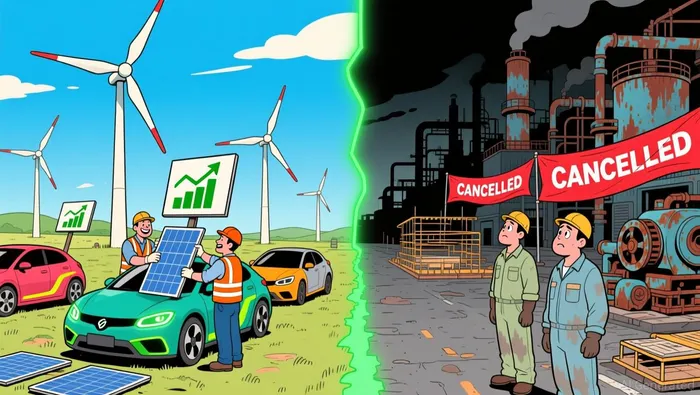
This growth, however, masks a sharp decline elsewhere. Manufacturing investment in clean energy fell 10% quarter-on-quarter to just $10 billion. The situation is particularly acute in industrial decarbonization, where only one-tenth of announced projects actually materialized, translating to $3 billion in spending against a $30 billion announcement pipeline. A substantial $14 billion in potential investment remains at risk, largely due to uncertainties surrounding federal grant support.
The disparity underscores a fundamental tension: while capital is flowing strongly into certain clean energy segments like retail EVs and utilities, the critical transition in heavy industry and manufacturing is progressing far more slowly. Project cancellations, including $4 billion across manufacturing and energy/industry initiatives, reflect significant execution friction. Investors should note that the sustainability strategy's challenges extend beyond market sentiment, mirroring real-world difficulties in translating clean energy announcements into concrete, funded projects, especially outside the strongest utility-scale segments.
Policy Shifts and Compliance Landscape
The Trump administration's pivot away from climate action triggered immediate market reactions. Withdrawal from the Paris Agreement and the dismantling of EPA greenhouse gas regulations, including power plant pollution limits, directly eliminated federal tax incentives and canceled $13 billion in green energy funding, according to industry analysis. This policy reversal manifested sharply in capital markets, causing a 36% plunge in U.S. renewable investment during 2025. While clean energy spending elsewhere held steady, this retreat highlighted how abruptly federal support can evaporate.
The manufacturing sector felt particular pressure. A quarter-on-quarter decline of 10% in manufacturing investment, falling to $10 billion, underscored the fragility of this segment amid the policy shift. The most acute risk materialized in industrial decarbonization, where $14 billion of its $136 billion potential pipeline became highly vulnerable due to Department of Energy grant terminations. This uncertainty led to tangible project cancellations, with $4 billion in manufacturing and energy/industry projects being called off in Q3 alone.
Compounding these investment shocks was the erosion of domestic climate data infrastructure. The slashing of climate science programs, including NOAA and the National Climate Assessment, alongside revoked climate-preparedness grants, created significant hurdles for companies attempting robust ESG assessments. This loss of reliable foundational data makes it harder to measure, report, and manage climate-related risks and opportunities accurately, adding a layer of operational friction beyond the immediate funding cuts and policy volatility.
Cash Flow and Valuation Risks
The sudden cancellation of $4 billion in manufacturing and energy/industry projects directly undermines the valuation foundation for investment funds holding related assets, creating immediate uncertainty about asset worth and future returns. These cancellations represent real, lost capital deployment that was previously counted on for growth projections. This follows a broader pattern where only 10% of announced industrial decarbonization efforts actually translate into realized spending, highlighting a significant execution and pipeline quality risk intrinsic to the sector.
A major source of this vulnerability lies in federal support. Specifically, $14 billion within the industrial decarbonization pipeline – a substantial portion of its total $136 billion size – is directly tied to Department of Energy (DOE) grants now subject to termination. This abrupt withdrawal of government-backed financing creates substantial funding gaps and raises serious questions about whether these projects can proceed without alternative sources, potentially leading to further delays or cancellations and eroding investor confidence in the sector's near-term prospects.
Furthermore, the rapidly shifting policy landscape forces companies to absorb rising compliance costs. Evolving Environmental, Social, and Governance (ESG) disclosure requirements, combined with the volatility of recent federal climate policy rollbacks, demand significant resources for adaptation. Companies must now navigate an unstable regulatory environment, potentially diverting capital from core operations or growth initiatives to meet new reporting mandates and manage the fallout from withdrawn government support, adding another layer of financial pressure.
Forward Scenarios and Monitoring Focus
Utility-scale clean electricity investment proved resilient in Q3 2025, holding steady at $25 billion despite shifting policy landscapes. This stability contrasts sharply with manufacturing's struggles, where investment sank 10% quarter-on-quarter to just $10 billion. The sector's challenges are compounded by a 37% drop in battery production-a trend warranting close monitoring as supply chains face renewed uncertainty.
Industrial decarbonization projects remain particularly fragile, with $14 billion of the $136 billion pipeline at risk due to DOE grant terminations. Only 10% of announced industrial decarbonization initiatives have materialized into actual spending, signaling execution gaps that could delay broader clean energy transitions.
Key metrics to watch include regulatory policy shifts, the pace of decarbonization project deployments, and the fate of grant-dependent investments. While retail EV and clean tech purchases surged 19% to $41 billion, translating broader sustainability sentiment into manufacturing momentum will require clearer policy signals and reduced project cancellation risks. Investors should balance optimism about utility-scale resilience against operational headwinds in manufacturing and industrial decarbonization.





Comentarios
Aún no hay comentarios