
The Impact of Trump's TikTok Deal on U.S.-China Tech Tensions and Global Market Volatility
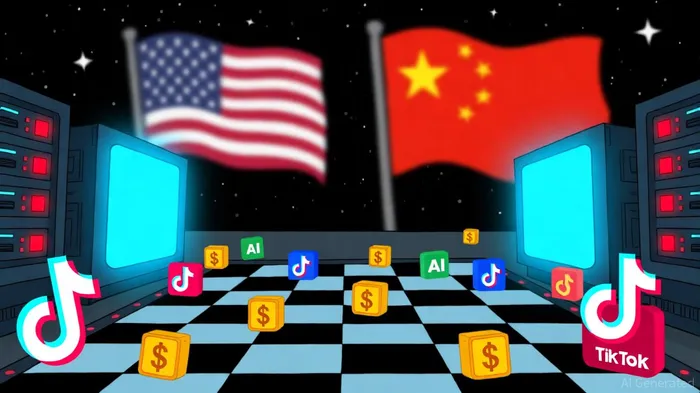
The Trump administration's restructuring of TikTok's U.S. operations has emerged as a pivotal moment in the evolving U.S.-China tech rivalry, with far-reaching implications for global market dynamics. By allowing the app to continue operating under a new joint-venture company controlled by American investors—led by OracleORCL-- as the security provider—the deal aims to address national security concerns while preserving TikTok's commercial viability[1]. However, the arrangement has sparked debates over its strategic intent, with critics labeling the multibillion-dollar “fee for service” as crony capitalism[2]. This analysis examines how the TikTok deal intersects with broader trends in a post-tariff, AI-driven global economy, offering insights for investors navigating heightened geopolitical and market volatility.
Strategic Sector Positioning in a Post-Tariff Landscape
The U.S.-China tech competition has intensified in 2025, driven by Trump-era tariffs on semiconductors, EVs, and robotics. These tariffs have disrupted global supply chains, forcing companies to diversify production to countries like Vietnam and Mexico to mitigate costs[3]. For instance, U.S. firms such as Dell and Supermicro have shifted manufacturing to Taiwan and Southeast Asia, while Chinese tech exports to the U.S. have declined by 70% since late 2024[4].
China's response has been a dual strategy of fiscal stimulus and technological self-reliance. The country's 2025 ICT spending is projected to grow at 9.1% under a baseline tariff scenario, driven by domestic demand for AI and cloud computing[5]. Meanwhile, Chinese tech giants like Huawei and DeepSeek are accelerating investments in AI infrastructure, with Huawei's AI chips capturing 27% of the global market in 2024[6]. This shift underscores a broader trend of “competitive coexistence,” where both nations pursue technological leadership while managing geopolitical tensions[7].
The TikTok Deal: A Microcosm of Broader Rivalries
The TikTok deal exemplifies the strategic maneuvering at play. By granting U.S. investors an 80% stake in the app's U.S. operations and entrusting Oracle with data security, the Trump administration has sought to neutralize national security risks while retaining economic benefits[8]. However, the deal's structure—resembling a “shake-down” in critics' eyes—highlights the tension between geopolitical objectives and market logic[2]. For investors, this raises questions about the long-term sustainability of such arrangements and their impact on cross-border tech collaboration.
The deal also intersects with AI-driven market dynamics. Oracle's role in retraining TikTok's algorithm for a U.S.-based version could influence the platform's data governance and user experience, potentially affecting its competitiveness against Western social media platforms[9]. Meanwhile, China's DeepSeek AI model, which achieved breakthrough efficiency in large language model development, has disrupted investor confidence in U.S. hardware stocks like Nvidia[10]. This underscores the growing importance of cost-effective AI innovation in shaping sector positioning.
Navigating Market Volatility in an AI-Driven Economy
The interplay of tariffs, AI advancements, and geopolitical tensions has created a volatile investment environment. For example, Trump's 50% tariff on semiconductors has accelerated China's push for self-sufficiency, with domestic AI chip production expected to grow by 40% in 2025[11]. Conversely, U.S. firms are investing in AI-optimized chips and energy-efficient systems to offset higher costs, with Microsoft committing $80 billion to AI infrastructure in 2025[12].
Investors must also contend with the ripple effects of the TikTok deal. While the arrangement stabilizes TikTok's U.S. presence, it introduces regulatory uncertainty for other cross-border tech ventures. For instance, the U.S. government's emphasis on “technological sovereignty” could lead to stricter oversight of foreign-owned platforms, further fragmenting global tech markets[13].
Strategic Recommendations for Investors
- Diversify Exposure to AI Supply Chains: Given the fragility of U.S.-China trade relations, investors should prioritize companies with diversified production networks. For example, firms leveraging Southeast Asian manufacturing hubs or investing in AI-optimized hardware (e.g., energy-efficient GPUs) may mitigate tariff risks[3].
- Monitor Regulatory Shifts in Cross-Border Tech Deals: The TikTok precedent suggests that U.S. regulators will increasingly prioritize national security over commercial interests. Investors should track policy developments affecting foreign-owned platforms, particularly in social media and cloud computing[8].
- Leverage China's AI Self-Reliance Push: While U.S. tariffs have constrained Chinese tech exports, they have also accelerated domestic innovation. Investors could target Chinese AI startups like DeepSeek or firms expanding into emerging markets to bypass U.S. restrictions[10].
- Balance Short-Term Volatility with Long-Term AI Demand: Despite near-term turbulence, the AI infrastructure market is projected to grow at a 30.4% CAGR through 2030[12]. Investors should focus on companies with scalable AI solutions, such as cloud providers pursuing vertical integration to reduce supplier dependency[14].
Conclusion
Trump's TikTok deal is more than a corporate restructuring—it is a strategic signal in the U.S.-China tech rivalry. By aligning with broader trends in AI-driven innovation and supply chain resilience, the deal reflects the complexities of navigating a post-tariff global economy. For investors, the key lies in balancing geopolitical risks with the transformative potential of AI, ensuring portfolios are agile enough to adapt to an era of competitive coexistence.





Comentarios
Aún no hay comentarios