
The Impact of Trump Tariffs on U.S. Retail Supply Chains and Holiday Commerce
The 2025 holiday shopping season has become a litmus test for the resilience of U.S. retailers in the face of Trump-era tariffs. While big-box retailers like WalmartWMT-- and CostcoCOST-- have leveraged their scale and supply chain agility to weather the storm, small businesses are grappling with existential threats. This divergence underscores a growing structural imbalance in the retail sector, with profound implications for investors.
Small Retailers: A Perfect Storm of Costs and Constraints
Small retailers are bearing the brunt of Trump's tariffs, which have exacerbated supply chain bottlenecks and eroded profit margins. According to a report by Reuters, operating margins for small retailers have plummeted to negative 20.7%, driven by volatile import costs and inventory shortages. For example, Matt Hassett of Loftie, a sleep wellness brand, reported delayed orders and insufficient stock for the peak holiday period due to fluctuating tariffs on Chinese imports. Similarly, Dean Smith of JaZams, a toy store, noted that wholesale prices for 80% of his inventory rose by 5% to 20%.
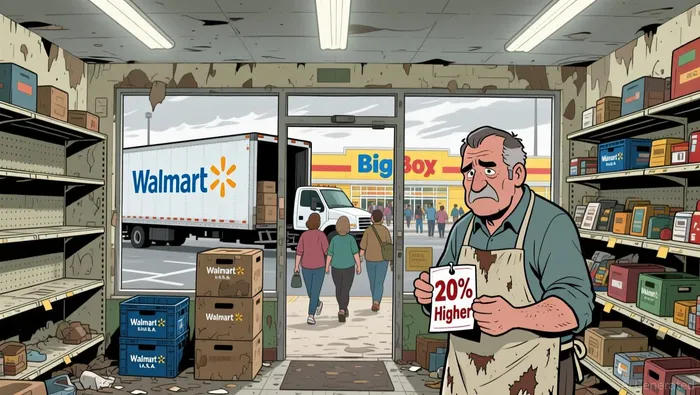 The financial strain has forced small retailers to adopt defensive strategies. Many are ordering smaller quantities to avoid being stuck with unsold inventory, a move that further limits product availability. Others, like Jeremy Rice of House, a home décor shop, have raised prices on items like red berry stems from $8.95 to $10.95 to offset import costs. These adjustments, however, come at a cost: consumers are shifting to more affordable or locally produced goods, and small retailers are losing ground to larger competitors.
Big-Box Resilience: Scale, Negotiation Power, and Strategic Adaptation
In contrast, Walmart and Costco have demonstrated remarkable resilience. Walmart's U.S. sales rose 4.5% year-over-year for the three months ending October 31, 2025, driven by its ability to absorb tariff costs through vendor negotiations and supply chain flexibility. The company's e-commerce sales surged 28%, reflecting a dual strategy of in-store and digital dominance. Costco, meanwhile, has leveraged its loyal customer base and bulk purchasing power to maintain low prices and inventory stability. The company even filed a lawsuit against the Trump administration over emergency tariffs, signaling its proactive stance.
Big-box retailers' financial metrics further highlight their advantage. Walmart's ability to offer the lowest prices on daily essentials 68% of the time has attracted budget-conscious shoppers, while Costco's warehouse-level replenishment systems kept out-of-stock rates lower than industry averages. These strategies have allowed them to capture over half of new retail spending in Q2 2025, even as small businesses absorbed an estimated $85–100 billion in direct tariff costs.
Market Implications: A Fractured Landscape for Investors
The widening gap between small and big-box retailers raises critical questions for investors. Small businesses, already operating on thin margins, face a precarious 2026 holiday season if tariff policies remain unchanged. Conversely, Walmart and Costco are well-positioned to capitalize on shifting consumer behavior, including a shift toward essential goods and value-oriented shopping.
For investors, the key takeaway is clear: the retail sector is undergoing a structural realignment. While big-box players are fortifying their market share through cost management and pricing power, small retailers are increasingly reliant on niche strategies, such as local sourcing and customer loyalty programs, to survive according to reports. This dynamic suggests a long-term tilt toward consolidation, with smaller players either adapting or exiting the market.
Conclusion
Trump's tariffs have acted as a stress test for U.S. retail supply chains, exposing the vulnerabilities of small businesses while reinforcing the dominance of big-box giants. As the 2025 holiday season unfolds, the contrast in financial performance and strategic agility between these two groups is stark. For investors, the lesson is unambiguous: in a fractured market, scale and supply chain resilience are no longer just advantages-they are survival imperatives.







Comentarios
Aún no hay comentarios