
The Impact of Trump's China Tariffs on U.S. Equity and Treasury Markets in a Post-Election Landscape
The return of Donald Trump to the White House has ushered in a new era of economic uncertainty, with his aggressive China tariff policies reshaping the landscape for U.S. equity and treasury markets. Since the November 2024 election, investors have grappled with the dual forces of protectionism and volatility, recalibrating portfolios to navigate a world where trade wars and geopolitical risks dominate the agenda. The implications for asset allocation, sector exposure, and risk management are profound, demanding a strategic rethinking of traditional investment paradigms.
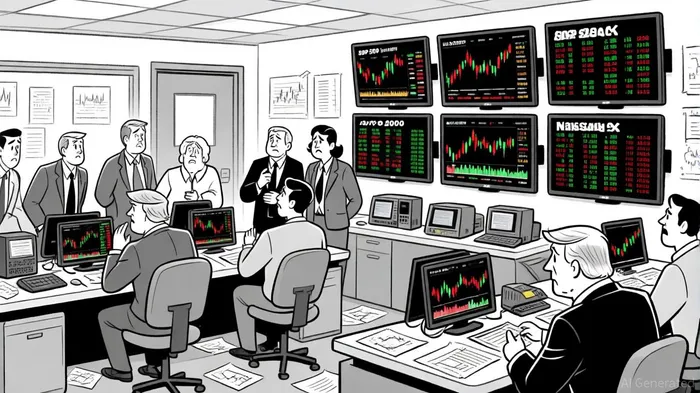
Equity Markets: Volatility as the New Normal
The immediate aftermath of Trump's tariff announcements has been marked by sharp market corrections. When the former president threatened a "massive increase of tariffs" on Chinese imports in early April 2025, the S&P 500 slumped more than 2 percent, while the Nasdaq plummeted 3.6%-its steepest decline in six months, according to a New York Times report. These drops were not isolated to tech stocks; the broader market, including small-cap indices like the Russell 2000, saw cumulative losses of $2.2 trillion in market value as investors braced for a deepening trade conflict, according to an AIER analysis.
Yet the market's response has been anything but linear. A 90-day pause on reciprocal tariffs in mid-April triggered a relief rally, with the Magnificent 7 rebounding 6% in a single session, the AIER analysis noted. This seesaw effect underscores the fragility of investor sentiment in a policy environment where announcements can shift overnight. According to J.P. Morgan Global Research, the uncertainty has eroded business confidence, with companies delaying expansion plans and reshoring efforts mired in logistical and cost challenges.
Sector Reallocation: Winners and Losers in a Protectionist World
The sectoral implications of Trump's tariffs are stark. Defensive industries such as utilities and healthcare have outperformed, as their low exposure to global supply chains insulates them from trade-related shocks, according to a Morgan Stanley guide. Conversely, technology, materials, and energy sectors-reliant on cross-border inputs-have faced margin compression. For instance, semiconductor firms grapple with tariffs on Chinese components, while steel producers contend with retaliatory measures from Beijing, a trend described in a Newsweek report.
Investors are increasingly turning to exchange-traded funds (ETFs) to hedge sector-specific risks. Morgan Stanley noted a surge in demand for ETFs focused on defensive sectors and inflation-protected assets, as portfolios tilt toward resilience over growth. Meanwhile, the financial sector, less vulnerable to tariffs due to its services-oriented model, has seen mixed fortunes. Deregulation and tax cuts have boosted profitability, but inflationary pressures from trade wars have introduced periodic volatility, according to an AcuityKP analysis.
Geographic Diversification: Beyond the U.S. Bubble
The trade war has also accelerated a shift in geographic exposure. Fund managers, once overwhelmingly bullish on U.S. assets, now favor emerging markets and European equities. By June 2025, global investor sentiment had rebounded to pre-tariff levels, but capital flows increasingly bypassed the U.S., reflecting concerns over dollar overvaluation and trade policy instability, according to a Quartz report.
Reshoring efforts, meanwhile, have proven more aspirational than practical. While Trump's policies favor traditional energy and manufacturing, companies remain "trapped" in China due to the high costs of relocation. As one industry executive put it, "We're stuck in a game of chicken between tariffs and supply chain inertia," according to a Politico article. This has led to a hybrid strategy: automating production in China while diversifying to secondary hubs like India and Vietnam, albeit with limited success in replicating the efficiency of Chinese manufacturing, as shown in a World Economic Forum timeline.
Hedging Strategies: Gold, Treasuries, and the New Normal
In a world of heightened uncertainty, traditional safe-haven assets have seen renewed demand. Gold prices surged to $3,500 by April 22, 2025, according to a Forbes analysis. However, the role of U.S. Treasury bonds as a hedge has been compromised. Yields on 10-year Treasuries spiked from 4.01% to 4.48% in early April, reflecting fears of inflation and reduced global demand for U.S. debt, according to a Confluence report.
Investors have also embraced alternative hedging tools, including defined outcome ETFs and zero-day options. These instruments, which cap upside gains to provide downside protection, have attracted significant inflows amid the VIX's post-tariff spike, a trend highlighted in a Business Insider piece. As one strategist told a CNBC report, "The old playbook is obsolete. Investors now prioritize non-correlated assets and dynamic hedging in a world where policy shocks are the norm."
Treasury Markets: A Fragile Safe Haven
The U.S. Treasury market, long the bedrock of global finance, faces its own reckoning. Trump's tariffs have exacerbated inflationary pressures, with the Federal Reserve's mandate to control prices clashing with the administration's protectionist agenda. J.P. Morgan warns that prolonged trade tensions could erode confidence in Treasuries, traditionally seen as a risk-free asset.
Moreover, the Treasury's reliance on foreign buyers-particularly China and Japan-has been strained by retaliatory tariffs. While China has mitigated its U.S. trade deficit by redirecting exports to Southeast Asia and Africa, the long-term sustainability of this strategy remains uncertain, the New York Times reports. If global investors perceive the U.S. economy as less stable, they may seek alternatives, potentially driving up yields and increasing borrowing costs for the federal government, analysts told an AP News report.
Conclusion: Navigating the New Protectionist Era
Trump's China tariffs have redefined the investment landscape, forcing a strategic reallocation of assets across sectors, geographies, and hedging mechanisms. The days of complacency in U.S. equity and treasury markets are over, replaced by a world where policy-driven volatility is the norm. For investors, the key lies in agility: balancing exposure to resilient sectors, diversifying geographically, and embracing non-traditional hedges to weather the storms ahead.
As the trade war rages on, one thing is clear: the markets will continue to test the limits of adaptability, and those who fail to reallocate risk will find themselves left behind.







Comentarios
Aún no hay comentarios