
The Impact of U.S. Tariffs on North American Auto Sales and Supply Chains in 2025
The U.S. automotive industry in 2025 has been reshaped by a surge in tariffs, recalibrating supply chains, investor strategies, and cross-border dynamics. Under the Trump administration, tariffs on imported vehicles and parts-ranging from 25% to 27.5% for non-USMCA-compliant goods-have created a fragmented yet adaptive landscape. For investors, understanding these shifts is critical to navigating volatility and identifying opportunities in a restructured North American automotive ecosystem.
Tariff-Driven Supply Chain Reconfiguration
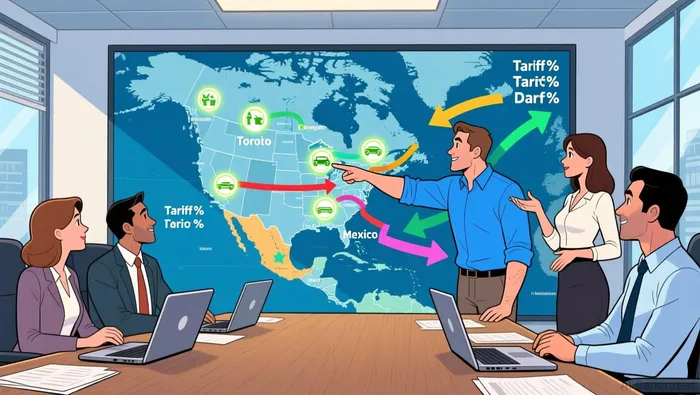
The U.S. tariffs, implemented in May 2025, have forced automakers to rethink sourcing and production strategies. Vehicles compliant with the U.S.-Mexico-Canada Agreement (USMCA) face tariffs only on non-U.S.-sourced content, incentivizing regional integration. For example, a Canadian-built vehicle with $5,000 in U.S.-sourced parts would incur a 25% tariff on the remaining $25,000 of its value. This has accelerated nearshoring, with Mexico emerging as a pivotal hub. By leveraging USMCA exemptions, Mexico has attracted significant foreign direct investment, particularly from Asian automakers, while maintaining 92% of its vehicle exports to the U.S., Canada, and Germany.
However, the U.S. raised tariffs on Canada to 35% in August 2025, exacerbating trade tensions and prompting retaliatory measures. Meanwhile, Mexico's strategic position-bolstered by competitive labor costs and free trade agreements-has made it a preferred destination for reshoring. Automakers like General MotorsGM-- and Hyundai have committed to expanding U.S. assembly facilities, though these projects are expected to materialize by mid-2027.
Investor Strategies: M&A, Capital Reallocation, and Regional Shifts
The tariff environment has spurred significant capital reallocation and M&A activity. In 2025, automakers and suppliers prioritized liquidity optimization and nearshoring, with investments in U.S. and Mexican facilities rising sharply. For instance, American Axle & Manufacturing Holdings acquired Dowlais Group for $1.44 billion to strengthen its position in driveline technologies and EV components. Such deals reflect a broader trend of vertical integration and operational efficiency amid margin pressures.
Capital flows have also shifted toward logistics and infrastructure. Warehousing near assembly plants and ports has become a critical buffer against tariff-related surcharges, while dual-path routing models and air cargo usage have mitigated supply chain volatility. Additionally, private equity has shown renewed interest in profitable internal combustion engine (ICE) and hybrid platforms, as EV adoption slows and regulatory uncertainty persists.
Regional investment patterns highlight the U.S. and Mexico as key beneficiaries. With tariffs on Chinese imports reaching 50%, companies are diversifying production to Vietnam, India, and Southeast Asia. However, North America remains central, with Mexico's automotive sector projected to grow as a nearshoring hub. Investors are also prioritizing software-defined vehicle (SDV) capabilities, recognizing the long-term importance of software in automotive competitiveness.
Navigating Uncertainty: Strategic Positioning for Investors
For investors, the 2025 tariff landscape underscores the need for agility and long-term planning. Key strategies include:
1. Regional Diversification: Allocating capital to U.S. and Mexican automakers and suppliers to capitalize on nearshoring trends.
2. Supply Chain Resilience: Investing in logistics infrastructure, transportation management systems, and warehousing to buffer against tariff volatility.
3. Sector-Specific Opportunities: Targeting companies adapting to electrification and SDVs, despite short-term headwinds from policy shifts.
4. M&A Activity: Monitoring consolidation in the automotive sector, particularly in driveline technologies and ICE-focused firms.
The U.S.-Japan and U.S.-EU trade agreements-capping automotive tariffs at 15%-also signal a shift toward structured, reciprocal arrangements. Investors should remain attuned to these developments, as they may unlock new cross-border synergies.
Conclusion
The 2025 U.S. tariffs have redefined North American automotive dynamics, creating both challenges and opportunities. For investors, success hinges on strategic positioning: leveraging nearshoring, embracing technological innovation, and maintaining flexibility in a high-tariff environment. As the industry adapts to evolving trade policies, those who align with regional strengths and supply chain resilience will be best positioned to thrive.







Comentarios
Aún no hay comentarios