
The Impact of Strong Q3 U.S. Growth on Fed Rate Cuts and Fixed Income Strategy for 2026
The U.S. economy's robust performance in Q3 2025, marked by a 4.3% annualized GDP growth rate, has reshaped expectations for the Federal Reserve's 2026 policy trajectory. This surge, driven by resilient consumer spending and a rebound in exports, has tempered optimism for aggressive rate cuts, while elevating long-term bond yields. For fixed income investors, the implications are clear: a constrained rate-cut environment and a yield curve that remains anchored by inflationary pressures and structural economic shifts.
Resilient Consumer Spending and GDP Growth: A Double-Edged Sword
Consumer spending, which accounts for over two-thirds of U.S. economic activity, grew at a 3.5% annual rate in Q3 2025, up from 2.5% in Q2 according to initial GDP estimates. This resilience, fueled by high-income households' spending in sectors like travel and dining amid a stock market boom, has offset weaker discretionary spending from lower-income households grappling with inflation as economic data shows. Meanwhile, exports surged 8.8% annually, reflecting global demand for U.S. goods and services according to GDP data.
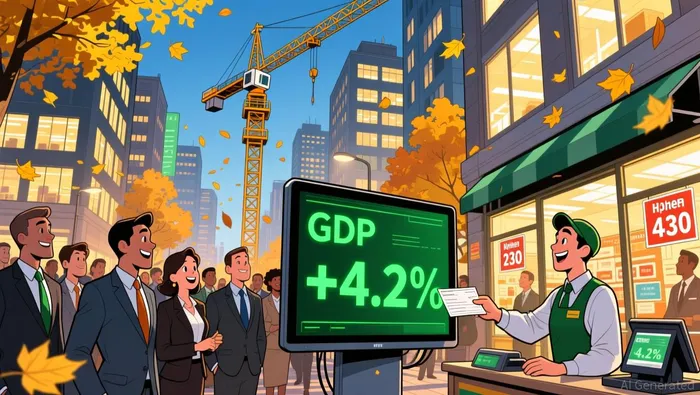 However, this strength has complicated the Fed's inflation-fighting calculus. While the PCE price index-a key Fed inflation gauge-rose to 2.8% in Q3 2025 according to market analysis, the economy's ability to sustain growth without overheating has led analysts to question the urgency of rate cuts. Collin Martin of Schwab, for instance, argues that the Fed may limit 2026 cuts to one or two, as policymakers await clearer signals on inflation and labor market cooling as market analysis suggests.
Fed Rate Cuts: A Narrow Path in 2026
The Fed's initial projection for 2026 includes a single rate cut, but some forecasters, including Morningstar's Preston Caldwell, anticipate two cuts according to economic forecasts. This divergence reflects uncertainty around two key factors: the sustainability of the AI-driven capital expenditure boom and the inflationary risks posed by rising tariffs. If the AI-driven productivity surge continues to boost non-residential investment-contributing to GDP growth-monetary easing could be further delayed as market analysis suggests. Conversely, persistent inflation or a surge in import prices could force the Fed to maintain a tighter policy stance.
Fixed Income Strategies for a High-Yield, Low-Cut Environment
Investors navigating this landscape must balance the allure of elevated yields with the risks of a prolonged restrictive policy environment. LPL Research recommends maintaining a neutral duration profile and favoring high-quality sovereign bonds over cash, as yields decline modestly in response to limited rate cuts according to fixed income analysis. Capital Group echoes this, noting that a steepening yield curve and historically elevated yields present "solid return potential" for fixed income portfolios as investment analysis indicates.
However, caution is warranted. Cambridge Associates warns that public corporate credit has become a "one-sided trade" with limited upside and heightened downside risks, particularly as middle- and lower-income households face affordability challenges as economic analysis suggests. Schwab's analysis further underscores the importance of aligning allocations with policy guidelines, emphasizing high-quality bonds and avoiding duration bets in a market where inflation surprises could disrupt expectations as market analysis indicates.
Conclusion: Navigating the New Normal
The U.S. economy's Q3 2025 performance has created a policy and market environment where strong growth and consumer spending act as both a tailwind and a headwind. While elevated bond yields offer attractive starting points for fixed income investors, the Fed's reluctance to aggressively cut rates means returns will hinge on careful positioning. For 2026, the path forward lies in prioritizing quality, managing duration risk, and staying attuned to the evolving interplay between AI-driven growth, inflation, and global trade dynamics.







Comentarios
Aún no hay comentarios