
The Impact of New Stablecoin Regulations on Digital Asset Markets: Navigating Risk Rebalancing and Regulatory Arbitrage Opportunities
Regulatory Frameworks and Risk Mitigation
The U.S. GENIUS Act, enacted in July 2025, has become a cornerstone of stablecoin oversight, mandating 100% reserve backing with liquid assets and imposing anti-money laundering (AML) requirements. This federal framework has reduced systemic risks by ensuring stablecoins remain redeemable at par, fostering institutional confidence. Similarly, the EU's Markets in Crypto-Assets Regulation (MiCA), fully implemented in December 2024, enforces strict capital and governance standards for stablecoin issuers, while reserving the right to restrict non-euro stablecoins if their usage exceeds thresholds. These measures have curtailed volatility and fraud risks, encouraging traditional financial institutions to integrate stablecoins into their portfolios.
In Asia, Hong Kong's August 2025 licensing framework for fiat-referenced stablecoins under the Hong Kong Monetary Authority (HKMA) has set a precedent for transparency and user protection. Singapore's Digital Token Service Provider (DTSP) regime, effective June 2025, further tightens prudential standards, requiring entities to secure licenses and adhere to AML obligations. These frameworks collectively reduce counterparty risks, enabling institutional investors to allocate capital with greater certainty.
Regulatory Arbitrage Opportunities
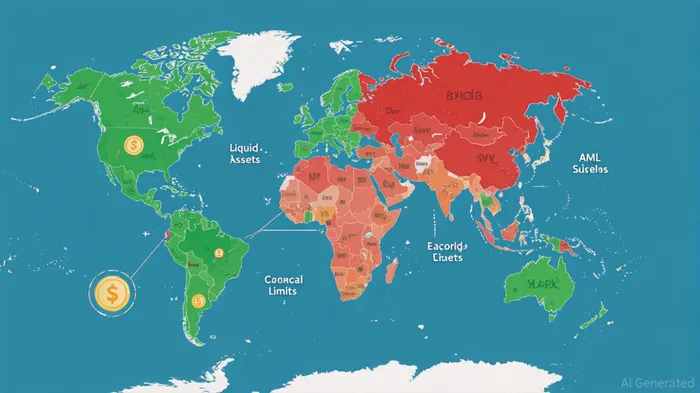
Despite progress, jurisdictional disparities persist, creating arbitrage opportunities. For instance, while the U.S. and EU enforce stringent reserve and governance rules, jurisdictions like Türkiye and Thailand have adopted cautious or fragmented approaches, such as transaction limits or partial bans. This divergence incentivizes capital to flow toward regulated hubs. Data from Artemis Analytics reveals that stablecoin transaction volumes surged from $7.6 trillion in 2023 to $18.4 trillion in 2024, with U.S.- and EU-compliant stablecoins capturing a growing share of cross-border transactions.
Institutional investors are leveraging these gaps by prioritizing jurisdictions with innovation-friendly policies. For example, Singapore's MAS has become a magnet for stablecoin issuers seeking to bypass stricter U.S. or EU requirements, while Hong Kong's tokenization pilots attract firms exploring blockchain-based settlement. Conversely, jurisdictions with weak enforcement face outflows, as seen in Türkiye, where proposed transaction caps aim to curb illicit fund movements.
Quantitative Trends and Institutional Strategies
Quantitative analysis underscores the scale of capital reallocation. By 2025, over 70% of jurisdictions had advanced stablecoin regulations, with the U.S., EU, and Asia leading adoption. The Basel Committee's reassessment of prudential rules for crypto exposures further highlights the sector's systemic importance. Institutions are now favoring markets with clear compliance pathways, such as the U.S. and Singapore, where partnerships with regulated financial intermediaries mitigate legal uncertainties.
Notably, the GENIUS Act has created a "credibility premium" for U.S.-issued stablecoins, though simulations suggest fragility under redemption shocks, even with conservative reserve ratios. This has prompted investors to diversify holdings across jurisdictions, balancing U.S. dollar-backed stablecoins with alternatives like Hong Kong dollar (HKD)-pegged tokens to hedge against liquidity risks.
Conclusion
The evolving regulatory landscape for stablecoins is a double-edged sword: it mitigates systemic risks while enabling strategic arbitrage. As the U.S., EU, and Asia solidify their frameworks, institutional investors must navigate a complex interplay of compliance, liquidity, and jurisdictional advantages. While global coordination remains elusive, the next phase of stablecoin adoption will likely hinge on harmonizing standards to prevent fragmentation and ensure sustainable growth. For now, the market's agility in exploiting regulatory gaps underscores the enduring tension between innovation and oversight in digital finance.







Comentarios
Aún no hay comentarios