
The Impact of SEC's Token Taxonomy on Crypto Investment Opportunities
Regulatory Clarity and Asset Classification
The SEC's framework distinguishes between tokens that are securities and those that are not. For instance, tokens tied to decentralized systems, digital collectibles, or utility functions (e.g., membership or ticketing) are generally excluded from securities classification, according to the Cryptobriefing report. Chairman Paul Atkins emphasized that a token's status may evolve over time: if a project becomes sufficiently decentralized, the token could lose its security designation, enabling broader adoption without regulatory friction, according to a Blockonomi article. This dynamic approach provides developers and investors with clearer guidelines, reducing ambiguity in compliance and market participation.
However, tokenized securities-such as blockchain-based representations of stocks or bonds-remain under the SEC's purview, according to the Blockonomi article. This distinction ensures that traditional financial instruments retain regulatory oversight while fostering innovation in asset tokenization.
Investor Strategy Adaptations
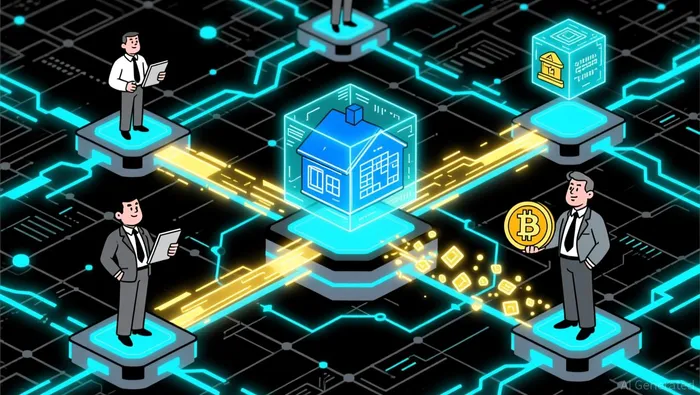
The framework's clarity has spurred institutional adoption of tokenized RWAs, particularly in sectors like real estate, private credit, and commodities. For example, tokenized U.S. Treasuries have surged in popularity, with a total value of $33 billion as of October 2025, according to an XBT0 report. These instruments offer real-time settlement, lower transaction costs, and global accessibility, making them attractive for institutional portfolios. BlackRock's USD Institutional Digital Liquidity Fund (BUIDL), which raised over $500 million, exemplifies this trend, according to a Decrypt article.
Real estate tokenization has also gained traction through fractional ownership models. A luxury hotel in New York, tokenized at a minimum investment of $1,000, demonstrates how illiquid assets can become accessible to retail and institutional investors alike, according to the XBT0 report. Similarly, tokenized private credit instruments, such as Santander's $20 million blockchain-issued bond, streamline fundraising and enhance liquidity, according to the XBT0 report.
Market Reactions and Case Studies
The SEC's taxonomy has catalyzed market innovation, particularly in ESG-focused investments. Tokenized carbon credits and renewable energy credits now offer verifiable ownership, enabling investors to directly support sustainability projects, according to the Decrypt article. Hamilton Lane's tokenization of middle-market corporate loans further illustrates this shift, reducing minimum investment thresholds from $5 million to $20,000 and democratizing access to private credit markets, according to the Decrypt article.
Institutional investors are also reallocating portfolios to capitalize on tokenized assets. While the SEC's framework does not explicitly detail portfolio shifts, the emphasis on transparency and categorization suggests a growing preference for assets with clear regulatory status. For instance, the UAE's emergence as a hub for tokenized real estate highlights global regulatory alignment efforts, according to the XBT0 report.
Future Outlook
The SEC's Token Taxonomy Framework is a double-edged sword: it mitigates regulatory uncertainty but also demands adaptability from market participants. As tokenization expands into commodities and structured products, investors must balance risk management with opportunities for diversification. The framework's success will hinge on its ability to evolve alongside technological advancements while safeguarding market integrity.
For now, the data speaks volumes. Tokenized RWAs are no longer a niche experiment-they are reshaping traditional finance. As Chairman Atkins noted, the SEC's approach is not about stifling innovation but about creating a framework where it can thrive, according to the Blockonomi article.







Comentarios
Aún no hay comentarios