
The Impact of Rising Corporate Tax Burdens on Business Viability: Strategic Sector Reallocation in a Shifting Fiscal Landscape
The global corporate tax landscape has undergone a seismic shift between 2023 and 2025, driven by the OECD's Pillar Two global minimum tax and divergent national tax reforms. As statutory corporate tax rates and effective tax burdens rise, businesses are recalibrating their strategies to preserve viability. This analysis examines how sectors-particularly manufacturing, technology, and finance-are reallocating resources, restructuring operations, and navigating fiscal policy uncertainty to adapt to these changes.
The New Tax Normal: Pillar Two and National Reforms
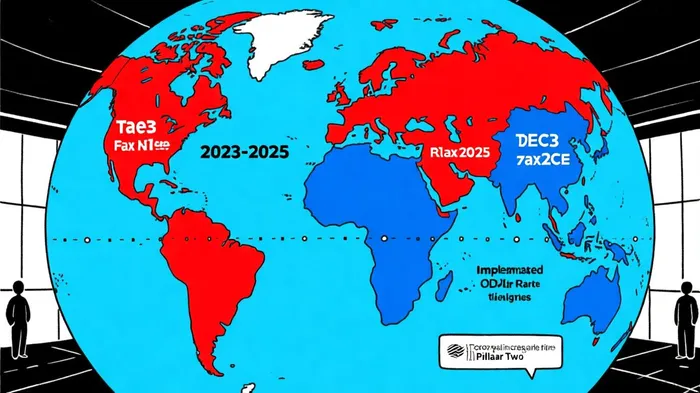
The OECD's Pillar Two initiative, mandating a 15% minimum effective tax rate for multinational enterprises (MNEs) with €750 million in revenue, has become a cornerstone of global tax policy. By 2025, over 90% of qualifying MNEs faced compliance with this framework, as countries like Spain, Poland, and the UAE implemented domestic rules such as the Qualified Domestic Minimum Top-Up Tax (QDMTT) to align with the global standard, according to the OECD Pillar Two Country Tracker. Concurrently, national tax rates have diverged: South America's average corporate tax rate rose to 28.38% in 2024, while Asia's dropped to 19.74%, reflecting varied fiscal priorities, as reported in the 2024 Corporate Tax Rates by Country. These shifts have created a fragmented but increasingly predictable tax environment, compelling businesses to adopt sector-specific strategies.
Manufacturing: Reshoring and Supply Chain Rebalancing
Manufacturers, long reliant on low-tax jurisdictions for cost efficiency, are now prioritizing reshoring and localized production. For example, a UK-based automotive parts firm recently shifted production from Eastern Europe to the West Midlands, leveraging regional industrial policies and Industry 4.0 technologies to offset higher domestic tax rates, as detailed in The Manufacturing Reshoring Phenomenon. This trend is not merely reactive but strategic: the fragility of global supply chains, exposed during the pandemic and the Ukraine war, has accelerated the case for domestic production.
However, reshoring is not without challenges. The phase-out of U.S. TCJA provisions like 100% bonus depreciation for capital investments has reduced the financial allure of reshoring. A 2025 study by the Equipment Leasing & Finance Foundation, on TCJA expiring provisions, found that the expiration of these incentives could lead to a 10% tax increase for capital-intensive firms, dampening investment in machinery and automation. To mitigate this, manufacturers are adopting hybrid models, balancing domestic production with strategic offshore hubs in countries like Morocco, where tax rates are rising but still below the OECD minimum, as shown in global corporate taxation trends.
Technology: IP Restructuring and R&D Incentives
The technology sector, with its reliance on intangible assets, faces unique challenges under Pillar Two. Companies are reengineering intellectual property (IP) ownership structures to avoid profit reallocation under Pillar One and to ensure compliance with the 15% minimum tax. For instance, a U.S. cloud computing firm recently centralized its IP portfolio in Ireland, a Pillar Two-compliant jurisdiction, to streamline tax reporting and avoid top-up taxes in lower-tax markets, as discussed in RSM's analysis of Pillar Two and M&A.
Simultaneously, the TCJA's phase-out of 100% bonus depreciation for R&D equipment has forced tech firms to accelerate investments before 2025. A 2025 report by CBH & Co., on 2025 tax reform impacts, noted that companies in AI and biotech are prioritizing immediate capital expenditures for servers and lab equipment to maximize deductions, even as Pillar Two reduces the tax advantage of offshore R&D hubs. These strategies highlight the sector's dual focus on compliance and innovation, with fiscal policy uncertainty acting as both a constraint and a catalyst.
Finance: Compliance Shifts and Debt Restructuring
The financial sector, particularly banks and private credit firms, is recalibrating its approach to tax compliance and risk management. Pillar Two's Income Inclusion Rule (IIR) has compelled institutions to reassess cross-border lending and investment structures. For example, a European private equity firm recently restructured its debt portfolio to reduce exposure to low-tax jurisdictions, aligning with the OECD's 15% threshold while maintaining liquidity, according to Pillar Two and Financial Sector Compliance.
Meanwhile, the U.S. Global Intangible Low-Taxed Income (GILTI) rules, set to increase to 13.125% in 2026, are prompting financial institutions to explore hybrid financing models. A 2025 analysis by Deloitte highlighted how banks are leveraging Pillar Two's administrative safe harbors to simplify cross-border tax reporting, while also diversifying into sectors like green finance, which benefit from tax credits under the Inflation Reduction Act, as noted by the OECD/G20 Inclusive Framework. These moves underscore the sector's agility in navigating a complex regulatory environment.
Visualizing the Fiscal Shift
Conclusion: Agility as a Survival Strategy
The interplay of Pillar Two and national tax reforms has created a landscape where fiscal policy uncertainty is the new norm. Businesses that thrive will be those that treat tax strategy as a dynamic, sector-specific discipline. For manufacturers, this means reshoring with technology-driven efficiency. For tech firms, it entails rethinking IP ownership and R&D timelines. For financial institutions, it requires compliance innovation and risk diversification. As tax rates stabilize and global rules converge, the ability to adapt swiftly will remain the defining factor in business viability.







Comentarios
Aún no hay comentarios