
The Impact of PENGU USDT Sell Signals on Crypto Market Sentiment
Technical Analysis: A Tale of Contradictions
PENGU USDT's technical indicators in November 2025 painted a mixed picture. On the 4-hour chart, bullish momentum was evident, with the Accumulation/Observation (AO) oscillator showing accelerating green bars and the Money Flow Index (MFI) nearing overbought territory, signaling strong demand. However, the daily chart told a different story: a bearish RSI divergence and weakening support levels suggested exhaustion among buyers. This duality reflects the inherent instability of algorithmic stablecoins, which rely on algorithmic rebalancing rather than collateralized reserves.
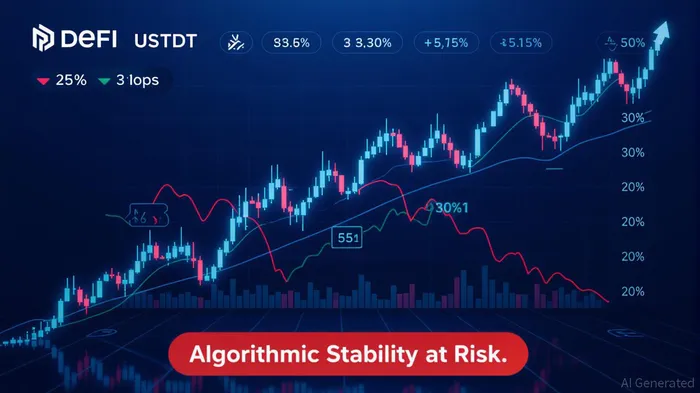 Key price levels became critical battlegrounds. A break above $0.013 could have triggered a rally toward $0.020, but the failure to hold above $0.010 led to a retest of support at $0.0093 according to analysis. Meanwhile, institutional inflows of $430k and a 32% increase in open interest hinted at growing optimism, though these metrics were overshadowed by the $66.6 million outflow from PENGU's team wallets-a red flag for retail investors according to reports.
Investor Behavior: From Panic to Prudence
The PENGU sell signal exposed stark contrasts in investor behavior. Retail traders, already wary of algorithmic stablecoins after the 2022 TerraUSD (UST) collapse, accelerated their shift to fiat-backed alternatives. On-chain data revealed $157,000 in inflows from seasoned investors, but this was dwarfed by the $66.6 million exodus from team wallets, fueling speculation about internal liquidity issues.
Retail participation in the U.S. stock market also mirrored crypto's turbulence. As the S&P 500 fell 1.6% and the NASDAQ-100 dropped 3.1% in November 2025, individual investors scaled back buying dips, with Vanda Research noting the weakest retail conviction since May 2025. This defensive shift extended to crypto, where automated tools like Bluwhale's AI Stablecoin Agent gained traction for hedging against volatility according to market data.
Broader Market Correlations and Macroeconomic Pressures
PENGU's collapse did not occur in isolation. The S&P 500 and NASDAQ-100 exhibited a 42% and 46% correlation with crypto indices in 2025, underscoring the interconnectedness of asset classes. The broader market's decline-driven by AI valuation concerns and trade tensions-amplified PENGU's fragility, as investors rotated into defensive assets like gold and regulated ETFs according to market analysis.
Regulatory developments further compounded the crisis. The U.S. GENIUS Act, which excludes algorithmic stablecoins from its 100% reserve requirements, left PENGU and similar tokens in a legal gray area. This regulatory ambiguity accelerated the migration to fiat-backed stablecoins, with USDC's market share rising as investors prioritized transparency over algorithmic complexity according to research.
Stablecoin Strategy Implications: A New Era of Caution
The PENGU sell signal has forced a paradigm shift in stablecoin trading. Investors now prioritize overcollateralized, fiat-backed options and explore central bankBANK-- digital currencies (CBDCs) as alternatives. On-chain analytics have become essential for real-time risk monitoring, with tools tracking liquidity outflows and smart contract vulnerabilities.
For portfolio managers, the lesson is clear: diversification and regulatory alignment are non-negotiable. The collapse of PENGU underscores the risks of relying on algorithmic models during periods of stress, particularly when redemption runs can trigger cascading failures according to market analysis. Strategic entry points now require rigorous due diligence on reserve composition and governance structures, while exit strategies must account for rapid liquidity shifts.
Conclusion: Navigating the New Normal
The PENGU USDT sell signal of November 2025 serves as a cautionary tale for crypto markets. While technical indicators and retail behavior provide valuable insights, the broader implications-regulatory uncertainty, macroeconomic volatility, and systemic fragility-demand a holistic approach to risk management. As the market stabilizes, investors must balance innovation with prudence, ensuring that the lessons of PENGU's collapse inform a more resilient financial ecosystem.






Comentarios
Aún no hay comentarios