
The Impact of Municipal Infrastructure Grants on Commercial Real Estate and Economic Development: Assessing the Webster NY $9.8M FAST NY Grant as a Model for Industrial Land Value Appreciation
Infrastructure Investments and Industrial Land Value Appreciation
The FAST NY Grant has enabled Webster to address critical infrastructure gaps, including road upgrades, expanded sewer systems, and electrical grid modernization. These improvements are not merely functional but strategic, designed to attract high-tech manufacturers and renewable energy firms. For instance, the redevelopment of the Xerox campus and the Northeast Area for Technology (NEAT) site has transformed a formerly underutilized brownfield into a shovel-ready industrial zone. By 2025, nearly one million square feet of industrial space will be available, with full site readiness projected for 2026.
The grant's focus on infrastructure has directly driven industrial land value appreciation. According to a report by Bitget, the availability of scalable, cost-effective industrial land in Webster has surged, with nearly 300 acres prepared for development. This aligns with Governor Kathy Hochul's broader economic strategy, which emphasizes creating "shovel-ready sites" to attract advanced industries. The synchronized timeline of infrastructure completion and site readiness-such as the August 2025 demolition of the 600 Ridge Road site-has created a favorable investment window for manufacturers and developers.
Economic Development Metrics: Jobs, Income, and Property Values
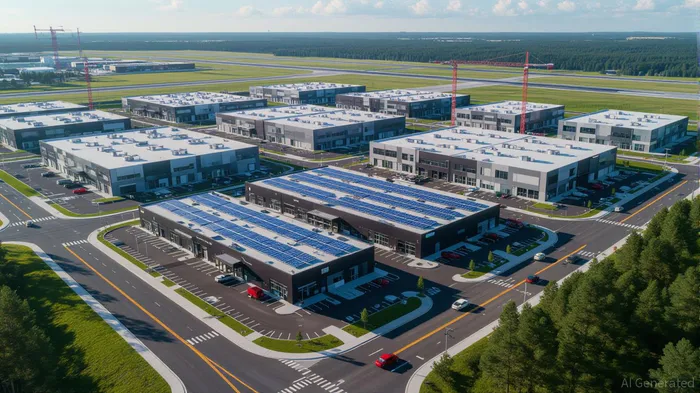 The economic ripple effects of the FAST NY Grant are already evident. The $650 million fairlife® dairy facility, a FAST NY Round One awardee, is projected to create 250 new jobs by 2025. This project, coupled with the influx of industrial activity, has spurred a 10.1% increase in residential property values over the past year. While industrial land value appreciation is the primary focus, the broader economic uplift underscores the interconnectedness of infrastructure and real estate markets.
However, employment data from 2023 reveals a slight decline in the employed population, dropping from 3,060 to 2,987-a 2.32% decrease (https://datausa.io/profile/geo/webster-ny). This dip, though modest, highlights the transitional challenges of redeveloping brownfields and shifting industrial focus. Yet, the median household income in Webster rose by 4.31% during the same period, from $63,833 to $66,584. This suggests that while employment in traditional sectors may contract, high-value industries are compensating with higher wages and long-term stability.
Strategic Location and Future Prospects
Webster's strategic location near major transportation corridors further amplifies its appeal. The town's proximity to I-390 and the Rochester International Airport positions it as a logistics and manufacturing nexus. As stated by the FAST NY program, these geographic advantages, combined with the town's alignment with Governor Hochul's economic agenda, create a "prime location for investment in manufacturing, retail, and residential sectors."
The coordinated timing of infrastructure completion and environmental assessments-such as the year-end 2025 completion of assessments for the 600 Ridge Road site-ensures that redevelopment can begin in 2026 without delays. This forward-looking approach minimizes risk for investors and developers, fostering confidence in the town's long-term viability.
Conclusion: A Blueprint for Municipal Revitalization
Webster's experience demonstrates that municipal infrastructure grants, when strategically allocated, can drive industrial land value appreciation while fostering economic diversification. The town's focus on brownfield redevelopment, coupled with targeted infrastructure upgrades, has created a scalable model for other municipalities seeking to attract high-tech industries. While short-term employment fluctuations may occur, the long-term gains in income, property values, and industrial capacity underscore the efficacy of this approach.
As the FAST NY program continues to distribute $51 million in upstate investments, Webster's success offers a roadmap for leveraging infrastructure grants to unlock commercial real estate potential and stimulate sustainable economic growth. For investors and policymakers alike, the lessons from Webster are clear: infrastructure is not just a public good-it is a catalyst for value creation.







Comentarios
Aún no hay comentarios