
The Impact of Judicial Intervention on U.S. Monetary Policy and FX Markets
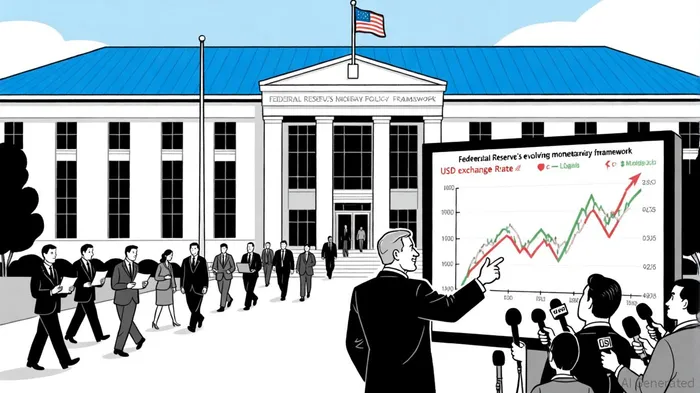
The U.S. Federal Reserve's operational independence has long been a cornerstone of its ability to navigate economic turbulence. However, recent judicial interventions and geopolitical upheavals have tested this independence, reshaping monetary policy frameworks and influencing foreign exchange (FX) market dynamics. As the Fed grapples with a divided policy environment, investors must reassess risks to USD stability and adapt strategies to mitigate exposure in an increasingly fragmented global economy.
Judicial Interventions and the Reinforcement of Fed Independence
In 2025, a pivotal court ruling upheld the tenure of Lisa Cook, a Federal Reserve governor, against a politically motivated attempt by former President Trump to remove her from the board[3]. This decision underscored the judiciary's role in safeguarding the Fed's autonomy, ensuring that monetary policy decisions remain insulated from partisan pressures. Such independence is critical, as the Fed's 2025 five-year review of its monetary policy framework revealed a deliberate shift away from the controversial "average inflation targeting" (FAIT) approach to a more traditional "flexible inflation targeting" model[2]. The revised framework now balances maximum employment and price stability, acknowledging that employment can temporarily exceed capacity without triggering inflation—a lesson drawn from the post-pandemic surge in inflation to 40-year highs[3].
This recalibration reflects the Fed's responsiveness to evolving economic realities while maintaining institutional credibility. According to a report by the Brookings Institution, the updated framework emphasizes transparency and stakeholder engagement, with input from Fed Listens events and academic forums[3]. By anchoring policy to data rather than political expediency, the Fed aims to preserve long-term economic stability—a goal now complicated by rising geopolitical risks.
Geopolitical Risks and the USD's Safe-Haven Role
Geopolitical tensions, particularly the Russia-Ukraine war and U.S.-China trade disputes, have intensified since 2022, creating a divided global policy environment[3]. These conflicts have historically driven capital toward the USD as a safe-haven asset, reinforcing its dominance in foreign exchange markets. A study published in the Latin American Journal of Central Banking notes that during periods of geopolitical uncertainty, the USD often appreciates against major currencies like the euro and yen, as investors seek liquidity and stability[1].
The Fed's cautious approach in 2025—gradual rate cuts and a balanced stance on employment and inflation—has further bolstered the dollar's resilience. According to a Forbes analysis, the USD's strength is expected to persist as global banks reduce cross-border lending to high-risk regions, redirecting capital to U.S. assets[3]. However, this stability is not without vulnerabilities. The International Monetary Fund (IMF) warns that geopolitical fragmentation could disrupt global financial systems, increasing funding costs for banks and reducing lending to the private sector[3]. For investors, this means hedging against currency volatility while monitoring how central banks, including the Fed, respond to asymmetric risks.
Investment Strategies in a Divided Policy Environment
The interplay between judicial interventions and geopolitical risks demands a nuanced investment approach. First, diversification remains key. While the USD's safe-haven status offers short-term protection, overreliance on dollar assets could expose portfolios to long-term risks if global tensions escalate. Investors should consider allocating to non-U.S. reserves, such as gold or Swiss francs, and explore emerging markets with strong fiscal policies.
Second, hedging FX exposure is critical. The Fed's balance sheet reduction from "abundant" to "ample" reserves has altered the mechanics of monetary policy, affecting interest rate stability and market liquidity[3]. As a result, currency pairs like EUR/USD and USD/JPY are likely to exhibit higher volatility. Investors should use forward contracts or options to mitigate downside risks, particularly in sectors sensitive to exchange rate fluctuations (e.g., multinational corporations).
Third, monitoring Fed communications is essential. The 2025 framework revision highlights the central bank's commitment to transparency, but geopolitical shocks could force abrupt policy pivots. For instance, a renewed escalation in the Middle East or a trade war between the U.S. and China might prompt the Fed to adopt more aggressive tightening measures, even at the expense of short-term growth. Real-time analysis of Fed speeches and minutes will be crucial for anticipating such shifts.
Conclusion
Judicial interventions have reinforced the Fed's independence, enabling it to adapt its policy framework to post-pandemic challenges. However, the rise of geopolitical risks has created a divided global environment, where the USD's stability is both a blessing and a liability. For investors, the path forward requires a dual focus: leveraging the dollar's safe-haven appeal while hedging against the unpredictable fallout of geopolitical fragmentation. As the Fed navigates this complex landscape, its ability to balance institutional independence with pragmatic policy adjustments will remain a defining factor in global financial markets.







Comentarios
Aún no hay comentarios