
**Impact Investing in Global Water and Sanitation: Where Philanthropy Meets Market Forces to Solve a $600 Billion Gap**
The world is running out of clean water. By 2030, global demand for freshwater will outstrip supply by 40%, according to the United Nations. Yet the solution is not simply to build more wells or pipes—it is to rethink how we finance infrastructure in a way that aligns the urgency of social impact with the discipline of market returns. For investors, the $182 billion to $600 billion annual funding gap in water and sanitation infrastructure represents not just a moral imperative but a high-impact, scalable opportunity. The convergence of philanthropy and market-driven solutions is proving to be the most effective lever to pull.
The Broken Model: Why Traditional Approaches Fail
Public sector funding has long been the backbone of water and sanitation projects, but it is increasingly inadequate. Governments in developing countries often lack the fiscal space to prioritize long-term infrastructure, while private investors are deterred by low returns and high political risks. Blended finance—a mix of public, philanthropic, and private capital—was introduced to bridge this gap. Yet as critics note, the sector still accounts for less than 1.5% of blended finance in emerging markets. The problem is not a lack of capital but a lack of alignment: philanthropy often underwrites risk without scalability, while market actors demand returns that ignore social equity.
The New Paradigm: Blended Finance and Public-Private Partnerships
The most promising solutions lie in models that combine the best of both worlds. Consider the Water Access Acceleration Fund (W2AF), which has mobilized $62 million from a mix of family offices, corporations, and banks. Its investment in Spouts International in Uganda—a company that sells affordable ceramic water filters and carbon credits—has brought clean water to 700,000 people. Spouts' business model is a masterclass in blended finance: philanthropy de-risks the initial rollout, while carbon credits and user fees ensure long-term sustainability. This is not charity; it is a scalable, bankable asset.
Another example is WaterEquity's “Under One Roof” initiative, which streamlines the investment pipeline from capital generation to execution. By bundling philanthropic grants with private debt and equity, WaterEquity has funded projects that provide sanitation access to 2.5 million people in sub-Saharan Africa. The key innovation here is not just the capital but the governance structure: projects are designed to be self-sustaining, with revenue reinvested into expansion.
Case Studies: Where Philanthropy and Markets Align
The European Investment Bank (EIB) has taken a different approach in Kenya, partnering with local banks like Cooperative Bank to fund utility infrastructure. This public-private partnership (PPP) model has transformed perceptions of what is achievable in the water sector. By leveraging the EIB's technical expertise and the local banks' on-the-ground presence, the initiative has financed projects that would otherwise be too risky for private investors.
Meanwhile, Aqua for All has pioneered “water funds,” which aggregate private and philanthropic capital to finance small-scale projects. In India, these funds have supported decentralized water purification systems in rural communities, ensuring both accessibility and profitability. The lesson here is that scalability does not require monolithic solutions; it can emerge from modular, community-driven projects.
Investment Opportunities: The $600 Billion Prize
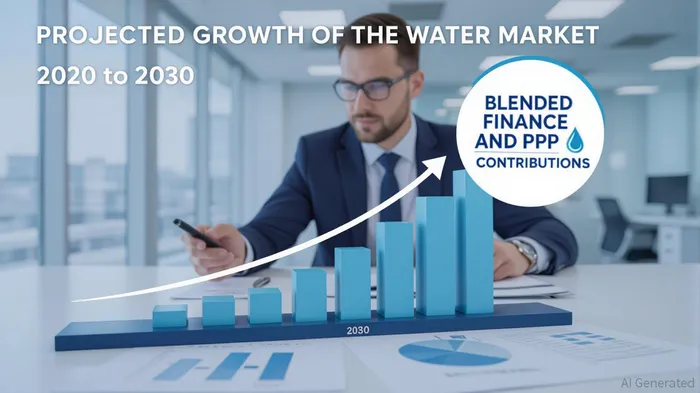
For investors, the global water and sanitation sector is a treasure trove of opportunity. The market is projected to grow at 3.8% annually, reaching $250 billion by 2030. But the most compelling investments are those that combine social impact with financial returns.
- Infrastructure Bonds: Companies like Veolia and Suez are issuing green bonds to fund water treatment plants and desalination projects. These bonds offer yields of 4-6% while aligning with ESG mandates.
- Carbon Credits: As seen with Spouts International, water projects that reduce carbon emissions (e.g., replacing firewood with solar-powered filters) can generate revenue from carbon markets.
- Private Equity in WaterTech: Startups developing AI-driven water management systems or modular filtration units are attracting venture capital. These firms often partner with NGOs to de-risk early-stage investments.
The Risks and the Reassurance
Critics argue that philanthropy-driven models risk subsidizing private interests at the expense of the poor. In some cases, blended finance has been accused of prioritizing middle-income countries over the most vulnerable. However, these risks are not inherent to the model—they are a function of design. Successful projects share three traits:
1. Community Ownership: Projects must be co-designed with local stakeholders to ensure long-term maintenance and usage.
2. Transparency: Public reporting of outcomes and financials is essential to prevent aid diversion.
3. Alignment with SDGs: Projects must explicitly tie to Sustainable Development Goal 6 (clean water for all) to avoid fragmentation.
Conclusion: The Next Frontier of Impact Investing
The global water crisis is not just a humanitarian issue—it is a systemic risk to economic growth and stability. For investors, the opportunity is clear: by blending philanthropy with market discipline, we can create infrastructure that is both profitable and equitable. The examples of W2AF, WaterEquity, and the EIB demonstrate that scalability is possible when risk is shared and purpose is prioritized.
As the world moves toward 2030, impact investors must act with urgency. The question is not whether to invest in water and sanitation, but how to do so in a way that leaves no one behind. The answer lies in convergence.







Comentarios
Aún no hay comentarios