
The Impact of Holiday Retail Hours on Consumer Spending and Retail Stock Performance
Retail Hours and Consumer Behavior: A Shifting Paradigm
The decision by many retailers to close on Thanksgiving Day reflects a broader cultural and economic shift. While chains like Denny's and McDonald's remain open, the majority of major retailers have opted to prioritize employee well-being and align with evolving consumer preferences. According to a report, 186.9 million shoppers are expected to participate in the 2025 holiday season, with 59% citing discounts and exclusive offers as their primary motivation for shopping during the Thanksgiving weekend. This surge in participation, however, is tempered by economic caution: 68% of shoppers attribute their Black Friday plans to inflation, and 39% anticipate reducing their spending.
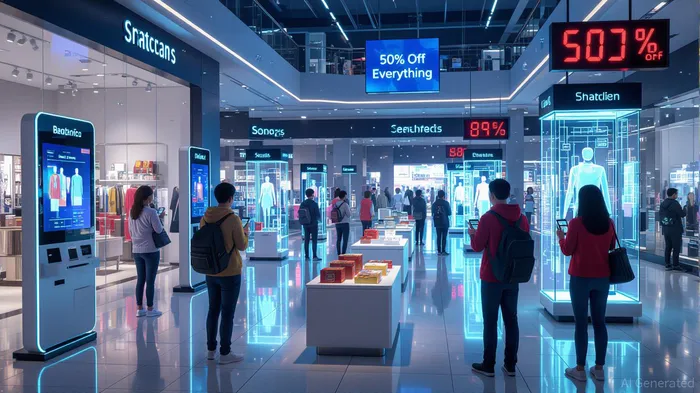
The closure of physical stores on Thanksgiving Day has accelerated the shift toward omnichannel shopping. Retailers like Walmart and AmazonAMZN-- have launched early promotions weeks ahead of Black Friday, capitalizing on consumers' desire for convenience and price transparency. Meanwhile, 83% of shoppers plan to use buy-online-pickup-in-store options, highlighting the importance of integrating digital and in-store experiences. For younger demographics, particularly Millennials and Gen Z, who represent a significant portion of holiday shoppers, the emphasis on value-driven purchases - such as gift cards and "stock stuffers" - has become a defining trend.
Stock Performance: E-Commerce vs. Traditional Retailers
The retail sector's stock performance during the 2025 holiday season has been marked by stark contrasts. E-commerce giants like Amazon, Walmart, and Target have outperformed industry averages, leveraging robust online platforms, AI-driven personalization, and early promotional strategies to capture market share. These companies are well-positioned to benefit from the $1 trillion in projected holiday sales, despite macroeconomic headwinds such as inflation and tariffs as noted in economic analysis.
Conversely, traditional retailers with weaker digital capabilities or inefficient logistics have struggled. The S&P Retail Select Industry Index, which includes major players like Macy's and Costco, remained flat for the year, while companies like Bath & Body Works experienced significant declines. The National Retail Federation noted that holiday sales growth in 2025 is expected to rise by 3.7% to 4.2%, a slowdown compared to the 4.3% increase in 2024. This moderation reflects broader consumer caution, with real retail sales (adjusted for inflation) declining in September 2025.
Volatility and Market Sentiment: A Post-Pandemic Reality
The retail sector's stock volatility during Thanksgiving 2025 has been amplified by external factors, including the Federal Reserve's policy uncertainty and concerns over the AI valuation bubble. The VIX index, a key measure of market volatility, remained above 20, signaling ongoing uncertainty. Meanwhile, the S&P 500 and Nasdaq Composite outperformed historical averages during Thanksgiving week, with the S&P up 12.3% and the Nasdaq up 15.3% through November 21 as market analysis indicates. This divergence highlights the broader market's resilience compared to the retail sector's struggles with inventory management and pricing pressures.
For investors, the key takeaway lies in the importance of adaptability. Retailers that can balance competitive pricing with profit margins - while optimizing logistics and digital engagement - will likely outperform. Off-price retailers like TJX and Ross Stores, which reported better-than-expected quarterly sales, exemplify this strategy. Conversely, those unable to navigate the complexities of tariffs, inflation, and shifting consumer preferences may face eroded market share.
Conclusion: Strategic Implications for Investors
The Thanksgiving 2025 retail season underscores a pivotal moment for the sector. As consumers prioritize value and convenience, and as digital commerce continues to dominate, investors must focus on companies that can innovate in omnichannel strategies, AI-driven personalization, and efficient inventory management. While the broader market has shown optimism, the retail sector remains a high-volatility segment, requiring careful analysis of macroeconomic indicators and consumer sentiment. For those willing to navigate the turbulence, the holiday season offers both challenges and opportunities in a post-pandemic landscape.







Comentarios
Aún no hay comentarios