
The Impact of US Government Shutdown Resolution on Risk Asset Allocation
Fiscal Clarity: A Tailwind for Equities
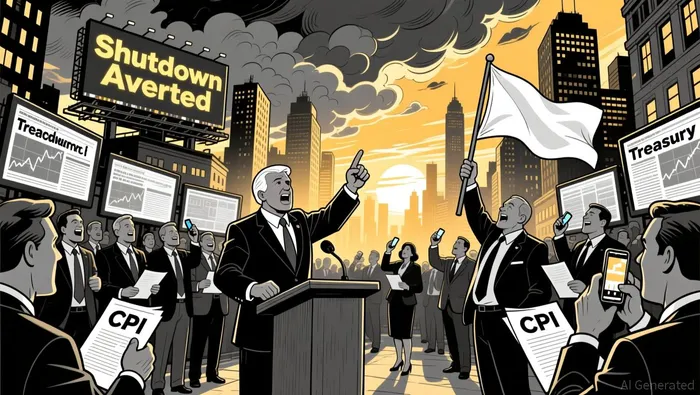
When the government reopens, uncertainty about economic data and policy stagnation dissipates. For equities, this clarity is critical. During the 2025 shutdown, the S&P 500 dipped by 0.1% as key economic reports, including the jobs and CPI data, were delayed, according to Russell Investments. However, the Senate's bipartisan agreement restored confidence, with the Stoxx 600 rising 1.4% and U.S. stock futures surging pre-market, as noted in a TCW Quicktake. The airline sector, a bellwether for consumer confidence, saw shares rebound as fears of travel disruptions eased, per the same TCW Quicktake.
Historically, shutdowns have had minimal GDP impacts-typically reducing growth by 0.1% to 0.2% per week-but the psychological toll on markets is significant. As Russell Investments notes, the absence of reliable data creates a "black box" for investors, forcing them to speculate rather than analyze, as described in the Russell Investments report. The resolution of this uncertainty, therefore, acts as a liquidity multiplier for equities, particularly in sectors sensitive to consumer spending and regulatory clarity.
Liquidity Rebound: Bitcoin's Secret Sauce
Bitcoin's performance post-shutdown is less about fiscal policy and more about liquidity. During the 2025 shutdown, the Treasury General Account (TGA) drained hundreds of billions of dollars, effectively freezing liquidity in the financial system, according to Coinotag. This tightening hit Bitcoin hard, with prices dropping 5% as traders fled risk assets, per the Coinotag. However, the prospect of renewed government spending-via stimulus checks, infrastructure projects, or even speculative bets like Trump's proposed $2,000 tariff dividend-reintroduced liquidity, sending Bitcoin surging 6% past $106,000, as reported in the Coinotag.
This pattern mirrors historical cycles. In 2018–2019, Bitcoin rallied over 300% after a similar shutdown ended, as liquidity returned to crypto markets, per JPMorgan. The mechanism is straightforward: when liquidity tightens, risk assets correct; when it rebounds, they surge. JPMorgan analysts note that Bitcoin's volatility makes it a "hydraulic gauge" for liquidity conditions, reacting faster and more dramatically than equities, as detailed in the JPMorgan analysis.
Broader Fiscal Context: A Double-Edged Sword
While short-term resolutions boost risk assets, the U.S. fiscal outlook remains dire. According to the Government Accountability Office (GAO), federal debt could hit 200% of GDP by 2047 under current policies, as described in GAO's America's Fiscal Future. This long-term uncertainty creates a paradox: investors flock to risk assets during shutdown resolutions but remain wary of the underlying fiscal instability. The Federal Reserve's cautious stance on rate cuts-delayed by shutdown-induced data gaps-further complicates the picture, as noted in the Russell Investments report.
For Bitcoin, this duality is particularly pronounced. On one hand, fiscal clarity and liquidity rebounds drive short-term optimism; on the other, the specter of inflation and dollar devaluation could fuel long-term adoption. As Coinotag highlights, Bitcoin's recent rally was as much about renewed Treasury spending as it was about macroeconomic fears, as noted in the Coinotag.
Conclusion: Allocating for Fiscal Cycles
The 2025 shutdown resolution underscores a key investment insight: risk assets thrive when fiscal clarity and liquidity align. Equities benefit from reduced uncertainty and sector-specific tailwinds, while Bitcoin acts as a liquidity-sensitive proxy for global risk appetite. However, these gains are ephemeral without addressing the U.S. fiscal trajectory. Investors must balance short-term opportunities with long-term risks, using shutdown resolutions as signals rather than guarantees.
As the government reopens and liquidity returns, the next phase of the market cycle will likely see continued rotation into risk assets. But with federal debt on an unsustainable path, the question remains: how long can this optimism last?






Comentarios
Aún no hay comentarios