
The Impact of Fed Rate Cuts on Consumer Retail and Rental Services Sectors
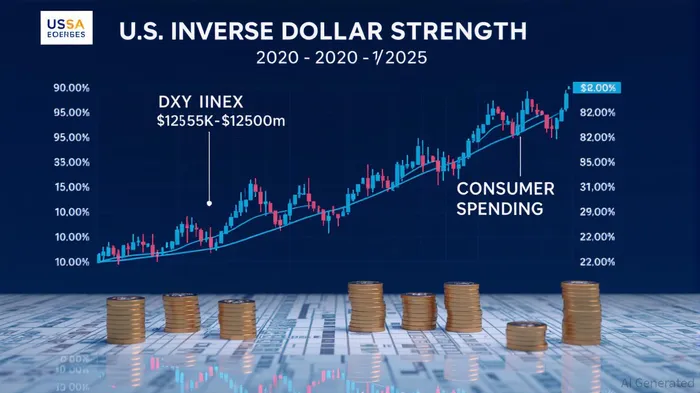
The Federal Reserve's 2025 rate-cut cycle, driven by cooling inflation and persistent economic headwinds, has created a unique confluence of macroeconomic forces reshaping consumer behavior and retail dynamics. As bearish dollar sentiment intensifies amid geopolitical fragmentation and trade policy volatility[1], budget-focused retailers like Dollar, Dollar TreeDLTR--, and Dollar GeneralDG-- are emerging as asymmetrically positioned beneficiaries. This analysis evaluates how falling interest rates and a weaker U.S. dollar could catalyze demand for value-driven services while dissecting the valuation potential of these retailers in a shifting monetary landscape.
Macroeconomic Catalysts: Rate Cuts and Dollar Dynamics
The Fed's 2025 rate cuts—projected to reduce borrowing costs by 150 basis points year-to-date—have lowered the cost of credit, incentivizing consumer spending on durable goods and services[1]. Historically, rate cuts have disproportionately boosted sectors with high consumer sensitivity, such as retail, by increasing disposable income and reducing debt servicing costs. However, the simultaneous erosion of the U.S. dollar's global purchasing power introduces a dual-edged dynamic. While a weaker dollar makes American exports cheaper and supports domestic manufacturing, it also inflates the cost of imported goods, squeezing profit margins for retailers reliant on international supply chains[1].
For budget-focused retailers, this duality creates a strategic inflection pointIPCX--. On one hand, higher import costs could pressure gross margins. On the other, a weaker dollar often correlates with rising demand for low-cost alternatives as consumers adjust spending habits. This pattern was evident during the 2020–2022 inflationary period, when Dollar General's same-store sales grew 12% annually as households prioritized value[1].
Strategic Adaptability: The Case of Dollar Tree and Dollar General
Recent 2025 Q3 financial reports for Dollar Tree and Dollar General underscore their operational resilience in navigating these macroeconomic pressures. Both companies have proactively restructured supply chains to reduce reliance on high-cost imports, shifting toward domestic sourcing and private-label products[1]. For example, Dollar General's 2025 inventory strategy emphasized high-turnover, low-margin items with inelastic demand—such as household essentials and seasonal goods—to buffer against inflationary shocks[1].
Moreover, the firms have leveraged their real estate portfolios to optimize pricing power. Dollar Tree's “$1 +” model, which allows for price adjustments based on regional inflation, has enabled it to maintain competitive pricing without eroding margins[1]. These adaptations position the companies to capitalize on the Fed's accommodative stance while mitigating the risks of a weaker dollar.
Valuation Opportunities in a Low-Rate, Weak-Dollar Environment
The interplay of falling interest rates and dollar depreciation creates a compelling case for capital appreciation in budget-focused retailers. Lower borrowing costs reduce the discount rate for future cash flows, inherently boosting valuations for companies with stable, recurring revenue streams. For Dollar Tree and Dollar General, whose business models are anchored by high-volume, low-margin transactions, this environment amplifies their appeal to income-focused investors.
However, valuation analysis must account for sector-specific risks. The 2025 Q3 reports highlight rising input costs for energy and logistics, which could offset gains from increased consumer demand[1]. Analysts suggest that companies with strong balance sheets and flexible capital allocation—such as Dollar General's $2 billion share buyback program—will outperform peers in this environment[1].
Conclusion: Navigating the New Normal
As the Fed's rate cuts and dollar weakness redefine consumer priorities, budget-focused retailers are uniquely positioned to thrive. Their ability to balance cost discipline with strategic pricing flexibility—demonstrated in 2025 Q3—suggests a durable competitive moat in an era of economic uncertainty. For investors, the key lies in identifying firms that can scale value-driven offerings without compromising margin stability. Dollar Tree and Dollar General's proactive operational adjustments and robust capital structures make them compelling candidates for long-term capital appreciation, particularly as monetary policy remains accommodative.





Comentarios
Aún no hay comentarios