
The Impact of Extended Electric Vehicle Tax Incentives on the Automotive and Energy Sectors
The global transition to electric vehicles (EVs) has become a cornerstone of modern investment strategies, with tax incentives playing a pivotal role in shaping capital allocation and sector rotation. As of 2025, the interplay between policy frameworks, consumer demand, and corporate strategy is redefining the automotive and energy sectors. This analysis examines how extended EV tax incentives influence investor behavior, M&A activity, and long-term capital trends, while addressing the risks posed by policy uncertainty and global trade dynamics.
Automotive Sector: Policy-Driven Reallocation and Strategic M&A
Extended EV tax incentives have catalyzed a reallocation of capital toward electrification, though regional disparities and policy shifts are creating divergent trajectories. In the U.S., the federal tax credit of up to $7,500 for new EVs and $4,000 for used models has driven demand, but its future is under threat from proposed rollbacks, according to a White & Case analysis. This uncertainty has prompted automakers to adopt defensive strategies, such as consolidating non-core assets and prioritizing domestic supply chains, according to BloombergNEF. For example, a major automaker recently spun off its autonomous vehicle division to focus on electrification, while European suppliers merged to strengthen capabilities in cockpit electronics, per BloombergNEF.
Meanwhile, China's renewed trade-in subsidies-offering up to RMB20,000 ($2,730) for scrapping older vehicles-have fueled a 40% growth in its EV market in 2024, according to China Briefing. This stability has attracted significant capital inflows, with Chinese EV producers like IM Motors securing $1.1 billion in funding from domestic partners, as noted in the White & Case analysis. In contrast, European markets exhibit fragmented incentives, such as Austria's €5,000 purchase bonuses and Germany's 10-year tax exemption for BEVs, per VECharged's calculator. These variations are driving sector rotation toward regions with favorable policy environments, particularly in emerging economies where localized production and government support create new opportunities, according to VECharged's calculator.
Venture capital (VC) funding for EV startups has also shifted. While early-stage investments in battery recycling and redox-flow technologies remain robust, according to CleanMobilityShift's analysis, broader VC activity has declined due to geopolitical tensions and rising interest rates. This trend underscores a focus on upstream and downstream innovations rather than speculative bets on full electrification.
Energy Sector: Infrastructure and Innovation Amid Policy Volatility
The energy sector's capital allocation is increasingly tied to EV infrastructure and battery technology, though policy reversals threaten long-term stability. In the U.S., the Inflation Reduction Act (IRA) initially spurred $208.8 billion in private-sector investments for EV supply chains, according to Advanced Energy United's analysis on building the U.S. EV supply chain (Advanced Energy United). However, the passage of H.R.1-the "One Big Beautiful Bill"-has introduced headwinds by repealing key tax credits, including the 45X Advanced Manufacturing Credit for batteries, which has led to a recalibration of energy investments, with firms adopting scenario-based planning to navigate tariff uncertainties and commodity price volatility (China Briefing).
China's tax exemptions for new energy vehicles (NEVs) until 2027 and Europe's infrastructure grants for charging stations are counterbalancing U.S. policy risks (China Briefing; VECharged's calculator). Energy companies are also prioritizing dynamic capital allocation strategies, integrating ESG factors and leveraging data-driven models to adapt to shifting regulatory landscapes, as reported by China Briefing. For instance, BloombergNEF notes that global EV sales are projected to account for one in four new vehicles in 2025, with China dominating 58% of the market (BloombergNEF). This growth is driving demand for lithium-ion batteries, though overcapacity has pressured pricing and profitability, per BloombergNEF.
Cross-Sector Implications and Investor Strategies
The interdependence of automotive and energy sectors is reshaping sector rotation strategies. As automakers pivot toward hybrid vehicles and localized production (VECharged's calculator), energy firms are aligning with these shifts by investing in regional charging networks and battery recycling. For example, Volkswagen's $5 billion joint venture with RivianRIVN-- highlights cross-sector collaboration to share EV architecture and software (White & Case), while Chinese battery maker CATL's investments in EV startups reflect a vertically integrated approach (White & Case).
Investors are adopting defensive strategies amid volatility, favoring utilities and healthcare sectors, according to a YCharts analysis, but long-term capital is increasingly flowing into technology and industrials-sectors historically leading post-downturn recoveries, per the YCharts analysis. Schwab's "Marketperform" rating for energy and automotive sectors underscores the need for caution until policy clarity emerges (YCharts).
Conclusion: Navigating Uncertainty in the EV Transition
Extended EV tax incentives have undeniably accelerated the transition to electrification, but their uneven implementation and political fragility necessitate agile investment strategies. While the U.S. faces policy headwinds, China and Europe offer more stable environments for capital deployment. Investors must balance short-term defensive allocations with long-term bets on innovation, particularly in battery technology and regional infrastructure. As the EV landscape evolves, strategic sector rotation will hinge on geopolitical stability, regulatory foresight, and the ability to adapt to a fragmented global market. 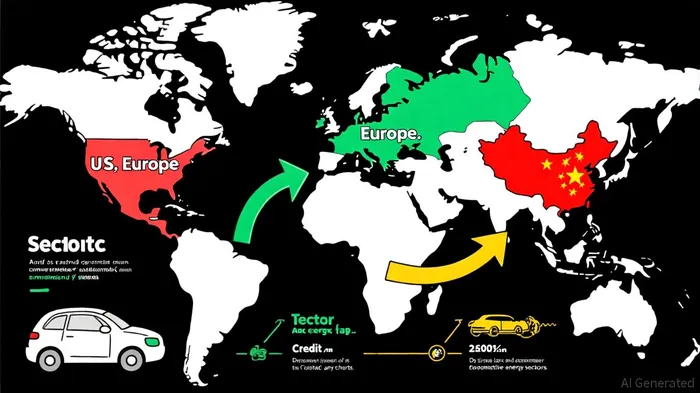





Comentarios
Aún no hay comentarios