
Impact of EPZA Lahore Closure on Pakistan's Export-Driven SMEs
Administrative Gaps and Regional Imbalances
The (LCCI) has criticized the closure as a rushed decision lacking stakeholder consultation, a concern highlighted in a BRE Recorder report. Punjab, , hosts key export zones in Sialkot and Gujranwala, both of which rely on Lahore-based EPZA services for regulatory compliance, logistics, and export facilitation, according to a The Tribune report. The absence of a regional office could delay approvals, increase bureaucratic hurdles, and weaken coordination between manufacturers and federal authorities. This administrative vacuum risks exacerbating existing challenges, such as inconsistent energy supply and outdated infrastructure, which already plague SMEs in the textile and manufacturing sectors.
Moreover, the LCCI warns that the decision may shift EPZA's operations toward a Sindh-centric model, favoring Karachi and other Sindh-based zones at the expense of Punjab's industrial base, as the BRE Recorder report notes. Such a shift could deepen regional economic disparities, as Punjab's SMEs-responsible for a significant share of national exports-face reduced access to federal support mechanisms. For investors, this raises concerns about uneven policy implementation and the potential for localized economic downturns in Punjab, which could ripple across the national export ecosystem.
Economic Impact: Mixed Signals for Textile SMEs
Despite the administrative challenges, Pakistan's textile and manufacturing exports have shown resilience in 2025. According to an Arab News report, , respectively, in July and August 2025, , as reported in an Arab News article. However, this growth is overshadowed by broader sectoral declines. , reflecting ongoing volatility, according to a Tribune report.
The closure of the EPZA Lahore office coincides with a broader crisis in the textile sector. Political instability, the abrupt termination of the Export Facilitation Scheme (EFS), , , as reported in an Al Mayadeen article. While the government has announced a five-year Textiles and Apparel Policy to boost competitiveness, its success hinges on resolving energy shortages and stabilizing policy frameworks. For investors, the sector presents a paradox: short-term growth in niche categories like knitwear contrasts with long-term structural risks, including energy dependency and global trade tensions.
Investor Sentiment: A Sector in Transition
Investor confidence in Pakistan's textile and manufacturing sectors has been eroded by a combination of factors. The political turmoil following the dismissal of former Prime Minister and subsequent crackdowns has created an environment of uncertainty, as noted in the Al Mayadeen article. Additionally, the lack of consistent policy support-such as the sudden withdrawal of the EFS-has left SMEs vulnerable to cash flow disruptions, according to the Tribune report.
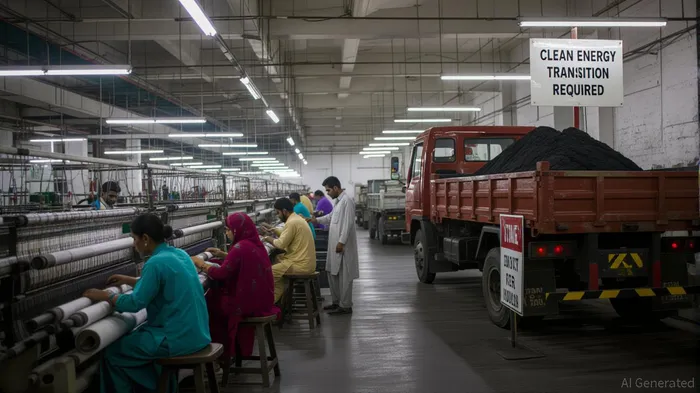
However, the sector's struggles have also created opportunities for strategic investors. The government's push for cleaner energy, while costly for SMEs, could attract foreign capital into renewable energy infrastructure and green manufacturing technologies, as noted in a INP report. For instance, the Punjab Environment Department's crackdown on coal usage has forced SMEs to explore alternatives like corn cobs and wood, albeit with significant upfront investment, as the INP report notes. Investors willing to navigate these challenges may find value in firms adapting to environmental regulations or in government-backed initiatives aimed at formalizing and modernizing SME operations.
Policy Responses and Future Prospects
In response to the EPZA closure and broader sectoral challenges, the government has introduced measures to support SMEs. The (SMEDA) has launched programs to streamline registration processes, provide access to financing, and integrate SMEs into global supply chains, as noted in a BRE Recorder report. These initiatives, however, remain in their early stages and face implementation hurdles, particularly in Lahore, where the EPZA closure has left a regulatory void, as the INP report notes.
For investors, the key to navigating this landscape lies in balancing risk and opportunity. While the EPZA closure and energy crisis pose immediate threats, the government's focus on policy reform and green manufacturing offers long-term potential. Investors should prioritize firms with diversified energy sources, strong export networks, and alignment with national industrial policies. Additionally, partnerships with local institutions like SMEDA could provide access to critical resources and market insights.
Conclusion
The closure of the EPZA Lahore office is a symptom of broader governance and economic challenges in Pakistan's export sector. While it exacerbates existing risks for textile and manufacturing SMEs, it also highlights the need for innovation and resilience. For investors, the path forward requires careful assessment of both short-term volatility and long-term structural shifts. Those who can navigate the sector's complexities-through strategic partnerships, policy engagement, and a focus on sustainability-may find themselves well-positioned to capitalize on Pakistan's evolving industrial landscape.







Comentarios
Aún no hay comentarios